---
title: "Generative AI and the Delivery of Legal Services"
author: "Thomas G. Martin"
url: "https://books.lawdroidmanifesto.com/3/generative-ai-and-the-delivery-of-legal-services"
---
# Generative AI and the Delivery of Legal Services:
## A Law Student Textbook and Workbook for Understanding and Implementing AI in Law
### Thomas G. Martin
**The LawDroid Press
Vancouver, British Columbia**
All rights reserved. No part of this book may be used to train artificial intelligence systems or reproduced in any form by any electronic or mechanical means (including photocopying, recording, or information storage and retrieval) without permission in writing from the publisher.
This book is hosted on an installation of the Writebook platform, created by 37 Signals.
**LawDroid Press
Vancouver, British Columbia**
# Praise for _Generative AI and the Delivery of Legal Services_
> “Tom is a main character in the evolving story of AI and law. He is clear, knowledgeable, and engaging.”
— **Professor Richard Susskind CBE KC (Hon)**, author of _How to Think About AI_
> “Tom’s textbook offers a clear and insightful exploration of how generative AI is reshaping legal services. It’s a valuable read for students preparing to enter a rapidly evolving legal landscape. Tom’s dedication to advancing legal innovation and education is evident throughout his work, making this textbook a valuable resource for aspiring legal professionals.”
— **Gabriel H. Teninbaum**, _Assistant Dean of Innovation, Strategic Initiatives & Distance Education & Prof. of Legal Writing_ at Suffolk University Law School
> "No one has been focused on leveraging AI to improve the work of lawyers and accessibility to legal help longer than Tom Martin. His expertise is borne of the kind of in-the-trenches work that yields the highest value, and his textbook 'Generative AI and the Delivery of Legal Services' showcases both the breadth and depth of Tom’s expertise and experience. He has created an exhaustive and highly accessible learning journey for law students. In fact, practicing lawyers can benefit greatly from the textbook and accompanying workbook. I highly recommend this valuable learning tool for any legal professional seeking to build understanding and skills at the intersection of generative AI and law practice."
— **Cat Moon**, _Founding Co-Director of Vanderbilt AI Law Lab (VAILL), Co-Director of Program on Law & Innovation (PoLI), Professor of the Practice_ at Vanderbilt Law School
> “Tom has been a lodestar in legal tech through all its fits and starts. I’m grateful Tom is now tackling the frontier of AI and legal services. I’ll be tapping into Tom’s writings as a guide in my teaching and legal activities, and I hope my students and enterprising grads will too.”
— **Jonathan Askin**, _Professor of Clinical Law and Director of the Brooklyn Law Incubator & Policy (BLIP) Clinic_ at Brooklyn Law School; _Founder_ of Legal Hackers
> "Tom Martin is simultaneously one of the most generous and knowledgeable leaders in the legal technology industry today, as evidenced by the wealth of information he shares in this book. Tom has been innovating and teaching about AI's transformative potential for legal services long before ChatGPT made it trendy to do so. His experience, combined with his innate talent for clear explanation, makes this book an indispensable toolkit for law students navigating both the current landscape of Generative AI in law and the path ahead."
— **Mark Williams**, _Founding Co-Director at Vanderbilt AI Law Lab (VAILL), Professor of the Practice of Law, AIGP_ at Vanderbilt Law School
> "We're finally at one of those long-mooted 'inflection points' in the trajectory of legal services delivery. This text supplies crucial insights on the state of play for students and practice veterans alike."
— **Marc Lauritsen**, _President_ of Capstone Practice Systems and _Adjunct Professor_ at Suffolk University Law School
> “As someone who stands at the intersection of law, technology, and legal education, I can confidently say that Tom Martin’s Generative AI and the Delivery of Legal Services is not only timely, but a much-needed resource for advancing legal education as it grapples with how to teach the intersection of generative AI and the practice of law. Tom has created an essential guide for understanding how generative AI is reshaping the legal landscape in a modern and innovative format, all with the clarity, insight, and deep understanding that Tom imparts through his own experiences as a practitioner, educator, legal technology founder and leader. In this work, Tom distills complex concepts into actionable knowledge for law students to become the next great generation of legal professional.
> This work reflects Tom’s longstanding commitment to innovation and access in the legal field. His expertise in legal automation and AI, combined with his passion for making legal services more efficient and equitable, shines through every chapter. Any law professor teaching at the intersection of Generative AI and the practice law should look to this text as definitive guide for their students. I'm proud to recommend this book, and proud to call Tom a friend and thought leader in this space.”
— **Kenton S. Brice, J.D., M.L.S.**, _Director of the Law Library_ and _Associate Professor of Law_ at University of Oklahoma College of Law
> “This is a timely and accessible guide to how AI is reshaping the delivery of legal services. Tom's expertise and clarity make this an essential read for legal professionals, educators, and students navigating the quickly evolving legal tech landscape.”
— **Grace L. Simms**, _Information Technology Librarian, Adjunct Professor_ at Samford University Cumberland School of Law
> "Being your student has been an honor. I learned so much about how generative AI can impact legal services and cannot wait to implement what I learned in practice. Beyond the class materials, your class challenged me to explore the impossible – to seek efficient solutions using AI in ways that have not been considered before. The creative mindset that your class instilled in me will have a positive impact on the rest of my career."
— **LT Jack Brandt**, _Suffolk Law; Operations Office, USCG_
> "I thoroughly enjoyed being a part of your class this semester. As we discussed at length, generative AI is going to change the way we practice law, and I feel that I am at a huge advantage going into the job market next year having taken your course. Thank you for a wonderful semester, and I hope you have a great summer!"
— **Nicole Harvey**, _Suffolk Law_
> "It was a great semester with you learning various AI tools and practicing with hands-on exercises! Thank you for guiding us through the material you crafted! I really enjoyed the podcasts with each module where there were inspiring questions followed by your sharing of real-world experiences. Thank you for creating the certificate of completion! I plan to print it out and save it in my "law school album":)"
— **Yiwen Wang**, _Suffolk Law_
> "It was a pleasure being part of your class this semester. I learned so much about the evolving intersection of AI and legal services, and I’m excited to carry that knowledge forward."
— **Murat Ersin**, _Suffolk Law_
> "The course I took with you last semester was particularly instrumental in shaping key aspects of my Ph.D. dissertation, which focuses on child online privacy and data protection in the age of artificial intelligence. Thank you again for your support and for such a valuable learning experience."
— **Jephnei Orina**, _Suffolk Law_
> "After taking this class, I see why law schools need to prioritize integrating AI-focused courses like yours into their core curricula. As AI becomes increasingly integrated into legal practice, I’m excited to apply the skills and knowledge from your course."
— **Vraj Patel**, _Suffolk Law_
#Acknowledgements
First of all, I would like to thank Suffolk University Law School for giving me the opportunity to teach this course, *Generative AI and the Delivery of Legal Services.* I am forever grateful to Professor Dyane O'Leary for reaching out to me and generously sharing her class with me. Her work is inspiring, and I am honored to collaborate with her and the incredible faculty at Suffolk Law, including Dean Andrew Perlman, Assistant Dean Gabriel Teninbaum, and all my esteemed colleagues.
I would also like to express deep appreciation to my family for the countless hours, days, and nights they supported me while preparing this course and writing this textbook. Miriam, I couldn't have done this without your unwavering support. I am especially indebted to you for patiently listening to my endless discussions about AI; far more times than you probably ever wished.
My heartfelt gratitude goes out to all of my friends, colleagues, and fellow legal innovators in the legal tech community. Each and every one of you has inspired me, provided me with a strong sense of community, and motivated me throughout this journey. I sincerely hope that this textbook contributes positively to our collective understanding of how artificial intelligence can be harnessed for the greater good.
Last but not least, many thanks to my students, from whom I learned in many different ways how to view the use of AI in the practice of law differently. Their curiosity and numerous questions opened new windows of thought and investigation. I wish them all the best of luck and success in their brave new future as generative AI law graduates.
Thomas G. Martin
_North Vancouver, British Columbia, Canada_
_May 12, 2025_
#Stay Updated
This textbook is supported by **weekly news, articles and interviews**. Subscribe below to keep updated. **It's free!**
# Preface
**[for Law Professors and Law Librarians]**
Generative artificial intelligence is already reshaping both the practice and the pedagogy of law. *Generative AI and the Delivery of Legal Services* aims to give students an intellectually rigorous yet approachable guide to this fast-moving landscape. No background in computer science, mathematics, or coding is assumed. Instead, each chapter blends plain-language narrative, real-world examples, practice tips, and “concept call-outs” that translate AI jargon into everyday legal reasoning. Whether their comfort zone is torts or tensors, every student can engage confidently with the material and leave the course ready to spot AI opportunities and pitfalls in practice.
## A Living Textbook
I chose to self-publish so the book can evolve at the pace of the technology it describes. New case law, regulatory guidance, and technical breakthroughs will be incorporated through rolling digital updates, sparing faculty and librarians the long delays of traditional publishing. Instructors who adopt the text will receive an email alert whenever substantive revisions are posted, and students always have access to the current edition through an institutional or individual account by subscribing at **[genailawtextbook.com](https://genailawtextbook.com/)**. The text is available at no cost; the only requirement is that students register at the url cited above and subscribe to the LawDroid Manifesto newsletter for regular updates.
## Pedagogical Design
The chapters are scaffolded around three pillars:
1. **Flipped-Classroom Friendly** – Short “minilecture” videos precede each class session, freeing in-person time for hands-on exercises and discussion. Professors can adopt the videos wholesale or use them as optional review material.
2. **Many-Doors Learning** – Because students absorb information differently, the core narrative is supplemented with podcasts, interactive quizzes, and an AI-powered chatbot tutor that answers questions drawn solely from the book’s content, then offers formative multiple-choice checks. Visual, auditory, and interactive “doors” all lead to the same doctrinal destination.
3. **Capstone Integration** – The course funnels into an “AI Implementation Plan,” modeled on Andrew Ng’s AI transformation playbook. Students synthesize doctrinal, ethical, and strategic lessons into a written report and a 20-minute presentation, demonstrating mastery in a manner that resists ghost-writing by the very tools they are studying.
## How to Use This Book
*Generative AI and the Delivery of Legal Services* is modular. You might:
* adopt the full twelve-chapter sequence for your course,
* assign selected chapters for a professional responsibility seminar, or
* place the text on reserve for independent study.
Each chapter includes:
* **Learning Objectives** and **Key Terms** for quick alignment with your syllabus.
* **Practice Problems** that can serve as in-class prompts or homework.
* **Further Reading** lists curated for law-library holdings and open-access sources.
Quiz banks (with answer keys) and sample grading rubrics are available upon request to verified faculty. Librarians will find persistent URLs, and a changelog in the appendix.
## An Invitation
This is my first book, and I view its readers, and the professors and librarians who guide them, as collaborators. Your feedback on its clarity, depth, and classroom utility will steer future updates. Please write to me at **tom@lawdroid.com** with suggestions, adoption stories, or requests for guest lectures. Together we can equip the next generation of lawyers to wield AI responsibly, creatively, and in service of justice.
Thank you for considering this text as part of your teaching and collection-development toolkit. I look forward to learning from you and your students as the field evolves.

#The Parable of the Origami Crane
Imagine spending years studying the art of origami under a master craftsman in a small, sunlit studio in Kyoto. The room smells of fresh paper and green tea, and dust motes dance in the beams of light that stream through rice paper windows. Your mentor, whose fingers have been creasing paper for seven decades, speaks little as he works. Instead, he communicates through the eloquence of demonstration: his weathered hands moving with the fluid certainty of water finding its path downhill.
Each fold, each crease, reveals something profound about balance and precision. The first few months, you simply observe and practice basic folds until your fingertips develop calluses and your mind begins to see the geometry hidden within the flat square. You learn that different papers have personalities, the handmade washi that resists then yields, the tissue-thin kami that responds to the slightest breath, the vibrant chiyogami whose patterns transform with each manipulation. Some days your fingers ache; some days your patience wears thin. Yet slowly, imperceptibly, the paper begins to speak to you.
With time, you internalize intricate patterns, not as memorized steps but as a conversation between your hands and the material. Your fingers develop a wisdom of their own, knowing instinctively how much pressure to apply, when to be firm and when to be gentle. This is not knowledge that lives in your mind alone, but wisdom embodied in muscle memory and aesthetic intuition. The master nods almost imperceptibly when you finally understand that origami is not about imposing your will on the paper, but discovering what the paper wishes to become.
Seasons change. Cherry blossoms fall. Snow melts. Years pass. Eventually, after countless imperfect attempts, you have become the master and you can fold delicate paper cranes so exquisite they seem to capture the very essence of the bird. Their wings appear poised for movement, their necks curved with such grace that you half-expect to feel a pulse beneath the paper. In the right light, they cast shadows that seem to flicker with life. Visitors to the studio mistake them for museum pieces.
Your cranes embody not just technical perfection but something more elusive: the patience of their creation, the lineage of the tradition, the meditative state in which they were formed. Each one carries a piece of your spirit, a record of your breath and heartbeat at the moment of its creation. Though they appear identical to the casual observer, you can look at any crane you've folded and recall the particular afternoon, the quality of light, the state of your mind when it took shape beneath your hands.
This is the way of mastery. Not merely knowing, but becoming one with your practice until the boundary between creator and created dissolves into something transcendent. In these moments of flow, time expands and contracts, and you understand that what you are folding is not merely paper, but reality itself.
#The Age of the Cranebot
Now imagine walking through Tokyo's Akihabara district one rain-slicked evening, neon reflections pooling at your feet, when you notice a crowd gathered around a sleek storefront. Inside gleams the "Cranebot 5000," a marvel of precision engineering with articulated robotic arms that move with hypnotic grace. Its creators, a team of engineers who have never folded a crane by hand, have programmed it after scanning thousands of master-crafted origami works and analyzing the geometric patterns that unite them.
With the gentle hum of servo motors and the whisper of mechanized precision, this silver-and-glass wonder presses a button and begins its dance. Paper feeds automatically from a climate-controlled chamber, perfect squares in flawless white, each sheet identical to the micron. The machine's movements are a blur of efficiency, each fold executed with mathematical perfection. No hesitation, no contemplation, no breath held in concentration. Where your fingers might tremble slightly after hours of work, the Cranebot maintains unwavering consistency from the first crane to the ten-thousandth.
Within seconds, not years, not decades, a perfect crane emerges from the exit port, followed by another, and another. The machine produces one thousand cranes in the time it takes you to create a single one. By midnight, it will have folded more cranes than you have in your lifetime. Each is flawless, with symmetrical wings and precisely angled necks, geometrically indistinguishable from the others. They cascade into a collection bin like precious jewels, identical origami masterpieces available for 100 yen apiece.
The crowd applauds. Smartphones eagerly capture the spectacle. A businessman purchases a dozen cranes, tucking them carelessly into his briefcase alongside contracts and business cards. A child receives one as a casual gift, plays with it momentarily, then discards it thoughtlesly for the next novelty. The Cranebot, meanwhile, continues its relentless production: tireless, emotionless, perfect.
Does this technological marvel negate your hard-won skill, your years of dedicated practice? The question hangs in the misty evening air as you watch the machine's rhythmic movements. No, but it fundamentally transforms the context in which your art exists. It simply means that anyone who desires an origami crane can possess one without traversing your path of apprenticeship and devotion. The crane, once rare and precious, has become commonplace, democratized, accessible to all.
But beneath this surface reality lies a constellation of deeper questions that shimmer like stars behind storm clouds. Do people still yearn for the experience of craftsmanship in an age of instant gratification? Can they perceive the difference between the machine's mathematical precision and the subtle irregularities that reveal human touch? Do they still appreciate the unspoken knowledge embedded in each fold? The wisdom passed from master to student across generations, the meditative silence, the relationship between breath and paper, the momentary alignment of mind, heart, and hand?
Standing before the Cranebot's window display, you unfold one of your own cranes from your pocket. It contains microscopic imperfections invisible to most, a slightly deeper crease here, a minute asymmetry there, evidence of its human origin. Yet it also contains what the machine cannot replicate: the afternoon sunlight that warmed the paper as you worked, the contemplation that accompanied each fold, the lineage of tradition flowing through your fingertips, the brief mortality that makes your creation simultaneously less perfect and more precious.
The machine's cranes are objects. Yours are a moment captured, a meditation materialized, a connection made tangible. The difference is invisible yet vast: like the space between notes in a melody that makes music more than mere sound.
#Symbolism Deciphered
The symbolism of origami on the textbook's cover art beautifully captures this tension between human expertise and artificial intelligence.
The parable of the origami crane speaks to something profound about expertise and technology. Just as the master of origami transforms a flat sheet into a three-dimensional work of art through precise, intentional folding, so too does a skilled attorney transform complex legal concepts into clear guidance through years of study, experience, and judgment.
Each fold in origami represents a decision point: once made, it cannot be easily undone without affecting the entire structure. Similarly, legal reasoning involves careful, sequential thinking where each precedent, statute, and interpretation builds upon previous understanding. The origami AI lawyer on the cover symbolizes this deliberate transformation of raw material (information) into something functional and elegant (legal solutions).
##The AI Paradox
The Cranebot in the parable represents today's generative AI tools that can produce legal documents, research, and analysis at unprecedented speed and scale. They can fold perfect "cranes" without apprenticeship or experience. This raises essential questions that echo throughout your textbook:
Does that negate your hard-won skill? No. It simply means that people who want an origami crane can have one without going through your years of training.
The origami imagery inside the book expands this metaphor. These illustrations remind us that while AI can replicate outputs, it doesn't possess the tacit knowledge, the professional intuition, or the ethical judgment that comes from human experience.
##The Value Beyond Replication
The deeper meaning of the origami symbolism lies in what automation cannot capture: the wisdom behind the folds. A lawyer's value isn't just in producing documents but in understanding client needs, navigating ethical dilemmas, exercising judgment in uncertainty, and maintaining the human connection that builds trust.
The origami AI lawyer on the cover stands as both acknowledgment and reminder: technology transforms our profession not by replacing the craftsperson but by changing how craftsmanship manifests. The attorney who embraces AI tools becomes like a master origami artist with new capabilities, able to focus on the most complex, creative aspects of legal work while routine folding happens elsewhere.
##The Path Forward
The final question of the parable gets to the heart of legal services' future: "Do people still want the experience of craftsmanship? Do they still appreciate the unspoken knowledge that goes into each fold?"
This tension, between efficiency and expertise, between automation and artistry, is precisely what this textbook explores. The origami imagery serves as a perfect visual metaphor for a profession at a crossroads: honoring its traditional craftsmanship while embracing new tools that reshape how that craft is practiced.
In the end, the origami lawyer isn't being replaced; it's being reimagined, folded into something new that preserves the essence of legal wisdom while adapting to technological possibility.

#Introduction
When I was a young lawyer, the idea that a computer could help me to draft legal documents or predict case outcomes was a fleeting fantasy. We had Westlaw and Lexis for legal research and Shepherdizing cases, but the core of legal work (analysis, writing, strategy) rested squarely on our all too human shoulders.
Today, for you, the landscape is different and, I would argue, better. Generative AI tools can produce coherent drafts, suggest negotiation strategies, and even highlight risk factors buried in complex contracts. What does this mean for you, a law student preparing to enter a profession on the cusp of a technological transformation? It means your legal toolbox is expanding, and if you know how to use it wisely, generative AI can make you a more efficient, insightful, and future-now lawyer.
##Who Is This Textbook For?
This book is for law students like you: people who are mastering the art of legal reasoning and advocacy, and who want to understand how emerging technologies will shape their careers. You may be comfortable researching cases, drafting memoranda, and thinking critically about statutes and regulations. Generative AI won’t replace these core skills, but it will change how you apply them.
Whether you plan to join a large firm, start your own practice, work in public interest, or pursue corporate counsel roles, familiarity with AI will give you an edge. Understanding AI’s capabilities, ethical dimensions, regulatory frameworks, and strategic implications means you’ll be ready to adapt as the legal market evolves. Rather than feeling overwhelmed, you’ll feel empowered to use these tools to deliver better services, open new business models, and potentially expand access to justice.
##What’s in This Book?
This textbook is divided into three parts, each corresponding to a different stage of your learning journey:
- **Part I (Chapters 1–5)** introduces the fundamentals of generative AI in legal practice. You’ll learn what AI is, how it’s used today (from contract review to client intake), and how these technologies are reshaping tasks that were once the sole province of human lawyers. By the end of Part I, you’ll understand the technical basics and appreciate the range of AI applications available to the profession.
- **Part II (Chapters 6–10)** guides you through more complex challenges, including ethical responsibilities, regulatory constraints, and the strategic integration of AI into law firms. How do you maintain client confidentiality when using AI-driven research tools? What about bias in AI predictions and recommendations? How can you ensure that human oversight remains central? This section helps you refine your understanding, offering concrete practice tips and highlighting real-world considerations that will shape your day-to-day decisions.
- **Part III (Chapters 11–12)** takes a broader, forward-looking perspective. You’ll consider the long-term impact of AI on the business of law, the importance of cultivating a culture of innovation within your firm, and, finally, you’ll reflect on all that you have learned. By exploring leadership strategies, change management techniques, and continuous learning approaches, you’ll be equipped to help guide your future organization through technological shifts. The concluding chapters bring together every concept covered, culminating in final project presentations and a comprehensive review.
Within each chapter, you’ll find a mix of narrative discussions, examples, callouts, and practice tips. The narrative discussions are approachable yet intellectual, designed to convey complex ideas without assuming any technical or programming background. We use plain language and concrete examples to demystify topics like data privacy compliance, understanding model outputs, or evaluating AI vendors.
In the Workbook section, you’ll encounter workbook exercises associated with each Chapter. These are designed to help you apply the concepts you’ve just studied. Some exercises ask you to imagine scenarios in a firm setting, others prompt you to reflect on ethical dilemmas, and still others challenge you to think strategically about integrating AI into hypothetical client engagements. Completing these exercises will help you internalize the concepts and build confidence in your abilities to tackle AI-related challenges.
##What’s Not in This Book?
You won’t find dense technical formulas or math-heavy explanations of neural networks here. We won’t ask you to program or code, and we won’t assume that you have an engineering background. The goal is for you to understand what AI tools can do, how they fit into legal practice, and how to manage them responsibly. Instead of diving into machine learning algorithms in detail, we focus on what you need to know as a lawyer: how to critically evaluate the outputs, how to comply with professional obligations, and how to communicate effectively with both clients and technologists.
This is not a technical manual, nor is it a replacement for hands-on training with specific AI tools. Think of it as a conceptual framework plus practical guidance. After reading this book, you should feel confident asking intelligent questions about AI, assessing risks, and guiding your firm’s AI-related decisions.
##How to Read This Book
To help you get the most out of this material, we’ve built in several features:
- **Callouts and Key Terms:** You’ll see short callouts in the margins or text boxes highlighting essential concepts or definitions. These will help you quickly identify the core ideas without sifting through pages of prose.
- **Practice Pointers:** Throughout the chapters, practice pointers offer immediately applicable advice—like how to verify AI research results, manage client expectations about AI-driven documents, or set up an internal “sandbox” for pilot testing new AI tools.
- **Examples and Scenarios:** We use concrete scenarios, such as a firm integrating an AI contract review system, or a solo practitioner adopting an AI research tool, to illustrate concepts. By seeing theory in action, you’ll better grasp how to apply these ideas in your own future practice.
- **Workbook Exercises:** After absorbing the content of a chapter, try the exercises at the end. They ask you to reflect, analyze, or solve problems related to AI integration, ethics, or strategy. Working through these exercises will help you bridge the gap between reading about AI and confidently using it.
I recommend you read this book sequentially to mirror our in-class discussions. You'll see that the progression, from Chapter 1 through Chapter 12, builds a coherent narrative of AI’s role in law, from basics to strategic foresight. You are welcome to read ahead, of course, as time permits. However you approach it, remember that these tools and frameworks are meant to empower you, not overwhelm you.
##Study Aids
In addition to the textbook and workbook, I have created several study aids to help you learn the material. Aptly, some tools use generative AI to teach you about generative AI.
They include:
- **Podcasts:** Using the content of each chapter, I have created engaging “Deep Dive” audio podcasts (using NotebookLM✨) that you can listen to at your convenience. The lively discussions between two podcast personalities helps to make the material more intelligible and accessible.
- **Chatbot Tutor:** I have created a chatbot tutor (using LawDroid Builder✨), that is trained on the contents of each chapter, to answer specific questions and to review key concepts with you. After you learn each concept, the tutor tests your progress in the same format as your multiple-choice exam.
- **Mini-lectures:** I have created video mini-lectures to cover the key concepts in each chapter, complete with a Powerpoint presentation. The slide deck is provided for your reference.
- **Class Recordings:** Each class is conducted remotely via Zoom. The class is recorded and the class video and transcript are provided for your reference.
- **Class Summaries:** Zoom's AI Companion✨ creates summaries of each class. The class summary is provided for your reference.
#Wishing You Well on Your Generative AI Journey
As you embark on this learning experience, keep an open mind and a critical eye. The legal profession is evolving, and generative AI stands poised to play a significant role in how lawyers practice and how clients receive services. With the knowledge, frameworks, and strategies offered in this book, you’ll be equipped to navigate these changes thoughtfully and ethically.
Your career will likely span multiple waves of technological innovation. Mastering AI concepts now sets the stage for adapting to whatever comes next. Embrace this opportunity to become a GenAI-educated lawyer, a professional who understands both the timeless values of the legal profession and the dynamic capabilities of emerging technologies.
Welcome to the wonderful world of generative AI in law. Let’s dive in!
Part I: Foundations of Generative AI in Law
# Chapter 1: The Context of Generative AI
## Chapter Overview
Welcome to the beginning of our journey into **Generative AI and the Delivery of Legal Services** together. Here, we lay the groundwork for the rest of the course by providing an accessible yet comprehensive overview of what generative artificial intelligence (AI) is, why it matters, and how it came to be. We will begin by examining the preexisting world of programming based on conditional logic, highlighting its strengths but also its limitations, and progress to a historical view of AI’s evolution, including the different “waves” of AI innovation and “winters” of stalled progress. We will then zoom in on generative AI itself, explaining its fundamental mechanics and capabilities, while clarifying why this emerging form of AI represents a significant inflection point in both technology and society.
Toward the end of this chapter, we will look at the “ChatGPT Moment,” the catalytic event that brought generative AI to the attention of lawyers, policymakers, and the general public in a dramatic way. Finally, we will consider the implications of the “Race to AGI” (Artificial General Intelligence), potential opportunities and challenges, and offer a hands-on experiment to help you see the power of generative AI firsthand. Throughout, we will tie these discussions to the legal profession, highlighting how AI could transform the way legal services are delivered.
This chapter is deliberately broad because it sets the stage for everything that follows. We will dive deeper into many of the technical and legal details in subsequent chapters, but for now, prepare to see the big picture that ties together the technological, historical, and legal dimensions of generative AI.
---
## Why Study Generative AI in Law?
Generative AI has already begun reshaping industries, from content creation and marketing to scientific research and software development. The legal sector is no exception. Law firms, corporate legal departments, and even courts are exploring and experimenting with AI-driven tools to enhance efficiency, reduce costs, and improve accuracy. It is not just about automating routine tasks; AI, particularly generative AI, enables unprecedented forms of creativity, insight generation, and decision support that extend beyond what we once imagined. Before we delve into how these processes function, let us first articulate why they are relevant to the daily practice of law.
1. **Efficiency Gains**
Traditional legal workflows are often time-intensive and require thorough review of large volumes of documentation, case law, and other reference materials. Generative AI can assist with drafting documents, providing quick first drafts, summarizing massive amounts of data, and identifying relevant precedents with improved speed and accuracy. By streamlining these processes, lawyers can focus on higher-level tasks that require nuanced judgment and advocacy skills.
2. **Cost Reduction**
Automated or AI-assisted tasks reduce billable hours for tasks that may not necessarily require full human oversight. This, in turn, enables law firms to offer more cost-competitive services to clients who demand greater transparency and budget predictability. Cost efficiencies also open up opportunities to serve markets previously unable to afford traditional legal services.
3. **Enhanced Decision Support**
Modern AI tools, especially generative models that excel in pattern recognition and language generation, can synthesize insights from massive datasets. This leads to more informed strategies, predictions about case outcomes, and even the ability to test hypotheticals quickly without requiring an entire team of associates to comb through thousands of cases.
4. **New Service Delivery Models**
AI-driven “legal bots” and other generative models could potentially make certain areas of legal services more accessible to the public. This could manifest in automated contract drafting, guided legal research, or self-service platforms. Lawyers who understand how to work with, supervise, and improve these tools are better positioned to create innovative service offerings.
5. **Ethical and Regulatory Considerations**
As with any emerging technology, the growing reliance on AI tools raises ethical questions: data privacy, bias, transparency, and professional responsibility. Studying generative AI in law is therefore not just about technical proficiency; it is also about understanding and shaping the regulations and ethical frameworks that will guide the future of AI-enhanced legal practice.
In short, generative AI is not a passing fad. It is a technological shift that is already establishing new norms and expectations in legal practice. Whether you plan to join a large firm, go solo, or work in government or academia, understanding AI is fast becoming an essential skill set for any legal professional.
---
## The Before Picture: Traditional Programming and Its Limits
To appreciate the power of generative AI, it helps to contrast it with the world of conventional software development that preceded it. Historically, computer programs relied on carefully designed sets of instructions, *if-this-then-that* logic and established control structures (such as loops and conditions), to handle data. The hallmark of this approach is a reliance on deterministic, rule-based systems where the outcome is fully specified by the program’s logic.
### Conditional Logic and Combinatorial Explosion
Consider a scenario where you want to build a program to draft a simple legal contract. Using a purely rule-based, conditional approach, you might set up a system like this:
- If the client is in State A, add Clause 1.
- If the client is in State B and is dealing with Issue X, add Clause 2.
- If the client is in State B and is dealing with Issue Y, add Clause 3.
- …and so forth.
Each new condition multiplies the complexity. This exponential growth in conditions, commonly known as the “combinatorial explosion,” makes it unwieldy to code every possible scenario. If the contract deals with multiple jurisdictions, diverse industries, and various contractual terms (e.g., indemnification, liability, payment terms), the number of possible permutations becomes astronomical.
Legal contexts inherently involve nuanced language, varied interpretations, and unforeseen scenarios that do not always map neatly onto black-and-white conditions. Traditional programming paradigms quickly become unmanageable when they must encode the ambiguities and complexities inherent in legal work.
### Callout: Combinatorial Explosion
> Definition: In programming, a combinatorial explosion refers to how quickly the number of possible outcomes or scenarios grows when you add new variables to a problem. In legal contexts, think about drafting a contract where each new clause and legal condition multiplies the potential variations. This exponential growth soon becomes unwieldy for traditional rule-based systems.
### The Knowledge Representation Problem
Another bottleneck emerges in the task of knowledge representation, how do we embed all the legal knowledge into code? Lawyers spend years learning how to interpret statutes, identify relevant precedents, and negotiate intangible aspects of an agreement. Attempting to formalize even a fraction of this knowledge into *if-then* statements results in:
1. **Loss of Nuance**
Rule-based systems struggle to encode the subtleties of language, context, idiomatic expressions, implied meanings, and culturally specific norms.
2. **Inflexibility**
Once coded, rules are difficult to update or adapt to new legal developments. This makes purely rule-based systems costly to maintain and keep current.
3. **Context-Dependence**
Legal rules often depend on context in ways that are hard to capture in binary conditions. The same word in a contract may mean different things in different jurisdictions or under different factual scenarios.
### Prelude to AI
These limitations set the stage for AI research. Instead of attempting to *hand-code* every rule, practitioners began to ask: “What if the system could learn the rules on its own, from examples of real-world data?” This idea, allowing a machine to learn from examples, became the core principle of machine learning, leading us from the “before picture” of inflexible, rule-based programming to the promise of data-driven AI systems.
---
## The Evolution of AI
### Early Foundations: Dartmouth Conference and the Birth of AI
AI as a field formally began with the Dartmouth Conference in 1956, organized by John McCarthy, Marvin Minsky, Nathan Rochester, and Claude Shannon. The premise was deceptively ambitious: they believed that “every aspect of learning or any other feature of intelligence can in principle be so precisely described that a machine can be made to simulate it.” This was the first bold claim that computers might someday replicate, even surpass, human intelligence.
**John McCarthy** is often credited with coining the term *Artificial Intelligence* at Dartmouth. His vision of symbolic reasoning systems, where machines could manipulate abstract symbols to perform tasks akin to logical reasoning, laid the foundation for early AI research. This first wave of AI had an optimism that computer programs would soon become as capable as humans in tasks like reasoning, problem-solving, and language translation.
### Callout: Artificial Intelligence (AI)
> Definition: AI is a branch of computer science focused on building systems capable of tasks usually requiring human intelligence, like reasoning, pattern recognition, and decision-making. This broad category includes everything from expert systems and machine learning to cutting-edge generative AI models.
### The Three AI Waves and Winters
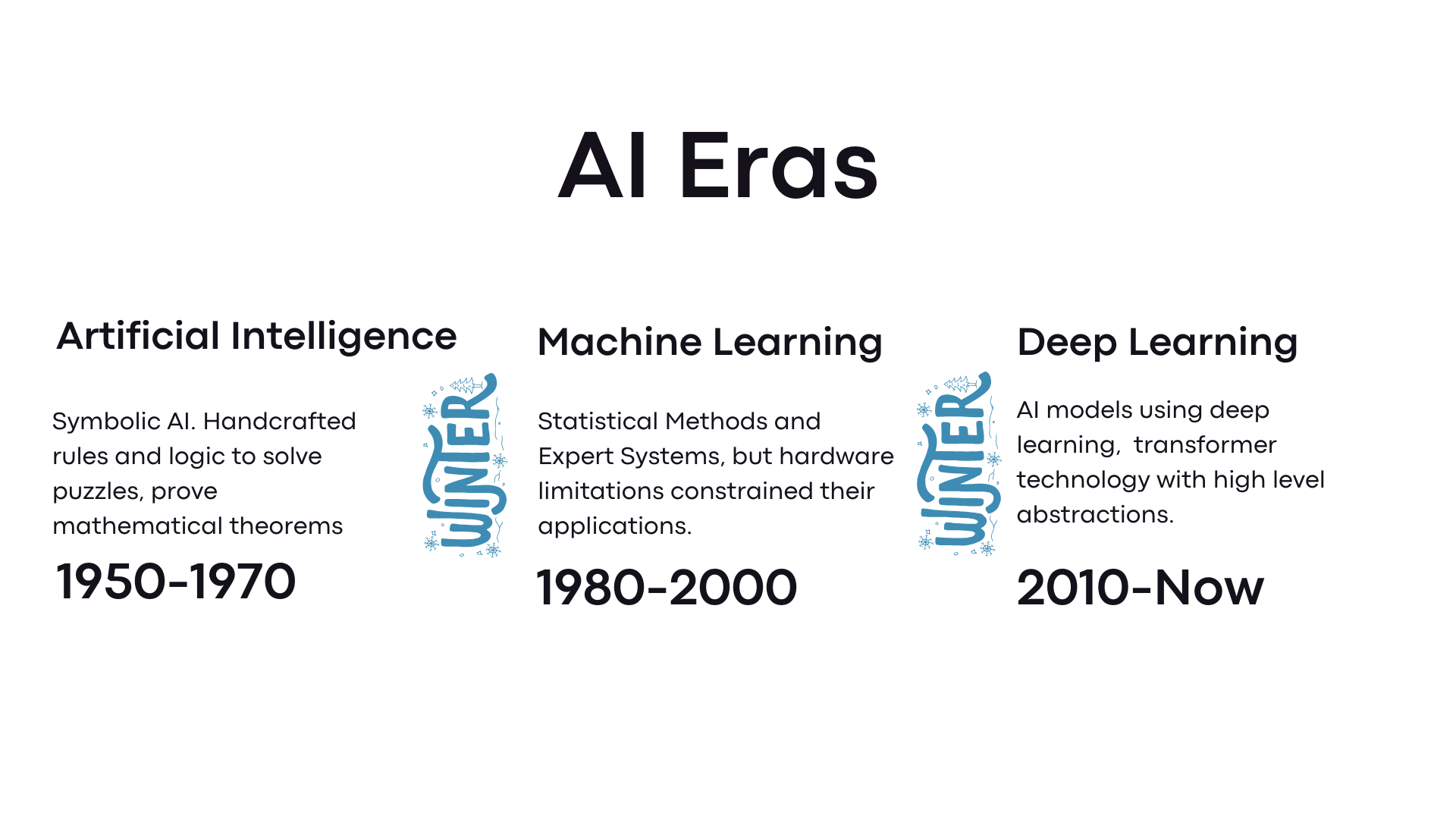
The trajectory of AI development is characterized by notable peaks of optimism and dips of skepticism, often termed “AI winters.” Let us outline three broad “waves” of AI:
1. **First Wave (1950s–1970s)**
- **Focus**: Symbolic AI. Researchers built systems that used handcrafted rules and logic to solve puzzles, prove mathematical theorems, and perform limited forms of language processing.
- **Limitations**: These systems struggled with real-world complexities. Large knowledge bases became unmanageable, leading to performance bottlenecks.
2. **Second Wave (1980s–2000s)**
- **Focus**: Statistical Methods and Expert Systems. Expert systems attempted to encode human expertise in specific domains (e.g., medical diagnosis, finance). Neural networks saw a revival in the late 1980s, but hardware limitations constrained their applications.
- **AI Winters**: Due to inflated expectations and the inability to meet them, funding dried up. One winter occurred in the 1970s, and another in the late 1980s/early 1990s. Researchers continued developing core ideas, but progress slowed considerably.
3. **Third Wave (2010s–Present)**
- **Focus**: Data-Driven Approaches and Deep Learning. Exponential growth in data availability and computing power revitalized neural networks, now called *deep learning*. Techniques such as convolutional neural networks (CNNs) and recurrent neural networks (RNNs) enabled breakthroughs in image recognition and language tasks.
- **Resurgence of Optimism**: Landmark achievements, including IBM Watson’s victory on *Jeopardy!* in 2011, propelled AI into the mainstream spotlight once again.
### Key Milestones: From Watson to AlphaGo to AlphaZero
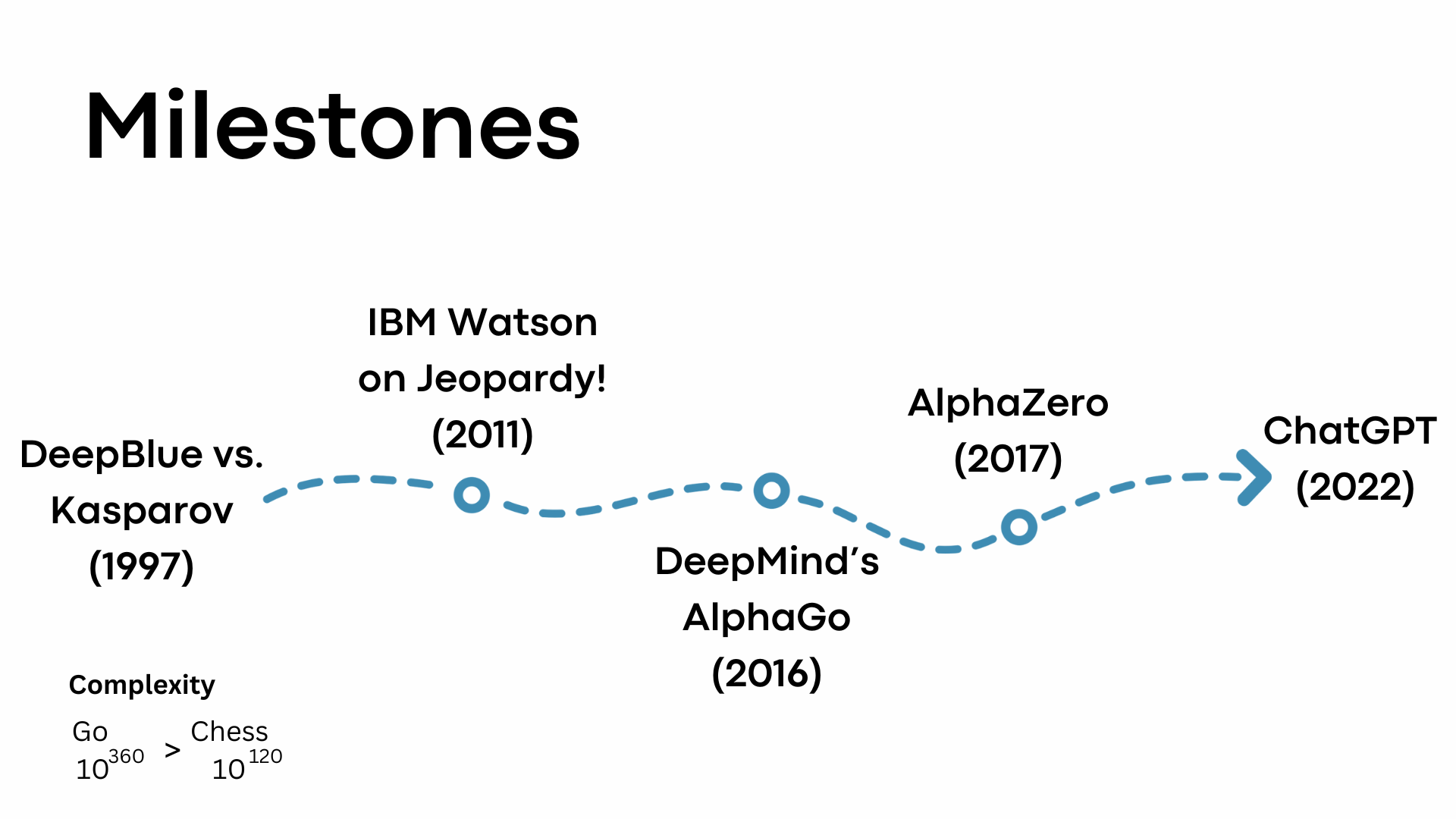
1. **IBM Watson on *Jeopardy!* (2011)**
Watson’s victory was a watershed moment. It showcased how a computer system could parse natural language questions, search through vast data sets, and return precise answers under strict time constraints. Although Watson used a combination of statistical and rule-based approaches, its success reinvigorated public interest in AI.
2. **DeepMind’s AlphaGo (2016)**
Go, an ancient board game known for its complexity, was seen as a grand challenge for AI. When *AlphaGo* defeated Lee Sedol, a world champion, it demonstrated that deep learning combined with reinforcement learning could outperform human experts in a highly strategic, historically “uncrackable” domain.
3. **AlphaGo’s Evolution to AlphaZero (2017)**
*AlphaZero* took a step further: it learned to play multiple games, Go, Chess, and Shogi, without being *explicitly* told the rules. It used self-play and reinforcement learning to reach superhuman levels of performance in all three games within a matter of hours. The leap from specialized systems (AlphaGo) to a more generalized system (AlphaZero) is significant because it illustrates the potential for AI to learn abstract principles applicable across different domains. This adaptability hints at how future AI might generalize knowledge in ways akin to human intelligence.
### Callout: Why does AlphaZero matter for lawyers?
> It exemplifies that AI can rapidly acquire and master complex rule sets, even those that have historically stumped human programmers, by generating new strategies. Translating this to law, there may come a time when AI can master complex bodies of legal doctrines, generate novel legal arguments, or optimize negotiation tactics with minimal human intervention. Though law is not a board game, the principle of fast, self-directed learning is an enticing preview of what may be possible.
---
## What Exactly Is Generative AI?
### Defining Generative AI
Generative AI refers to a subset of artificial intelligence models designed to *generate* new content, text, images, audio, video, rather than merely classify or predict within fixed boundaries. Traditional AI tasks often revolve around classification (e.g., “Is this email spam or not spam?”) or regression (predict a continuous value, such as tomorrow’s temperature). In contrast, **generative models create**: they formulate sentences, compose music, design virtual environments, or produce art, often with minimal human guidance.
Some well-known forms of generative AI include:
- **Generative Adversarial Networks (GANs)**: Pioneered in 2014, where two neural networks (generator and discriminator) train against each other, resulting in the generator producing increasingly realistic outputs.
- **Variational Autoencoders (VAEs)**: Models that learn efficient representations of data (latent spaces) and can reconstruct or generate new data points similar to the original training samples.
- **Transformers**: A more recent architecture for natural language processing (NLP). Models like GPT (Generative Pretrained Transformer) fall under this category, shining in tasks like text generation and machine translation.
In the legal domain, the potential for text-based generative AI is especially relevant: drafting contracts, summarizing depositions, creating litigation strategies, generating memos, and more. The hallmark of generative AI is its capacity to produce outputs that can appear remarkably human. This can be both exciting and concerning: it raises big questions about trust, authenticity, and the need for careful oversight in professional settings.
### How Does Generative AI Work?
Think of a generative AI model as a *supercharged predictive text engine*. If you use a smartphone, you may have noticed how your texting app suggests the next word in a sentence. It does this by looking at your previous words and predicting the most likely next word based on patterns it has learned from millions of messages. Generative AI like GPT is basically that idea “on steroids,” but with thousands or millions of times more parameters (think of these as internal “knobs” or “connections”) and trained on far larger and more diverse datasets: books, articles, websites, and more.
1. **Training**
During training, the model is fed massive amounts of text. It learns to predict the next word in a sentence by analyzing patterns in how words and phrases appear together.
2. **Contextual Understanding**
The model does not “understand” text the way humans do, but it captures statistical regularities and can approximate some aspects of semantic relationships.
3. **Generation**
When prompted with a question or a partial sentence, the model uses its learned patterns to generate the next likely word, and then the next, and so on, until it forms a coherent (or at least plausible) response.
We will dive deeper into the underlying mechanics, tokens, attention mechanisms, fine-tuning, and more, in the next chapter. For now, recognize that generative AI is distinct from other AI models because it synthesizes new data rather than sticking to classification or prediction tasks.
---
## The ChatGPT Moment
On November 30, 2022, OpenAI launched ChatGPT, an AI chatbot interface that took the world by storm. While GPT models had existed prior to ChatGPT, this release represented a watershed moment because:
1. **User-Friendly Interface**
Anyone could type a prompt in plain English and receive a coherent, contextually relevant response in seconds. This significantly lowered the barrier to entry for interacting with advanced AI models.
2. **Speed of Adoption**
Within just five days of its launch, ChatGPT amassed over one million users, and 100 million users within 2 months. Commentators described the growth rate as “unprecedented,” even surpassing adoption milestones seen by major social media platforms like TikTok.
3. **Broad Applications**
Users tested ChatGPT on everything from writing poetry and generating code to drafting legal templates and producing academic papers. The technology’s versatility caught the attention of professionals in law, medicine, finance, and beyond.
4. **Moving the Goalposts**
As AI continually demonstrated capabilities once deemed “five years away,” the public discourse shifted. “What else is possible?” became the central question. Heightened expectations has also hollowed out AI's magic. As John McCarthy famously remarked, "As soon as it works, no one calls it AI anymore." This acceleration also pressured competitors to innovate rapidly, kicking off an “AI arms race.”
In the legal world, ChatGPT quickly became a subject of fascination and controversy. Lawyers saw the tool’s ability to summarize or draft documents almost instantly. Judges pondered whether ChatGPT-like AI might one day aid in case management or even bench memoranda. The technology introduced fresh concerns about data confidentiality, unauthorized practice of law, and more, setting the stage for urgent discussions around regulation and best practices.
###Practice Pointer: Managing Client Expectations
1. **Explain AI’s Role:** Clarify to the client that AI drafts are starting points and require human review.
2. **Set Boundaries:** Communicate which tasks AI can handle effectively (e.g., summarizing large data sets) and which tasks require thorough attorney oversight.
3. **Highlight Limitations:** Be upfront about potential inaccuracies and emphasize the collaborative nature of the human–AI process.
---
## The Race to AGI
### Defining AGI
AGI, or Artificial General Intelligence, refers to an AI system with the ability to understand, learn, and apply knowledge across diverse tasks at a level comparable to, or beyond, that of a human. Unlike narrow AI, which excels at a single domain (like playing chess or drafting text), AGI would theoretically be capable of reasoning and problem-solving in multiple contexts, transferring learned skills from one domain to another without specific reprogramming.
### Incentives Driving the Race
1. **Economic Incentives**
The first organization or nation to develop AGI could reap enormous economic benefits. AGI systems might optimize supply chains, drive financial markets, and unleash new inventions.
2. **Strategic and Military Applications**
Governments and militaries are keenly interested in AI’s potential for surveillance, strategic planning, and cybersecurity. Having advanced AI capabilities could confer significant geopolitical advantages.
3. **Humanitarian and Research Prospects**
From disease cures to climate modeling, an AGI could tackle the world’s most urgent problems. Organizations like OpenAI and DeepMind aspire to harness AI for societal benefit, though strategies and motivations differ.
### Implications for Law and Society
- **Legal Frameworks**
As AI systems grow more autonomous, legal responsibility and liability become complex. How do we govern AI that acts on its own initiative?
- **Ethical Considerations**
Nick Bostrom’s *Superintelligence* warns of existential risks if AI exceeds human intelligence, requiring careful oversight and alignment with human values (Bostrom, 2014).
- **Rapid Technological Shifts**
The race to AGI might also spark a new era of intellectual property conflicts, antitrust concerns, and regulatory battles. Lawyers who understand AI will be at the forefront of guiding how these technologies are deployed and constrained.
---
## Opportunities and Challenges
The emergence of generative AI opens doors for innovation but also raises critical challenges. Below is a table outlining key opportunities and corresponding challenges in the legal sector.
| **Opportunity** | **Challenge** |
|------------------------------------------------|--------------------------------------------------------------|
| **Document Drafting & Summarization** | Ensuring accuracy, avoiding model “hallucinations” |
| **Client Screening & Triage** | Ethical issues regarding unauthorized practice of law |
| **Predictive Analytics (Case Outcomes)** | Risk of biased training data leading to biased predictions |
| **E-Discovery & Legal Research** | Maintaining confidentiality and compliance with data privacy |
| **Contract Analysis & Review** | Adapting to the dynamic nature of legal standards |
| **24/7 Legal Chatbots** | Regulation and oversight of AI-driven legal advice |
###Practice Pointer: Verifying AI-Generated Research
1. **Always Validate References:** AI tools may “hallucinate” case citations or statutes. Double-check each reference in official databases before relying on it.
2. **Have a Backup Method:** Maintain a manual or traditional research approach as a safety net for vital cases or complex legal issues.
3. **Draft a Checklist:** Develop an internal checklist (e.g., “Verify data source,” “Confirm factual alignment,” “Check for relevant jurisdiction”) for every AI-generated legal memo.
###Scenario: A Solo Practitioner Adopting an AI Research Tool
> Alicia runs a solo family law practice. Overwhelmed by the need to read and summarize cases on custody modifications, she adopts an AI legal research assistant. Initially, Alicia cross-checks every summary the system generates. After consistent accuracy is demonstrated, she grows comfortable relying on the tool’s quick overviews, though she still does final verifications before going to court. With the AI’s help, Alicia takes on more clients without compromising quality.
### Accuracy vs. Hallucination
Generative AI models may produce confidently stated but factually incorrect or nonsensical outputs, often referred to as “hallucinations.” For legal applications, the risk is high: imagine citing a non-existent case or misquoting a statute. Part of this course will address strategies to mitigate such risks, including validation mechanisms and “human in the loop” oversight.
### Ethical and Regulatory Complexity
Mustafa Suleyman, in *The Coming Wave*, emphasizes the destabilizing impact of powerful AI systems if governance frameworks do not keep pace. From data privacy to intellectual property, existing laws may not be fully equipped to handle the rapid evolution of generative AI. Similarly, Dario Amodei’s *Machines of Loving Grace* highlights the tension between technological optimism and the ethical obligations to ensure AI serves the greater good. Lawyers, policy experts, and technologists will need to work collaboratively to shape regulations that balance innovation with public interest.
### The Global Context
AI development is not happening in a vacuum. Nations and corporations alike are competing to set standards and achieve breakthroughs. For example, in contrast to the United States's laissez-faire approach, the European Union's AI Act imposes a wide range of obligations on the various actors in the lifecycle of a high-risk AI system, which include requirements on data training and data governance, technical documentation, recordkeeping, technical robustness, transparency, human oversight, and cybersecurity. Ethan Mollick’s concept of *Co-intelligence* points to the synergy between collective human intelligence and machine capabilities, suggesting that we are entering a new era of hybrid decision-making. Lawyers and legal scholars who grasp these global dynamics will be better positioned to advise clients, shape policy, and represent interests in international forums.
---
## A Hands-On Experiment
Before we end this chapter, let us do a small experiment to illustrate the capabilities of a generative AI model (e.g., ChatGPT). This experiment is designed for those with no technical background, so feel free to follow along:
1. **Open ChatGPT (https://chatgpt.com).**
2. **Prompt**: Type the following: “Explain the concept of *consideration* in contract law, but use the style of a bedtime story involving two friends exchanging marbles.”
3. **Observe**: Notice how ChatGPT weaves legal principles into a coherent narrative, demonstrating its ability to generate relevant text while maintaining a creative element.
4. **Reflect**: Think about how such a tool might be used to quickly draft creative briefs, educational materials for clients, or simplified explanations of complex legal doctrines.
This simple exercise reveals how generative AI can adapt content for different audiences and use cases. However, remember to verify accuracy and completeness, never rely solely on AI-generated text for professional legal work without thorough human review.
###Scenario: Pilot Testing a “Legal Bot” for Client Intake
> A legal aid organization launches a trial chatbot to guide potential clients through basic intake questions, like personal details and the nature of their legal issue. The chatbot generates a preliminary memo of the client’s situation, saving staff paralegals time. However, because users sometimes provide ambiguous answers, attorneys train the model to request clarifications. Staff attorneys review each memo before scheduling follow-up interviews, ensuring that nothing slips through the cracks.
---
## Use Cases of Generative AI in Legal Services
**Automated Drafting of Routine Documents**
**Description**
Many legal documents, NDAs, lease agreements, or simple contracts, follow standardized formats. A generative AI model can create a first draft customized to a client’s basic requirements.
- **Value**: Saves time, reduces repetitive tasks, and lowers costs.
- **Risk**: Potential errors or omissions require final review by a licensed attorney.
####Example: Mid-Sized Firm Integrating an AI Contract Review System
> A mid-sized firm specializing in commercial leases decides to implement an AI tool that flags key clauses for revisions or negotiations. Junior associates train the model with annotated samples, indicating where the AI accurately catches problematic terms and where it misses subtle red flags. Over time, the system cuts first-pass contract review hours by 40%, freeing associates to focus on complex client counseling.
**Intelligent Legal Research**
**Description**
Generative models can be used to quickly summarize cases or statutes and offer preliminary insights on how they might apply to a particular fact pattern.
- **Value**: Accelerates research, allowing lawyers to focus on analysis rather than manual searching.
- **Risk**: Hallucinated case law or inaccurate summaries if the model’s training data or parameters are out of date.
**Discovery and Due Diligence**
**Description**
Large-scale litigation or M&A due diligence often involves parsing through thousands of documents. AI-based systems can classify, tag, and generate summaries of relevant materials.
- **Value**: Rapid identification of key issues and evidence; cost savings in e-discovery.
- **Risk**: Inadvertent disclosure of privileged materials if the system is not carefully supervised; compliance concerns with data management.
###Practice Pointer: Establishing an "Internal Sandbox”
1. **Controlled Environment:** Create a separate, secure workspace where your team can pilot test AI tools without risking confidential data leaks.
2. **Defined Metrics:** Before testing, decide on key performance indicators (e.g., speed of drafting, error rates, user satisfaction).
3. **Iterative Approach:** Start with small-scale experiments, like drafting a simple contract. Collect feedback, refine processes, and then scale up.
---
## Chapter Recap
In this chapter, we built a foundational understanding of generative AI’s role in the legal sector by exploring:
- **Traditional Programming’s Limitations**
The rigidity and complexity of *if-this-then-that* logic laid the groundwork for seeking more flexible, data-driven approaches.
- **History and Evolution of AI**
From the Dartmouth Conference in 1956 to IBM Watson’s *Jeopardy!* victory and AlphaZero’s generalized game mastery, AI’s journey has been marked by peaks of optimism and valleys of disillusionment, yet it continues to advance.
- **Generative AI Defined**
We distinguished generative AI models from other AI approaches, noting that these models create new text, images, and more, rather than simply classify data.
- **The ChatGPT Moment**
The rapid adoption and media attention around ChatGPT in late 2022 reshaped public expectations and spurred intense competition in the AI space.
- **The Race to AGI**
While AGI remains a contested concept, the incentives to develop ever-more-powerful AI are accelerating. Lawyers will be pivotal in navigating the ethical, legal, and regulatory implications of these advances.
- **Opportunities and Challenges**
From drafting documents to predicting case outcomes, generative AI offers a broad array of benefits, but it also raises concerns about accuracy, bias, and data privacy.
- **Hands-On Experiment**
A quick demonstration highlighted how generative AI can generate stylistically tailored content for different audiences.
- **Use Cases in Legal Services**
We explored three practical areas, document automation, legal research, and e-discovery, where generative AI can bring tangible value.
---
## Final Thoughts
Generative AI stands at the intersection of decades-long research breakthroughs and a rapidly shifting technological landscape, offering legal professionals the potential to transform how they deliver services. By bridging the gap between rigid, rule-based systems and adaptive, data-driven approaches, generative models like ChatGPT broaden our capacity to analyze documents, craft arguments, and even discover uncharted avenues for legal innovation. Yet, as this chapter highlights, these same technologies come with inherent complexities, ranging from the risks of hallucinated outputs to the evolving ethical and regulatory concerns.
As you proceed through this course, keep the following in mind:
1. **Adaptability and Context Matter** — Generative AI excels in pattern recognition but still depends on appropriate contextual framing and oversight.
2. **Human Oversight Remains Key** — AI can greatly enhance legal practice but is no substitute for professional judgment, ethical practice, and real-world experience.
3. **Embrace Continuous Learning** — Technological progress in AI is swift; staying informed will be essential for leveraging these tools responsibly and effectively.
4. **Balance Innovation with Caution** — While AI opens new possibilities, the sophistication of legal analysis and client confidentiality demands a measured, well-supervised approach.
By embracing both the possibilities and the pitfalls of generative AI, you can begin to chart your own path in this emerging and exciting frontier of legal practice.
---
##What's Next?
Before we jump to more intricate details, it is crucial to understand that these advancements demand not just technical knowledge but also ethical, legal, and managerial acumen. **Chapter 2** will go deeper into **how** generative AI works at a technical level, exploring neural network architectures, training processes, and how the models generate text. We will also discuss how to evaluate AI systems for trustworthiness and accuracy, an essential skill for any legal professional who plans to integrate AI into practice.
---
## References
- Bostrom, Nick (2014). *Superintelligence: Paths, Dangers, Strategies*. Oxford University Press.
- Mollick, Ethan (2024). *Co-intelligence: Living and Working with AI*. Penguin Random House.
- Suleyman, Mustafa (2023). *The Coming Wave: Technology, Power, and theTwenty-First Century's Greatest Dilemma*. Crown Publishing.
- Amodei, Dario (2024, October). Machines of Loving Grace: How AI Could Transform the World for the Better. Retrieved from [https://darioamodei.com/machines-of-loving-grace](url)
# Chapter 2: How Does Generative AI Work?
## Chapter Overview
In Chapter 1, we discovered that generative AI is not just about classification or data analysis; rather, it creates *original* text and ideas based on patterns it has learned from existing information. We explored how these tools can streamline tasks like contract review and legal research, saving time and energy for legal professionals. We also discussed their limitations, such as the tendency to provide confident-sounding but erroneous answers, and the importance of using them responsibly.
In this chapter, we peel back the curtain on *how* these generative AI tools actually work. We will go step by step through the technical components, but in a way that remains accessible to a general audience (think: high school–level explanations). We will focus on the key ideas behind concepts like:
- **Neural networks** (the building blocks of modern AI systems)
- **Large Language Models (LLMs)** (like GPT-4o, o1, Claude, and others)
- **The Transformer Architecture** (the breakthrough that enables AI to handle words and sentences so effectively)
- **How LLMs learn from data**
- **Why these models can still make mistakes** and how to identify potential pitfalls
- **Hands-on experiment** to see, at a high level, how these systems predict the next word
By the end, you will be able to understand (1) how these systems process language, (2) what makes them both powerful and fallible, and (3) how to begin integrating them thoughtfully into your legal practice. We will also lay the groundwork for our next chapter, which focuses on specific AI tools, including ChatGPT and Claude, to better understand their practical use cases.
---
## From Conceptual Understanding to Technical Foundations
We often hear people talk about AI as if it were magic: “It just *knows* how to write a motion or contract.” But as future legal professionals, it’s essential to develop **AI literacy**, the ability to look beyond the “black box” mystique and grasp the essentials of how AI systems work. This understanding, even if it’s at a high level, will help you:
**Assess AI tools critically**
- Is the system trained on relevant legal data?
- How trustworthy are its outputs?
**Use AI responsibly**
- Recognize that AI can produce errors or biased content.
- Understand how to mitigate risks through review and validation.
**Communicate effectively with technical teams**
- Know the right questions to ask about data sources, training methods, and model performance.
**Leverage AI’s strengths**
- Speed up legal research, drafting, and other routine tasks.
- Focus your human expertise where it matters most (e.g., nuanced legal strategy).
Throughout this chapter, we will keep the explanations as simple as possible, sometimes using analogies and everyday language. For those wanting a *deeper* dive, look for the optional “Callouts and Key Terms” or “Practice Pointers” that give additional detail.
---
## Defining Artificial Intelligence
Artificial Intelligence (**AI**) is a broad field focused on creating computer programs that can perform tasks that normally require some level of human intelligence. These tasks range from recognizing speech or images to writing entire legal documents. While AI can sometimes seem magical, it is ultimately about **pattern recognition**, software that detects structures in data and uses those structures to make predictions or decisions.
### Machine Learning: A Subset of AI
Within AI, one of the most important and fast-growing areas is **machine learning (ML)**. Rather than manually programming rules for every scenario (which is nearly impossible for complex tasks like natural language understanding), ML systems learn automatically from examples.
### Types of Machine Learning
**Supervised Learning**
- The most common type in many industries. You provide labeled examples (e.g., “These 1,000 documents are contracts; these 1,000 are not”), and the model learns to distinguish one from the other.
- *Example in Law:* A system could learn to separate discovery documents that are relevant to a case from those that are not.
**Unsupervised Learning**
- The system is given **unlabeled** data and asked to find patterns or groups.
- *Example in Law:* Clustering documents by theme or topic to detect patterns in case files, without you having to label them first.
**Reinforcement Learning (RL)**
- The system learns by trial and error, receiving rewards (or penalties) based on actions it takes.
- *Example:* An AI that learns the best strategy to argue a mock case by trying different rhetorical approaches and getting feedback from human evaluators.
### Deep Learning: Where Neural Networks Come In
**Deep Learning (DL)** is a special branch of machine learning that involves *neural networks* with multiple layers. Each layer captures increasingly complex patterns. Think of it as a multi-layered structure that can start by recognizing letters, then words, then sentences, and so forth. When you hear about breakthroughs in image recognition, speech-to-text, or language generation, there’s a good chance it’s powered by deep learning.
### Reference Note
> For an in-depth, technical view of deep learning and neural networks, you might look at *Deep Learning* by Ian Goodfellow, Yoshua Bengio, and Aaron Courville (2016). They break down how these networks are constructed and trained to handle complex tasks.
---
## General vs. Narrow AI: What’s the Difference?
When discussing AI, it’s helpful to distinguish between two visions:
**Artificial General Intelligence (AGI)** or **Strong AI**
- An AI that can reason, learn, and apply knowledge across *any* task, much like a human.
- AGI is still a theoretical concept and is the stuff of science fiction, think of a computer that can write legal briefs *and* drive a car *and* solve advanced mathematical proofs *and* paint original artworks, all with the same level of skill.
**Narrow AI** or **Weak AI**
- AI that excels in *specific* tasks, such as recognizing faces, playing chess, or writing text based on patterns it has seen.
- Almost all of the AI used in business, law, healthcare, and other sectors today is considered narrow AI. Generative AI tools like ChatGPT, while incredibly versatile with language, are still *narrow* because they can’t do tasks *unrelated* to their language training.
### Practice Pointer
> Don’t be fooled by how “intelligent” a large language model seems. It’s still considered narrow AI. It can do many language-related tasks, but it doesn’t “understand” in the same way a human does, nor can it pivot to solve unrelated tasks like robotics (unless it is specifically designed or fine-tuned to do so).
---
## What Is a Neural Network?
A **neural network** is a computational model inspired by the structure of the human brain (though it’s much simpler, so the analogy is limited). In our brains, billions of neurons pass electrical signals to each other to interpret the world and drive our actions. An artificial neural network mimics this idea with layers of artificial “neurons.”
### Perceptron: The Simplest Building Block
The most basic form of an artificial neuron is called a **perceptron**. Think of a perceptron as a tiny decision-maker that receives inputs (numbers), multiplies them by some “importance factors” (called **weights**), sums them up, and passes them through a simple rule. If the total is above a certain threshold, the perceptron outputs 1 (like “Yes”); if not, it outputs 0 (like “No”).
**Analogy: Brain Neuron**
A single human neuron fires an electrical signal if it receives enough of the right inputs from other neurons. Similarly, a perceptron “fires” if the weighted inputs exceed a certain threshold.
### How Do These Networks Learn?
When you stack thousands or even millions of perceptrons into multiple layers, you get a **deep neural network**. These networks learn patterns from *lots* of data. During training they employ the following algorithm:
1. The network receives an example (like a sentence or an image).
2. It makes a prediction (which could be the next word in a sentence).
3. It checks how close that prediction was to the correct label or outcome.
4. It adjusts the weights and biases so next time, the prediction gets closer to correct.
Over many iterations, the network finds patterns that allow it to make increasingly accurate predictions.
---
## Large Language Models
Now, let’s zoom in on **large language models (LLMs)**, the AI systems that power tools like ChatGPT and Claude. As the name suggests, they are big neural networks designed specifically for language tasks. Their size is often described in terms of **parameters**, think of each parameter as a dial that the training process fine-tunes to recognize linguistic patterns.
### Scale: Why Are They Called “Large”?
- GPT-3.5 (the model behind ChatGPT for a while) has roughly **175 billion parameters**.
- GPT-4 has been reported to utilize **1.76 trillion parameters**. Yes, that's trillion, with a "t"\!
- Models like Claude also operate in the billions-parameter range.
The idea is that more parameters often give a model the ability to capture more nuanced patterns. If a model is “too small,” it might not learn the richness and variety of human language. But as you go bigger, you can capture a lot of subtle context. This is one reason advanced LLMs can produce surprisingly coherent, human-like text.
### Example and Scenario
- A smaller language model might consistently confuse words like “defendant” and “plaintiff,” especially in complex sentences.
- A large model that has seen more legal documents (and thus has more “experience”) is more likely to use these terms correctly, and even generate entire paragraphs that sound like they were written by a seasoned attorney.
### Key Term Callout: “Parameter”
> Each parameter in an LLM is like a tiny dial the model adjusts during training to reduce errors. Examples of parameters include the model's weights and biases. More parameters mean more dials, and typically, more capacity to represent complex language patterns.
---
## The Transformer Architecture: “Attention Is All You Need”
A huge breakthrough in language processing came in 2017 with a paper titled **“Attention Is All You Need”**, introducing the **transformer architecture**. Before transformers, AI models that handled text often processed words in order, one word after another, using recurrent neural networks (RNNs). This seems logical to process words in order, but many times the meaning of words is informed by the interrelationship of meaning between the words. Transformers changed the game by allowing the model to look at *all* words in a sentence *at the same time* and figure out which ones are most important to each other.
### What Is “Attention”?
“Attention,” in this context, means the ability of the model to weigh how relevant one word (or part of a sentence) is to another word or part of a sentence. The model doesn’t just read from left to right. Instead, it learns that, for example, in the sentence “The lawyer who was very tired argued the case,” the word “lawyer” is strongly connected to “argued,” while “tired” modifies “lawyer.” This helps the model keep track of context over long sentences.
**Analogy: Spotlight on Stage**
Picture multiple actors on stage delivering lines. “Attention” is like a movable spotlight that highlights the most relevant actor(s) at any moment, allowing you (or the AI) to focus on the key interactions.
### Detailed Example:
“When Jane realized she had forgotten her bag, she rushed back to the store, where Mark had hidden it behind the counter so no one else would take it.”
In this single sentence, the correct interpretation of words like “she,” “her,” “Mark,” and “it” depends on the relationships among them:
1. Who is “she”? It points back to “Jane.”
2. Whose bag is it? The word “her” (in “her bag”) also refers to Jane.
3. What is “it”? “It” refers to the same bag mentioned earlier.
4. What did Mark hide, and why? Mark’s action of hiding the bag behind the counter so that “no one else would take it” clarifies both his role and the function of “it.”
A language model equipped with self-attention (and cross-attention in multi-sentence contexts) can examine these words and their references simultaneously. Rather than simply reading each word in a linear fashion, the model creates a “map” of relationships among tokens. This allows it to recognize that “her bag” and “it” both point to the same object, that “she” is the same person as “Jane,” and that “Mark” is a different individual performing a distinct action. These interrelationships seem like common sense to us, but they can easily trip up less sophisticated language models. By tracking these interdependencies, the model demonstrates a form of “contextual understanding,” which is pivotal for interpreting meaning accurately in complex sentences.
### Why Transformers Changed the Game
1. **Parallel Processing**: Instead of reading text sequentially, transformers analyze entire sentences (or paragraphs) in parallel, which is faster and more efficient.
2. **Better Long-Range Context**: The model can connect words or phrases that are far apart in the text. In legal documents, context from the beginning of a paragraph can be critical at the end.
3. **Scalability**: Transformers scale very well to large amounts of data and large network sizes (hence “large language models”).
This transformer-based approach is *why* ChatGPT and similar tools can produce well-structured, contextually relevant paragraphs. They’re essentially experts at “paying attention” to the right parts of a sentence.
---
## Interpolation vs. Extrapolation
An important limitation of LLMs (and AI in general) is the difference between **interpolation** and **extrapolation**:
- **Interpolation**: Filling in gaps within the patterns the model already knows. For instance, if the model has seen thousands of standard clauses in legal contracts, it can “interpolate” to produce a new clause that fits that familiar pattern.
- **Extrapolation**: Going beyond the data the model was trained on and creating genuinely new ideas or patterns never before encountered.
LLMs are generally good at interpolation because they are experts at spotting and replicating patterns they’ve seen. But they’re not so great at true extrapolation, if you ask them something totally outside their training data, they might give nonsensical or made-up answers. This is one of the reasons why LLMs tend to hallucinate \- because they are, in a sense, not drawing from their experience, but just trying to make it up. Of course, this is a critical point in legal settings, where a unique or unprecedented scenario might arise and the model could fail to respond accurately.
### Practice Pointer
> Always remember that an LLM’s knowledge is bounded by what it has seen. If your legal scenario is highly novel or cutting-edge, rely more on human legal expertise and research rather than a model’s guesses.
---
## Weights, Biases, and Parameters
Let’s circle back to some foundational concepts in neural networks:
**Weights**
- These are the numbers the model uses to determine how strongly one neuron’s output should affect the next neuron’s input.
**Biases**
- Additional values that shift the output of a neuron up or down, similar to how you might adjust the baseline in a scale.
**Parameters**
- Both weights and biases are collectively called “parameters,” and these are what get tuned during training.
When someone says a model has “billions of parameters,” they mean billions of these numerical weights and biases. Training is the process of adjusting all these parameters so the model performs better on the task at hand.
**Example**
In a simplified sense, if we have an input word “contract,” the network might use a certain weight to link it strongly with “legal obligations” in the next layer. If that weight is too high or too low, the model might overemphasize or underemphasize certain words in its predictions.
---
## What Is Gradient Descent?
**Gradient descent** is the method most commonly used to train neural networks. Think of it as a systematic way of tuning weights and biases to reduce errors.
**Analogy: Climbing Down a Hill**
Imagine standing on a foggy hillside trying to reach the lowest point in the valley. You can’t see far, so you test small steps in different directions. If one step moves you downward, you keep going that way. If you go up, you backtrack. Over time, you (hopefully) reach the bottom.
In the same way, a neural network adjusts its parameters in tiny increments, guided by how much these adjustments reduce (or increase) the overall error on training examples.
The key to gradient descent is having a “loss function,” which measures how far off the model’s predictions are from the desired result. Each training step tries to **minimize** this loss. The ideal is for training to result **zero loss**, when the model’s predictions perfectly match the target outputs. While it can happen (especially for very simple datasets or overly flexible models), achieving literally zero loss is relatively rare.
Another way to think of it is to flip the numbers around: the model wants to score 100% and get everything right. It's graded at every training step so it knows how far off it is from perfection. If it scores 90%, it tries to adjust its strategy to get 10% better. Currently, getting 90%+ for LLMs is, like it is for us humans, pretty good\!
### Call Out: The Problem of Overfitting
> **For Humans**: Think of overfitting like a student who memorizes every word in a textbook but never truly learns the underlying concepts. They might ace a practice test because it uses the exact same examples, but when given new questions, they struggle to apply their knowledge.
> **For AI**: A model that is “overfitted” has learned the training data too well, picking up not just meaningful patterns but also noise and irrelevant details. As a result, it performs impressively on the examples it was trained on, yet falls short when it encounters new, unseen data.
> **Why It Matters**: In the context of law (and any real-world application), an overfitted AI tool can give misleading or incorrect results when faced with novel scenarios. Balancing how much a model learns from training data without memorizing every quirk is key to building reliable and trustworthy AI systems.
---
## Vectors and Embeddings
A fundamental idea in language models is representing words (and sometimes sentences or entire documents) as **vectors**, lists of dimensions or numbers that capture *meanings* or *attributes*.
### A Simple Analogy
Suppose you want to describe a friend. You might list attributes such as:
- Height
- Hair color
- Birthplace
- Occupation
- Favorite sports team
- Eye color
Each of these attributes is one "dimension" in a vector. If you know enough attributes (dimensions), you can uniquely describe your friend compared to everyone else.
### Word Embeddings
In language models, words are also turned into these multi-dimensional vectors called **embeddings**. If two words frequently appear in similar contexts (like “contract” and “agreement”), their embeddings will be similar. This helps the model “understand” relationships between words in a numeric way.
**Example**
- “Lawyer” and “attorney” may end up with vector embeddings that are very close.
- “Dog” and “car” are likely more distant in this “embedding space” because they appear in very different contexts.
### Practice Pointer
> Embeddings also explain why models might get confused between words that show up in similar contexts. If “defendant” and “respondent” appear in similar environments, a model might occasionally mix them up.
---
## Reinforcement Learning
We touched on **reinforcement learning (RL)** earlier. Instead of just training on fixed examples, RL has the model interact with an environment. It receives **rewards** for good actions and **penalties** for bad ones.
### RL With Human Feedback (RLHF)
**ChatGPT** famously uses a version of RL called **Reinforcement Learning with Human Feedback (RLHF)**. Humans rate the model’s responses, effectively telling it which answers are better or worse. The model uses these ratings to adjust its parameters. Over multiple rounds, it gets better at producing the kind of answers humans find helpful.
**Why Did RLHF Make ChatGPT So Good?**
Regular language models might produce correct but confusing answers, or answers that are correct in form but irrelevant in content. RLHF aligns the model with *human preferences*, so it tends to produce responses that are both accurate (most of the time) and helpful in tone.
**Janelle Shane’s Quote**
*“The danger of AI is not that it’s too smart but that it’s not smart enough.”* – from *You Look Like a Thing and I Love You* (2019)
This speaks to the fact that AI can seem brilliant in one moment and then make a glaringly obvious mistake the next. Reinforcement learning with human feedback partially helps, but it’s not a cure-all.
---
## The Scaling Hypothesis
`Compute + Data = Intelligence`
The **scaling hypothesis** in AI states that as we increase the size of our models (more parameters), provide more data, and use more powerful computers, we will continue to see improvements in AI capabilities. This is somewhat analogous to **Moore’s Law**, which for decades accurately predicted exponential increases in computing power.
### Relevance to Legal AI
- **Bigger Models** can potentially handle more diverse language tasks, including specialized legal tasks.
- **More Data** means the model might have read more legal documents, making it better at drafting or researching.
- **Better Hardware** enables training on bigger models and delivering faster responses.
However, bigger and faster does not guarantee *less bias* or *more accuracy*. If the training data is flawed or incomplete, the model’s output will reflect those flaws.
### Practice Pointer: Bigger Isn't Always Better
> Don’t assume that a newer, bigger model is always the best choice for every legal use case. Sometimes a smaller, more specialized model that has been carefully fine-tuned on relevant legal data can outperform a huge model that lacks domain-specific training.
---
## Garbage In–Garbage Out: The Importance of Quality Data
You’ve probably heard the expression **“garbage in, garbage out”** (GIGO). It highlights that AI models are only as good as the data they’re trained on. Poor or biased data can lead to poor or biased results.
### Janelle Shane’s Example: Rulers and Sheep
In *You Look Like a Thing and I Love You*, Janelle Shane provides vivid anecdotes about how AI isn't always as smart as we think it is:
1. **Ruler on an X-ray**: A machine learning system was supposed to detect cancer in X-rays. Surprisingly, it learned to spot the *ruler* often placed next to suspicious areas for measurement, confusing the presence of the ruler with the presence of cancer.
2. **Sheep in a Field**: Another system learned to recognize *green grass* as a signal for “sheep,” because in most training pictures, sheep were standing on green grass. The AI concluded that wherever there was a field of green grass, there must be sheep, even if no actual sheep were visible.
These stories underscore that AI can latch onto the wrong patterns if the data isn’t carefully curated.
### Implications for Lawyers
- Make sure the AI system has been trained on diverse, accurate legal documents.
- If the training data is from only one jurisdiction or era, the system might not generalize to others.
- Always verify critical outputs rather than accepting them at face value.
### Example and Scenario
> If a contract review AI mostly trained on consumer contracts from the 1990s, it may not handle new data privacy clauses introduced by modern regulations like the GDPR or CCPA. This might lead to incomplete or incorrect drafting suggestions. This scenario may seem obvious or unlikely, but humans still appear to have a bias toward viewing AI as a magical oracle and believing that it if it knows one thing well, it should know everything well.
---
## Are We Running Out of Data?
One concern in AI research is that we might be approaching a point where **publicly available, high-quality text** is nearly all used up. Think of data like *oil*, there’s a finite supply, and once we’ve extracted it, it becomes harder to find new sources.
1. **Finite Online Text**: Since LLMs train on huge swaths of the internet, at some point, they’ve seen most of the high-quality text available.
2. **Data Overlap**: Many data sets repeat the same texts (e.g., Wikipedia is reused often).
3. **Synthetic Data**: One possible solution is to have AI generate *new* training data. However, if it’s based on AI’s own output, you can end up in a feedback loop.
### Callout: Synthetic Data
> *Synthetic data* is artificially generated content used to expand or diversify a training set. For legal AI, we might create hypothetical case scenarios or fake but realistic contracts. However, synthetic data can introduce *new biases* or inaccuracies if not carefully validated.
---
## A Hands-On Experiment
It’s easy to talk in abstract terms about “attention” and “vectors.” Let’s do a short exercise using the **Transformer Explainer** tool at [**https://poloclub.github.io/transformer-explainer/**](https://poloclub.github.io/transformer-explainer/). This interactive site visualizes how a transformer-based model (like the ones used in LLMs) predicts the next word.
### Step-by-Step Guide
1. **Open the site** in your browser.
2. **Type a short sentence** like “The lawyer presented the argument before the judge.”
3. **Observe the Attention Weights**: The tool shows which words in the sentence have the strongest influence on predicting the next word.
4. **Experiment**: Try variations like “The exhausted lawyer presented the argument…” and see how “exhausted” changes the attention patterns.
### Example: Context Matters
You might notice that the word “exhausted” affects how the model weighs the context around “lawyer.” This reveals *why* a transformer can keep track of context in a more nuanced way than older models.
By experimenting, you’re seeing a real demonstration of how the model decides which words matter most. This capacity for “attention” is at the heart of why transformers are so good at generating text.
---
## Chapter Recap
We’ve covered a lot of ground in this chapter, moving from a basic notion of AI to the technical underpinnings of **generative AI**. Here are the key takeaways:
- **AI and Machine Learning**
AI is about machines doing tasks that normally require human intelligence. Machine learning focuses on letting machines learn patterns from data. Deep learning uses multi-layered neural networks to find complex patterns.
- **General vs. Narrow AI**
Current AI systems, including advanced LLMs, are narrow and excel only in specific domains. True Artificial General Intelligence is still a hypothetical future goal.
- **Neural Networks and Perceptrons**
Neural networks are built from tiny units (perceptrons) that learn to activate or not, based on inputs. Stacking many layers of these units allows the system to detect intricate patterns.
- **Large Language Models**
LLMs like GPT-4 have trillions of parameters. Training them involves digesting massive amounts of text data to predict what word comes next in a sentence.
- **Transformer Architecture**
The “Attention Is All You Need” paper introduced a way for models to look at all parts of a sentence at once, transforming what was possible with AI. Attention mechanisms let models figure out which words are most relevant to each other.
- **Interpolation vs. Extrapolation**
LLMs are masters at blending known patterns (interpolation) but struggle with truly novel scenarios (extrapolation).
- **Weights, Biases, Parameters & Gradient Descent**
Training tweaks these numerical parameters via a process akin to feeling your way downhill. Minimizing a “loss function” guides these adjustments.
- **Vectors and Embeddings**
Words get turned into numerical representations that capture their meanings. Similar words end up near each other in “embedding space.”
- **Reinforcement Learning (RLHF)**
ChatGPT uses human feedback to refine its responses. This helps produce more user-friendly and contextually coherent answers.
- **The Scaling Hypothesis**
Bigger models \+ more data \+ more compute \= more capable AI. But bigger doesn’t always mean *better* for every use case.
- **Garbage In, Garbage Out**
Quality data is crucial. Poor or biased training data yields flawed outputs. Janelle Shane’s examples (the X-ray ruler and the “sheep \= green grass”) show how AI can learn the wrong cues.
- **Are We Running Out of Data?**
High-quality text data might be finite, leading researchers to explore synthetic data. Must avoid feedback loops where models train on their own potentially flawed output.
- **Hands-On Experiment**
Using the Transformer Explainer site can help you visualize how attention guides AI predictions in real time.
### Practice Pointer
> Before proceeding, reflect on the core question: *How might these concepts affect the way you validate AI-generated legal documents?* Keep in mind that while AI can save time, it’s crucial to know how these models reach their conclusions and where they might slip up.
---
## Final Thoughts
Generative AI, especially large language models powered by the transformer architecture, represent a significant leap in how we create, analyze, and interpret text. For legal professionals, these tools hold the promise of faster, more efficient workflows, from document drafting to case law summarization. Yet they also come with caveats: they can generate errors or biased language, they may not handle entirely novel scenarios gracefully, and they remain reliant on the data they’re trained on.
Moving forward, keep these lessons in mind:
1. **AI is not a magical oracle nor infallible**, human oversight remains essential.
2. **Better data yields better outputs**, quality and representativeness matter.
3. **Scaling AI** continues to expand possibilities, but size alone doesn’t solve all problems.
4. **Transparency and ethical considerations** are crucial for legal professionals who adopt these tools.
---
## What's Next?
In **Chapter 3**, we’ll focus on the real-world tools that operationalize these concepts, including popular AI tools like **ChatGPT** and **Claude**, and other emerging platforms, diving into their strengths, weaknesses, and how they fit into the legal workflow. We’ll talk about what you can realistically expect these tools to do for you in a law office environment, how to integrate them responsibly, and what pitfalls to watch out for. We will also examine practical use cases, like drafting briefs, summarizing case law, and more, and explore the growing number of third-party AI tools tailored for legal tasks.
---
## References
- Goodfellow, I., Bengio, Y., & Courville, A. (2016). *Deep Learning*. MIT Press.
- Kneusel, R. (2021). *How AI Works: From Neural Networks and Deep Learning to Natural Language Processing*. No Starch Press.
- Russell, S. J., & Norvig, P. (2010). *Artificial Intelligence: A Modern Approach* (3rd ed.). Prentice Hall.
- Shane, J. (2019). *You Look Like a Thing and I Love You: How Artificial Intelligence Works and Why It’s Making the World a Weirder Place*. Little, Brown and Company.
- Wooldridge, M. (2021). *A Brief History of Artificial Intelligence: What It Is, Where We Are, and Where We Are Going*. Flatiron Books.
---
## Optional Deeper Dive (For the Inquisitive)
If you’re intrigued by any particular concept, consider exploring these subtopics on your own time:
- **Activation Functions:** These determine how neurons pass signals along in neural networks. Common examples are ReLU and sigmoid.
- **Hyperparameters:** Settings such as learning rate, batch size, or the number of layers in a network. Tuning these can drastically change performance.
- **Overfitting and Underfitting:** Problems that arise when a model memorizes the training data too closely (overfitting) or fails to learn enough patterns (underfitting).
Understanding these deeper topics can help demystify the “secret sauce” behind AI, but for most legal applications, a high-level grasp of the basics is sufficient.
# Chapter 3: Generative AI Models and Tools
## Chapter Overview
In Chapter 2, we dove into the inner workings of generative AI to see how neural networks, large language models, and the transformer architecture collaborate to produce human-like text. We discovered how attention mechanisms enable these models to handle context, and why data quality, along with thoughtful human oversight, matters so much. We also explored where generative AI excels, such as piecing together known patterns, and where it falls short, like truly novel scenarios. Ultimately, we learned that understanding the “nuts and bolts” of AI helps us gauge when and how to rely on these tools responsibly in legal practice.
In this chapter, we will focus more concretely on how to *apply* generative AI in the real world and what’s out there in the world of generative AI tools. You will:
- Compare proprietary large language models (LLMs) like **ChatGPT and Claude** with **open-source** models.
- Explore the distinctions between **predictive AI models and reasoning AI models**, terms that you will hear often in tech and legal circles.
- Discover how **AI copilots differ from AI agents**, and what that means for you as a future legal professional.
- Examine popular AI tools, including ChatGPT 4o, Anthropic Sonnet 3.5, Google Gemini, and Perplexity, so you can recognize their **unique benefits and challenges**.
By the end of this chapter, you should be able to confidently explain what each of these generative AI tools does, decide when a particular solution is best suited for the task at hand, and identify the practical considerations, like cost, security, and ease of integration, that should influence your choice.
---
## Proprietary vs. Open-Source Large Language Models (LLMs)
Imagine you’re choosing between using a commercial legal research platform that has all the bells and whistles or building a custom research tool from scratch. On one hand, the commercial platform might be easier to adopt and offer ready-made features. On the other hand, building your own system could give you greater flexibility and customization. This same dynamic plays out in the world of large language models.
### Proprietary LLMs
**Proprietary LLMs** (like ChatGPT or Anthropic Claude) are owned and maintained by a single organization. These companies manage every aspect of the model, from how it’s trained to how users connect with it, often with user-friendly interfaces that many people can use without deep technical knowledge.
- **Convenience**: They usually come with robust interfaces, good customer support, and polished features.
- **Accessibility**: You can start using them quickly. You don’t need to manage the system on your own servers.
- **Ongoing Updates**: The company will release improvements, maintain the software, and handle bug fixes.
However, proprietary models do have some limitations:
- **Less Transparency**: Companies often don’t disclose full details about how the model was trained or what data it was fed.
- **Vendor Lock-In**: You might be dependent on a single vendor. If they raise prices or change policies, you have limited recourse.
- **Limited Customization**: Although some proprietary tools are flexible, you cannot access the underlying model weights or extensively modify the model’s behavior.
### Open-Source LLMs
**Open-source LLMs** (like certain versions of LLaMA or other community-supported projects) make their code or model weights publicly available. This transparency allows anyone with sufficient resources and expertise to adapt the model for their needs.
- **Flexibility**: You can tailor the model to specific tasks or domains, like building a specialized legal research assistant that understands your firm’s style of drafting.
- **Community Support**: A large community of developers often contributes improvements, extensions, and bug fixes.
- **Cost Control**: There’s no monthly subscription if you run the model yourself, though you may incur cloud or hardware expenses.
Open-source models do have disadvantages:
- **Technical Complexity**: Installing, fine-tuning, and maintaining an open-source model may require in-house technical talent.
- **Ongoing Maintenance**: You (or your team) become responsible for updates, security patches, and bug fixes.
- **Hardware Requirements**: Depending on the size of the model, you might need powerful computing resources to run it effectively.
---
**Callout: Key Term – LLM (Large Language Model)**
A Large Language Model is a type of AI system trained on vast amounts of text. It learns statistical patterns of language and can generate coherent, contextually relevant responses to prompts. Think of it as a supercharged version of your phone’s autocomplete, but capable of much more nuanced understanding and creation of text.
---
## Predictive AI Models vs. Reasoning Models
As AI continues to evolve, you may hear terms like “predictive model” or “reasoning model.” These terms help describe how an AI system processes information and the kinds of tasks it performs well. Let’s break down what each type of model does and introduce three specific examples you may encounter: **GPT-4o**, **o1**, and **o3**.
### GPT-4o: A Predictive AI Model
**GPT-4o** is an example of a **predictive AI model**. Introduced in May 2024, it can process and generate text, images, audio, and video. That’s what we mean when we say it’s “multimodal.” Because it works with so many media types, GPT-4o can:
- **Draft legal documents or motions** (text).
- **Transcribe depositions** (audio).
- **Analyze and interpret video footage** (video).
- **Suggest quick edits or summaries** for code, legal content, or marketing materials.
Many lawyers appreciate GPT-4o for its **speed**. It offers faster response times and reduced operational costs compared to earlier versions. This speed is especially useful for tasks such as real-time content updates or code editing. If you need quick turnarounds, say, drafting a motion in court under time pressure, GPT-4o might be the right choice.
### o1: A Reasoning AI Model
Released in September 2024, **o1** shifts focus from pure prediction to **reasoning**. Think of it as an AI designed to “think aloud” (internally) before providing an answer. This feature, often described as a “chain of thought,” helps it tackle **complex tasks** more accurately than a purely predictive model.
Because o1 excels at analytical thinking, you might use it for:
- **Complex coding tasks**: If your firm automates document generation with custom scripts, o1 might debug or optimize that code more effectively.
- **Mathematical or scientific problems**: For example, analyzing detailed economic data in an antitrust case.
- **Deep legal analysis**: For tasks that require methodical reasoning, such as interpreting complicated statutory language or comparing multiple cases to derive legal arguments.
### o3: Advanced Reasoning Model
**o3**, introduced in December 2024, is the successor to o1. It refines the reasoning approach even further, using an internal “private chain of thought” that allows it to map out a plan and reason through tasks before arriving at an answer.
In testing, o3 demonstrated impressive performance in challenging settings:
- **Scored 87.7% on the GPQA Diamond benchmark**, which includes expert-level science questions not publicly available online.
- **Achieved 71.7% on the SWE-bench Verified software engineering benchmark**, surpassing o1’s 48.9%.
The key takeaway? o3 is built for **sophisticated problem-solving**. If your legal work demands advanced reasoning, such as analyzing complex procedural rules or dissecting intricate regulatory frameworks, o3 might be the ideal tool.
---
### Example Scenario
> **Context**: You’re working on a patent infringement case involving cutting-edge biotech.
> **Predictive Approach**: GPT-4o might quickly summarize the patents and relevant court rulings, or generate a draft argument.
> **Reasoning Approach**: o1 or o3 could delve deeper into the technical details, offering a line-by-line analysis that highlights nuances in the claim language or prior art references.
> In practice, you might use both. GPT-4o for speed and summarization, and o3 for deep analytical insights.
---
### Key Differences
- **GPT-4o**: Multimodal, **fast**, and **cost-effective** for generating content in various formats.
- **o1 and o3**: Built for **complex reasoning**, with an internal chain-of-thought approach that helps them tackle advanced analytical tasks.
In sum, if you need quick content generation, across text, audio, and video, GPT-4o is often your best bet. If your task demands careful, methodical thinking (e.g., analyzing complicated legal issues or performing detailed code debugging), then a reasoning model like o1 or o3 is a stronger choice.
---
### Practice Pointer
> When you’re deciding between a predictive or reasoning model, consider the complexity of the legal question. Does it demand in-depth analysis (reasoning) or a rapid overview (prediction)? Think about the time constraints you have, the degree of risk in getting an answer wrong, and whether the project involves tasks that benefit from the AI “thinking” through multiple steps.
---
## Copilots vs. Agents
Generative AI tools generally fall into two categories: **copilots** and **agents**. While these terms aren’t always used consistently in every product description, they represent helpful concepts for understanding how much autonomy the AI has in carrying out tasks.
### What Is a Copilot?
**Copilots** function as **assistants** or **extensions** of a human operator. They enhance your workflow but still require human oversight. For example, a copilot might:
- Generate the **first draft** of a contract or legal memorandum.
- **Summarize discovery documents** or deposition transcripts.
- **Check grammar** and spelling or suggest clarifications in your writing.
A copilot is like a junior associate who comes prepared with a rough draft or background research for your review. You remain in control and bear responsibility for the final work product. This oversight is crucial, especially in the legal profession, where your name (and potentially your license) is on the line.
### What Is an Agent?
**Agents** are designed to work **semi-autonomously** or sometimes even fully autonomously. Agents combine an LLM with a goal and instructions, knowledge, and access to tools. They can perform tasks end-to-end with minimal human intervention. In legal settings, an agent might:
- **Automate client intake**, collecting key information and generating initial conflict checks.
- Handle **e-discovery** by scanning, categorizing, and summarizing thousands of documents.
- Draft full legal documents or fill out forms based on client data.
While agents can save significant amounts of time, they also raise **ethical considerations**. If your agent is drafting a legal document for filing with a court, do you trust it to get everything right? If it makes a critical error, are you at risk of malpractice? For these reasons, many law firms still require a final human review, even if an agent does 90% of the legwork.
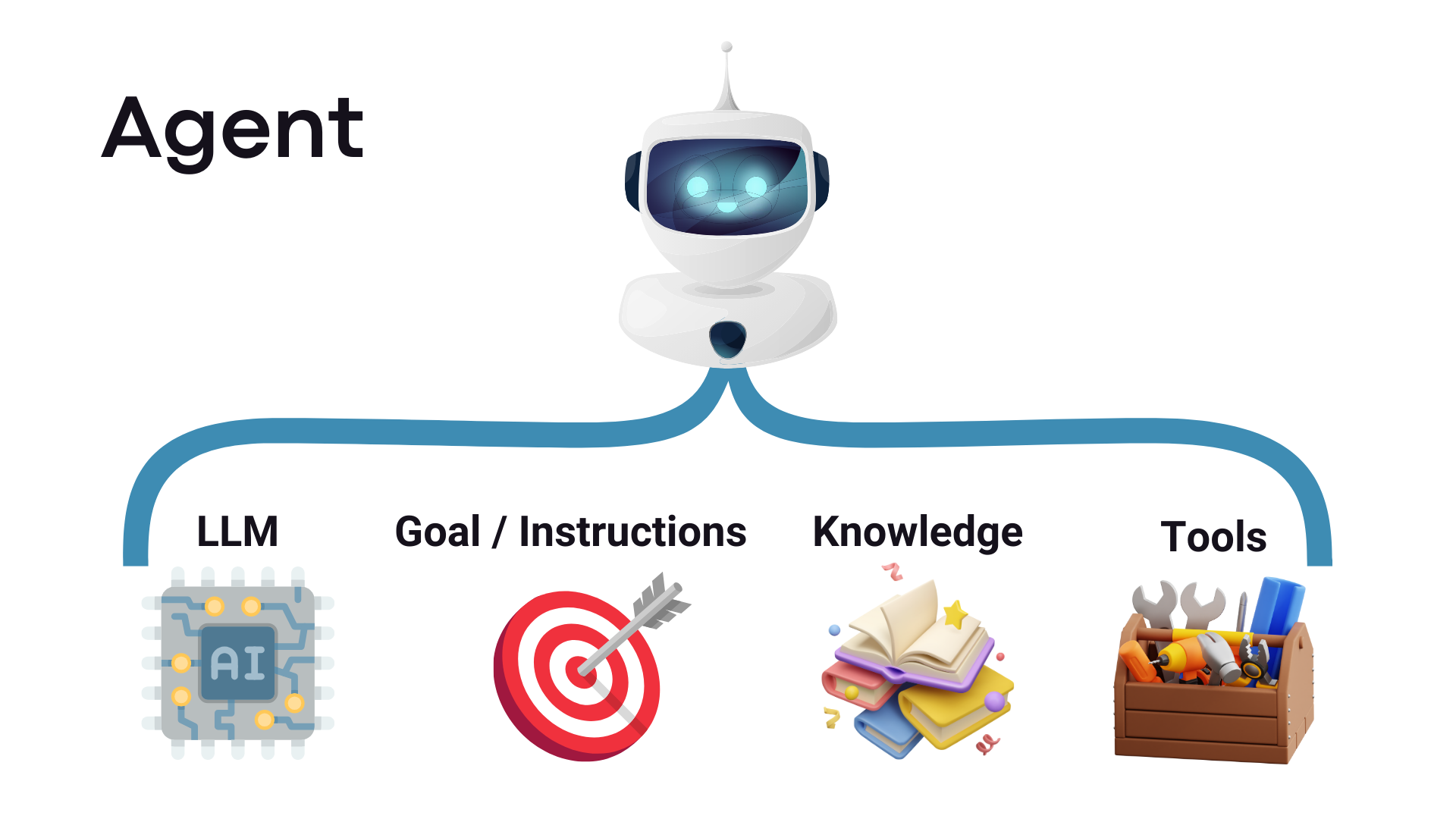
---
### Callout: Key Term – Autonomous
> When we say an AI tool is autonomous, we mean it can act on its own without constant human input. In law, this autonomy can be helpful for routine tasks but also risky if the AI makes flawed decisions. Always assess the appropriate level of human supervision.
---
## Practical Considerations Before Choosing an AI Tool
Picking the right AI tool for your legal work isn’t just about which has the best performance metrics or the coolest features. You also need to account for the **real-world practicalities** of practicing law.
### 1\. Usability
- **Non-Technical Staff**: In many law offices, paralegals, legal secretaries, or attorneys themselves may not have advanced technical skills. A tool with a steep learning curve might go unused.
- **User Interface**: Is it intuitive and easy to navigate? Does it require complex prompts or is it straightforward?
### 2\. Integration
- **Practice Management Systems**: If your firm uses Clio, MyCase, or another platform, can this AI tool integrate seamlessly to avoid duplicating efforts?
- **Research Platforms**: Tools like Westlaw or Lexis may already have AI features. Will adopting a separate tool create redundancy or synergy?
### 3\. Cost-Effectiveness
- **Budget Constraints**: Not every firm can pay high subscription fees for advanced AI features.
- **Value Proposition**: Is the tool going to save you enough time or reduce errors enough to justify its cost?
### 4\. Security and Privacy
- **Client Confidentiality**: Lawyers must safeguard sensitive client data. Some AI tools log user queries or store data on servers you don’t control.
- **Legal Compliance**: Consider data protection laws, such as GDPR or HIPAA, and attorney-client privilege requirements.
---
### Practice Pointer
> Before integrating a new AI tool, draft a concise checklist of must-have features and constraints. Include factors like data security, ease of learning, and cost. Having a clear list ensures you choose a tool that aligns with your firm’s unique needs.
---
## Popular Generative AI Tools
With the fundamentals in mind, predictive vs. reasoning, copilots vs. agents, proprietary vs. open-source, let’s now explore some specific generative AI tools making waves in the legal industry. Each tool has its strengths, weaknesses, and ideal use cases.
### Benefits of AI Tools for Lawyers
Regardless of the tool you choose, here are some broad benefits you can expect from generative AI:
- **Increased Productivity**: Automated document review, legal research, and initial drafting free you to focus on higher-value work.
- **Improved Accuracy**: Consistency in language and formatting, and fewer “oops” moments where an outdated clause sneaks into a contract.
- **Enhanced Client Communication**: Summaries in plain language can help clients understand their cases better, and swift drafting improves responsiveness.
- **Cost Savings**: Reduced hours on repetitive tasks can drive down operational costs for both you and the client.
- **Better Access to Information**: Quick parsing of vast databases or case law can uncover critical insights faster than manual research.
---
### ChatGPT 4o (and o1)
**ChatGPT 4o**, developed by OpenAI, is a **multimodal AI model** capable of handling text, audio, and visual inputs. Its speed is a standout feature: it can respond in near-real time, facilitating natural back-and-forth conversations.
#### Key Features
1. **Multimodal Input and Output**
- Process and respond to text, audio, and images.
- Potential to transform client interaction by allowing multiple input types (e.g., voice commands).
2. **Fast Response Time**
- Responds to audio inputs in as little as a few hundred milliseconds, close to human conversational speed.
3. **Vision Mode**
- Interprets visual content, which can be applied to analyzing images, diagrams, or even videos.
4. **Reasoning Capability with o1**
- o1 can “think before speaking,” adding a layer of deeper analysis for complex tasks.
5. **Advanced Data Analysis**
- Handles spreadsheets, helping lawyers track case details or financial records more efficiently.
6. **Text Analysis**
- Can review legal documents, check grammar, extract key information, and even translate content.
7. **File Compatibility**
- Supports multiple file types (PDF, .docx, .txt, .rtf, .xlsx) commonly used in legal practice.
#### Additional OpenAI Features
- **Advanced Voice**: Real-time, spoken-language interaction.
- **Tasks**: Schedule future actions or recurring updates, like daily docket reminders.
- **GPTs**: Create custom versions of ChatGPT for specialized tasks (e.g., a custom GPT for trademark law).
- **Canvas**: A collaborative editing space adjacent to the chat window for real-time drafting and editing.
- **Projects**: Organize and manage multiple files, chats, and custom instructions in a single workspace.
- **Search**: Access and retrieve real-time information from the internet, with source citations for transparency.
#### Pricing
- **ChatGPT Plus**: $20 per month for priority access, faster response times, and new features.
- **ChatGPT Pro**: $200 per month, offering expanded usage and rate limits.
#### Technical Aspects
- **2x Faster** processing than GPT-4 Turbo.
- **5x Higher** rate limits compared to GPT-4 Turbo.
#### Pros and Cons of Implementation
| Pros | Cons |
| :---- | :---- |
| **Increased Efficiency**: Automates tasks like document review. | **Potential for Bias**: AI models can mirror biases in training. |
| **Improved Accuracy**: Reduces errors in contracts and memos. | **Dependence on Technology**: Over-reliance can impede skill growth. |
| **Enhanced Client Communication**: Summaries in plain language. | **Data Security**: Sharing sensitive info may raise confidentiality issues. |
| **Accessibility**: Text-to-speech can help users with disabilities. | **Limited Creativity**: AI lacks the strategic nuance of human insight. |
| **Cost-Effectiveness**: Long-term savings by freeing attorney hours. | **Need for Human Oversight**: AI-generated work still requires review. |
---
### Anthropic Sonnet 3.5 (Claude)
**Anthropic Sonnet 3.5**, often referred to simply as **Claude**, aims to be helpful, harmless, and honest. As an **ethical AI** system, Claude incorporates an approach called **Constitutional AI** to align the model with human values.
#### Key Features
1. **Constitutional AI**
- A technique to reduce harmful or biased outputs by aligning the model’s decisions with a set of agreed-upon principles.
2. **Strong Reasoning and Comprehension**
- Useful for analyzing legal documents, writing research memos, and summarizing nuanced information.
3. **Natural Language Processing**
- Helps produce clearer, more concise text, benefiting legal drafting and client communications.
4. **Context Window** (200,000 tokens)
- Can handle lengthy documents without losing track, making it suitable for e-discovery or large contract reviews.
#### Unique Anthropic Features
- **Computer Control**: Claude can operate a computer autonomously, such as opening applications, browsing websites, and entering text.
- **Artifacts**: Creates dynamic outputs like code previews, animations, and interactive visualizations in a separate panel.
- **Projects**: Manage multiple chats under one umbrella with shared background info, making it ideal for complex, multi-document projects.
#### Pricing
- **Claude Pro**: $20 per month.
#### Technical Aspects
- **Context Window**: 200,000 tokens, which is larger than many other models.
- **Parameters**: Not publicly disclosed.
#### Pros and Cons of Implementation
| Pros | Cons |
| :---- | :---- |
| **Ethical AI**: Reduces biased or harmful outputs. | **Limited Transparency**: Exact model details are undisclosed. |
| **Strong Reasoning and Comprehension** | **Cost**: Still requires paid plans for extended features. |
| **Natural Language Processing** | **Potential for Over-Reliance**: Always verify AI outputs. |
| **Large Context Window** | |
---
### Google Gemini
**Google Gemini** is a multimodal AI model developed by Google AI. Like GPT-4o, it can process and generate text, images, audio, and even code.
#### Key Features
1. **Multimodal Capabilities**
- Can handle various information types, useful for analyzing scanned PDFs, images from case evidence, or audio interviews.
2. **Long Context Window**
- Gemini 1.5 Pro can handle up to 2 million tokens in one go, making it ideal for large-scale e-discovery.
3. **Advanced Reasoning**
- Built to excel at complex analysis and problem-solving tasks.
4. **Integration with Google Services**
- Syncs with Google Search, Google Docs, and other G-Suite tools, streamlining collaboration and research.
#### Pricing
- **Google One AI Premium Plan**: $19.99 per month for Gemini Advanced.
#### Technical Aspects
- **Context Window**: Up to 2 million tokens for Gemini 1.5 Pro.
- **Number of Parameters**: Varies by model; smaller “Nano” versions exist for lighter tasks.
#### Pros and Cons of Implementation
| Pros | Cons |
| :---- | :---- |
| **Multimodal Capabilities**: Handles text, images, audio. | **Cost**: Premium plans may be prohibitive for some smaller firms. |
| **Long Context Window**: Suitable for massive document sets. | **Integration Challenges**: May need technical support to integrate fully. |
| **Advanced Reasoning**: Good for complex legal questions. | **Dependence on Google**: Not everyone prefers or trusts deep Google integration. |
---
### Google NotebookLM
**Google NotebookLM** is an AI-powered research and note-taking tool. By uploading PDFs, Google Docs, websites, or Google Slides, NotebookLM helps you synthesize and summarize complex information. It provides inline citations so you can verify exactly where the answers are coming from.
- **Automatic Summaries**: Quickly distills large documents into key bullet points.
- **Question Generation**: Helps create study guides or discussion prompts.
- **Audio Overviews**: Transforms text into podcast-like audio summaries.
For law students, NotebookLM can be a handy tool to break down long cases or research papers into more digestible chunks.
---
### Google Advanced with Deep Research
**Google’s Gemini Advanced with Deep Research** is designed to gather and synthesize information from the web autonomously. You input a research question, and it:
1. **Plans its approach** to researching that question.
2. **Conducts iterative searches**, refining results as it goes.
3. **Compiles a detailed report** with source citations.
This is helpful when performing preliminary research on emerging legal issues. It can produce a well-organized overview, which you can then refine for briefs or internal memos.
---
### Google Learn About
**Google Learn About** is an **experimental AI-driven platform** that provides deep, interactive learning on a wide range of topics. Built on the **LearnLM** model, it tailors responses to different learning levels and includes educational aids such as images, videos, and quizzes.
While not exclusively focused on law, it’s easy to imagine “Learn About Torts” or “Learn About Contract Drafting” modules that help new attorneys or clients grasp fundamental legal concepts in an engaging, interactive way.
---
### Perplexity
**Perplexity** functions more like an AI-powered **search engine** with conversational abilities. It’s useful for research-driven tasks where you want quick answers plus source citations.
#### Key Features
- **AI-Powered Search**: Finds and summarizes relevant web pages, academic papers, and news articles.
- **Source Attribution**: Clearly cites its information so you can verify accuracy.
- **Conversational Interface**: Allows back-and-forth queries, refining your search as you go.
Because of its emphasis on credible sources, Perplexity can help lawyers or law students gather references. However, it doesn’t specialize in drafting or analyzing legal text to the same extent as GPT-4o or Claude.
#### Benefits for Lawyers
- **Efficient Legal Research**: Quick scanning of case law, statutes, and articles.
- **Diverse Sources**: Aggregates from multiple platforms and databases.
- **Credibility Checks**: Easily verify the reliability of each source.
#### Pricing
- Free tier with basic features.
- **Perplexity Pro**: $20 per month for faster responses and larger context windows.
---
## Generative AI Tools: A Comparative Analysis
Below is a side-by-side comparison of some of the tools we’ve discussed. While these details might change as the tools evolve, this table offers a snapshot of their unique strengths.
| Feature | ChatGPT 4o | o1 | Anthropic Claude 3.5 | Google Gemini | Perplexity |
| :---- | :---- | :---- | :---- | :---- | :---- |
| **Input Modalities** | Text, audio, visual | Text, visual | Text | Text, images, audio, code | Text |
| **Context Window** | 128,000 tokens | 128,000 tokens | 200,000 tokens | Up to 2 million tokens | Up to 32,000 (Pro) |
| **Number of Parameters** | 1.76 trillion | Not publicly disclosed | Not publicly disclosed | Varies (Nano to Pro models) | Not publicly disclosed |
| **Key Strengths** | Multimodal, fast | Deep reasoning, complex problem-solving | Ethical AI, strong reasoning | Multimodal, large context | Efficient search, citations |
| **Pricing** | $20/mo (Plus) / $200/mo (Pro) | Included with ChatGPT subscription | $20/mo | \~$19.99/mo \+ varied plans | Free or $20/mo (Pro) |
---
### Example Scenario
> **Situation**: A mid-sized law firm wants to adopt an AI tool to assist with e-discovery. They handle large litigation cases requiring review of millions of documents.
- **Gemini** with its 2 million token context window might be the most appealing for reviewing that huge volume of text.
- **Claude** is also attractive due to its extensive context window and ethical alignment.
- **ChatGPT 4o** could help draft quick summaries of findings in a more user-friendly way.
> Ultimately, the firm might combine the strengths of multiple models, using Gemini or Claude for the heavy-lifting e-discovery and ChatGPT for drafting short client summaries.
---
## Opportunities for Law Students
For law students, mastering at least a **working knowledge** of these tools is not optional, it’s increasingly **expected**. Clients today want efficient, cost-effective, and accurate legal services. When you can say, “I know how to use generative AI ethically and effectively,” you stand out in job interviews and on the job.
- **Internships**: Impress your supervising attorney by recommending an AI tool for a research project, or by quickly generating a well-polished first draft of an agreement.
- **Career Growth**: Law firms are actively seeking associates who can navigate new technologies. Demonstrating proficiency can open doors for leadership on tech-related projects.
- **Practice Innovation**: As you advance in your career, you can spearhead technology initiatives at your firm or legal department, improving efficiency and potentially generating new revenue streams.
---
### Callout: Key Term – Legal Tech Literacy
> “Legal tech literacy” is becoming as fundamental as knowing how to format a brief or file a motion. It’s about understanding what tools exist, how they can help, and knowing enough to ask the right questions, even if you’re not a programmer.
---
## Chapter Recap
We covered a lot in this chapter:
1. **Proprietary vs. Open-Source LLMs**
- Proprietary models offer convenience and user support, but come with closed systems and potential vendor lock-in.
- Open-source models offer flexibility and transparency, but can be more challenging to maintain.
2. **Predictive vs. Reasoning Models**
- Predictive models (like GPT-4o) generate quick, versatile responses across multiple media types.
- Reasoning models (like o1 and o3) engage in a deeper “chain-of-thought,” excelling in complex problem-solving.
3. **Copilots vs. Agents**
- Copilots assist humans with tasks but require oversight, ideal for drafting, summarizing, and editing.
- Agents can handle tasks autonomously, which can be powerful but also raises ethical and accountability concerns.
4. **Practical Considerations**
- Usability, integration, cost, security, and privacy are crucial when selecting an AI tool.
5. **Popular Generative AI Tools**
- **ChatGPT 4o (and o1)**: Multimodal, fast, with specialized reasoning capabilities in o1.
- **Anthropic Sonnet 3.5 (Claude)**: Ethical focus, large context window, strong reasoning.
- **Google Gemini**: Multimodal with an extremely large context window, integrated into the Google ecosystem.
- **NotebookLM, Advanced with Deep Research, Learn About**: Google’s suite of AI research and note-taking tools.
- **Perplexity**: Search-centric model with conversational and citation features.
You’re now equipped to weigh the pros and cons of each major AI player in the legal space and have a framework for deciding whether you need a predictive or reasoning model, a copilot or an agent, and a proprietary or open-source solution.
---
## Final Thoughts
Chapter 3 explored how generative AI models, both predictive and reasoning, are reshaping legal workflows. We looked at proprietary tools that offer ready-to-use solutions and open-source models that provide deeper customization. We also examined the difference between AI copilots, which enhance your work under human oversight, and more autonomous AI agents, which can tackle tasks with minimal input but present greater ethical and accountability concerns.
As you move forward, consider the following:
- **No Model Is Infallible**: Even advanced systems like GPT-4o or o3 can produce errors or biased outputs. Human review remains critical in legal contexts.
- **Quality Data, Quality Results**: The datasets used to train or fine-tune a model directly impact its accuracy and relevance, especially for specialized legal tasks.
- **Model Size Isn’t Everything**: A bigger model may handle more data, but it doesn’t always translate to better performance on nuanced legal questions.
- **Ethics and Oversight**: Transparency in how an AI system arrives at its results is essential, and ethical considerations, such as client confidentiality, must guide every adoption decision.
Generative AI offers the promise of faster drafting, more comprehensive research, and innovative client communications. Yet, caution is warranted: reliance on these systems without proper checks can jeopardize client trust and professional standards. By maintaining a balanced perspective, embracing AI’s efficiencies while upholding legal ethics, you can harness these tools to elevate your practice in a responsible way.
---
## What’s Next?
In **Chapter 4**, we’ll look at **legal-specific AI tools** such as **CoCounsel, Spellbook, AI.law, and Alexi**. These tools directly integrate into law office tasks, like drafting briefs, analyzing contracts for risk, or synthesizing case law, often providing ready-made solutions fine-tuned for the legal profession. We’ll dive deeper into their specific features, how they integrate with existing workflows, and relevant ethical considerations. Stay tuned to learn how these specialized tools can streamline your day-to-day legal practice and transform how you approach client service.
# Chapter 4: Legal AI Tools and Use Cases
## Chapter Overview
In Chapter 3, we focused on the real-world landscape of generative AI in legal practice. We examined how to compare proprietary and open-source large language models (LLMs), the distinctions between predictive AI and reasoning AI, and how various popular tools, such as GPT-4, Google Gemini, and others, could fit into a law firm’s everyday workflow. By the end of that chapter, you understood why certain AI platforms are better suited for particular tasks, as well as how “copilot” models differ from “agent” models in the level of autonomy they bring to legal work.
In this chapter, we turn our attention to the legal-specific AI tools that can fundamentally reshape how lawyers and law firms approach tasks like contract review, document management, litigation strategy, and more. We will explore:
- **What makes these specialized tools unique**, including how they address confidentiality concerns and align with ethical obligations.
- **Key criteria for evaluating AI solutions**, such as domain-specific accuracy, data security, and vendor reliability.
- **Essential use cases**, ranging from contract analysis to eDiscovery, to illustrate exactly where legal AI can offer the greatest benefits.
- **Real-world examples** of products designed with lawyers in mind, such as CoCounsel, Spellbook, AI.Law, and Alexi.
- **AI as a thinking partner**, using advanced software to brainstorm arguments, spot case weaknesses, and even visualize complex legal scenarios.
- **Ethical and practical considerations**, ensuring that the adoption of AI is both effective and responsible in a professional setting.
By the end of this chapter, you will gain deeper insight into (1) how to evaluate specialized legal AI platforms, (2) appreciate the wide array of applications they support, and (3) understand how to integrate them responsibly into your future legal practice. We will later build on these insights, looking at hands-on examples, case studies, and advanced topics that will help you bring AI into legal practice in a safe, effective, and forward-thinking manner.
---
## Why Specialized Legal AI Tools Matter
To understand why specialized AI tools are so valuable, let’s start with a quick analogy: a **general-purpose AI** is like a universal remote control, it can do a little bit of everything (change channels, raise the volume, adjust settings), but it might not do any one thing with perfect precision for your specific TV model. A **legal-specific AI**, on the other hand, is more like a remote custom-built for a particular entertainment system. It’s designed around the unique “channels,” “inputs,” and “language” that only that system speaks.
In everyday terms:
1. **Legal language is specialized**. Words like “tort,” “consideration,” or “res judicata” aren’t common in everyday chat. A system trained on broad internet text might not accurately capture the nuances of these or might mix up similar-sounding concepts.
2. **Confidentiality is crucial**. Lawyers handle sensitive client data, trade secrets, personal information, strategic insights, that must be closely guarded. Specialized AI platforms often have robust **data protection** measures, encryption, and clarity on how they store or use your data.
3. **Ethical rules demand higher accountability**. Lawyers must uphold rules on competency, confidentiality, and avoiding unauthorized practice of law. A specialized AI vendor that focuses on legal practice typically builds in features or disclaimers tailored to these professional obligations, such as advanced **access controls** or disclaimers that remind you of your supervisory role.
4. **Better integration with law firm workflows**. Law firms often rely on *document management systems*, *client relationship management (CRM)* tools, *billing software*, and more. Legal-specific AI solutions can plug into these platforms, making it easier to do tasks like bulk contract review or eDiscovery without constantly switching systems.
**Callout: Key Term – “Legal Domain Expertise”**
**Definition**: When we say an AI has *legal domain expertise*, we mean it’s been trained or fine-tuned on texts that come from legal sources (case law, statutes, regulatory documents, contracts). This specialized training helps the AI recognize legal language and concepts more accurately than a general system.
---
## Criteria for Evaluating Legal AI Tools
Before we dive into specific use cases, it’s important to have a roadmap for **evaluating any AI tool** you might consider adopting in your practice. Think of these as the “must-haves” or the “checklist” items you’ll want to confirm before bringing a new technology into your firm or organization.
### 1\. Data Security and Confidentiality
**What it is:**
Legal work often involves handling confidential or privileged information. If you upload your clients’ documents to an AI system, you must be absolutely certain it will remain secure and private.
**Key questions to ask:**
- How does the vendor store data?
- Is it SOC2 compliant? (SOC 2 is a security compliance standard to protect sensitive data from unauthorized access, security incidents, and other vulnerabilities.)
- Does the platform encrypt data “in transit” (while uploading/downloading) and “at rest” (while stored on their servers)?
- Does it comply with common privacy laws (like GDPR in Europe or CCPA in California)?
- Do you retain ownership of your data, and does the vendor have the right to use it for training?
### 2\. Domain-Specific Accuracy
**What it is:**
Some AI tools are trained on general web content, everything from social media posts to product reviews. That’s not necessarily helpful for identifying a specific legal clause in a contract. Tools fine-tuned on **legal-specific** datasets will generally perform better in analyzing or generating legal text.
**Key questions to ask:**
- Was the AI model trained (or fine-tuned) using legal texts such as statutes, case law, or publicly available legal documents?
- Does the vendor have examples or case studies demonstrating the tool’s performance in real legal scenarios?
### 3\. Ethical and Regulatory Compliance
**What it is:**
As an attorney, you have ethical duties that can’t be delegated. If the AI tool claims to “replace” lawyers entirely or give direct legal advice to clients, that can raise alarms about unauthorized practice of law.
**Key questions to ask:**
- Does the tool make disclaimers indicating it provides “information,” not “legal advice?”
- Does it have features that allow for **attorney supervision** or keep a “human in the loop” to review outputs?
- Are there references or certifications from bar associations or recognized legal tech organizations?
### 4\. Explainability and Customization
**What it is:**
Not all AI tools are “open books.” Some provide only the final answer, with no way of understanding how they arrived at that conclusion. Legal contexts often demand a deeper look, why was a particular clause flagged as risky?
**Key questions to ask:**
- Can you see which parts of the text triggered certain labels or suggestions?
- Does the vendor share its technical pipeline stack and prompts?
- Can you train or customize the system to match your firm’s style, clause libraries, or preferences?
### 5\. Cost, Scalability, and Vendor Reliability
**What it is:**
Even the best AI tool can become a burden if it’s too expensive, complicated to install, or provided by a vendor that might vanish in six months.
**Key questions to ask:**
- What’s the pricing model (monthly subscription, per-document, per-user)?
- Does the vendor have a stable track record or a solid financial backing?
- Will it integrate easily with your document management system?
**Practice Pointer: Start with a Pilot**
Before rolling a new AI tool out to your entire firm, test it on a small project, like reviewing a batch of contracts or summarizing a single deposition transcript. Track how much time you save, how accurate the results are, and how smoothly it fits into your team’s routine. This pilot phase can help you evaluate whether to invest more time and money.
---
## Why Use Legal AI Tools Instead of General-Purpose Platforms?
### The Limits of Generic Models
Popular AI chatbots like ChatGPT or Claude are useful for drafting quick memos or brainstorming. However, they may fall short when handling privileged information or requiring nuanced legal expertise. Issues include:
- **Data Privacy**: Publicly available services often store user inputs on external servers, creating risks around confidentiality.
- **Lack of Legal-Specific Nuance**: Generic models may misinterpret legal terms or “hallucinate” case citations.
- **Limited Support and Accountability**: General-purpose AI vendors rarely tailor features, disclaim liability, and offer minimal legal-specific risk management.
### Example Scenario
If you need to draft a highly specialized contract (e.g., a biotech non-disclosure agreement), a general-purpose chatbot might not address local regulations or unique confidentiality terms. A specialized legal AI tool can provide industry-specific templates and automatically highlight risky indemnity clauses, ensuring a more accurate starting point.
---
## Other Concerns Shaping the Use of Legal AI
1. **Ethical Responsibilities**
Under rules of professional conduct, lawyers must protect client confidentiality and remain competent in technology. You cannot delegate your ethical obligations to an AI; ultimate responsibility lies with you.
2. **Client Communication and Trust**
Clients may worry that AI might compromise their data or replace personalized legal service. Clear communication can address these concerns, explain how AI speeds up routine tasks so you can focus on strategic, client-centered advocacy.
3. **Workflow Integration**
AI tools must integrate with document management, eDiscovery platforms, or billing systems to achieve real efficiency gains.
4. **Bias and Fairness**
AI systems trained on historical data may perpetuate past biases. Lawyers using AI in areas like bail or sentencing recommendations must remain vigilant about whether the data or the model could yield unfair results.
**Practice Pointer**
Pilot new AI tools with a small group or on a limited set of cases. Track the time saved and how easily the tool integrates into existing workflows, then refine and expand gradually.
---
## Core Use Cases for Legal AI
Below are some of the most common ways lawyers use AI, with concrete examples of how generative AI applies and what impact these tools can have on legal practice. For each use case, we highlight one or more legal AI products: CoCounsel, Spellbook, AI.Law, and Alexi (to show how specialized platforms differ from general-purpose AI).
### Use Case 1: Contract Review and Drafting
#### Description of the Use Case
Law firms and legal departments handle large volumes of contracts, mergers and acquisitions, real estate leases, vendor agreements, etc. **Contract review** involves verifying that key clauses match client requirements (e.g., termination rights, indemnities, warranties). **Drafting** involves composing new contracts or revising existing ones.
#### Example Scenario
A mid-size firm faces a tight deadline to review 200 vendor contracts for an upcoming acquisition. Instead of manually checking each document for governing law, dispute resolution clauses, and payment terms, an AI tool can rapidly scan all contracts, spot unusual or missing clauses, and generate a summarized report.
#### How Generative AI Is Applied
Generative AI can:
- **Identify & Extract Key Clauses**: Tag sections about liability, confidentiality, or indemnification.
- **Suggest Revisions**: Propose edits to align with the firm’s preferred language.
- **Draft New Contracts**: Start from a template but tailor it to specific jurisdictional or client needs.
#### Impact on Lawyers
- **Time Savings**: Lawyers focus on high-level strategy rather than searching for boilerplate text.
- **Reduced Errors**: Automated clause detection can catch omissions or inconsistent language.
- **Higher-Value Work**: Freed from repetitive tasks, attorneys can spend more time negotiating favorable terms or advising clients on strategic risks.
---
#### Featured Tool: Spellbook (for Contract Drafting & Review)
Spellbook is an AI-powered contract drafting and review tool designed for corporate, commercial, and in-house legal teams. It integrates with Microsoft Word, allowing lawyers to **draft, redline, and analyze** contracts within a familiar interface.
- **Key Features**: AI-powered drafting and redlining, customizable clause libraries, built-in Word integration.
- **Application**: Draft NDAs, commercial leases, or letters and memos. Spellbook uses large language models to suggest alternative clauses, highlight inconsistencies, and speed up the revision process.
- **Lawyer Impact**: Reduces manual review time, improves consistency, and can help junior associates learn standard clause variations by seeing AI suggestions in real time.
---
### Use Case 2: Document Review (Litigation and Beyond)
#### Description of the Use Case
Document review is a staple of legal practice, whether during litigation (discovery), corporate due diligence, or regulatory compliance checks. Lawyers must sift through large volumes of data, searching for relevant facts or red flags.
#### Example Scenario
During due diligence for a corporate merger, thousands of documents (emails, PDFs, spreadsheets) need review. The legal team is looking for references to specific liabilities, regulatory compliance issues, or ongoing litigation.
#### How Generative AI Is Applied
- **Smart Categorization**: The AI can cluster documents by topic or flag them as relevant vs. non-relevant.
- **Summarization**: It can generate short summaries of lengthy reports or email chains.
- **Highlighting Risks**: Based on patterns in your existing library, the AI flags unusual language or potential triggers (e.g., change-of-control clauses).
#### Impact on Lawyers
- **Efficiency**: Dramatically speeds up large-scale document review.
- **Risk Mitigation**: Reduces the chance of missing a critical document amid thousands.
- **Better Resource Allocation**: Senior lawyers can focus on analyzing exceptions rather than reading every word of every lease.
---
#### Featured Tool: CoCounsel (for Document Review and More)
CoCounsel, developed by Casetext (now part of Thomson Reuters), launched as an AI-powered legal assistant leveraging GPT-4. It automates critical legal tasks with speed and accuracy, including:
- **Document Review**: Quickly identifies important information in large document sets.
- **Database Search**: Upload your own document database; CoCounsel finds relevant entries in seconds.
- **Document Summarization**: Condenses complex legal documents into concise overviews.
- **Lawyer Impact**: Reduces manual review time, enhances accuracy, and frees you to concentrate on strategic issues rather than repetitive data searches.
---
### Use Case 3: Legal Research and Memo Creation
#### Description of the Use Case
Finding relevant case law, statutes, and regulations can be time-intensive. Lawyers also spend significant time drafting memos summarizing their findings and applying the law to specific client facts.
#### Example Scenario
An associate at a small firm needs to research emerging tort claims in environmental law. She might typically spend hours on traditional databases, reading through dozens of cases. AI-driven research can accelerate this process and even help draft a memo.
#### How Generative AI Is Applied
- **Natural Language Search**: Enter queries in plain English. The AI “understands” the question and finds pertinent authorities.
- **Automated Summaries**: Once relevant cases are identified, the AI summarizes the holdings.
- **Memo Drafting**: Some tools draft an initial memo outlining the main arguments, relevant statutes, and case precedents.
#### Impact on Lawyers
- **Faster Turnaround**: Immediate, targeted results rather than sifting through numerous search hits.
- **Improved Analysis**: AI might surface related concepts or lines of argument that might otherwise be overlooked.
- **Consistency**: Integrates case summaries directly into a coherent memo, reducing repetitive drafting.
---
#### Featured Tool: Alexi (for Research & Memos)
Alexi is an AI-powered platform that assists with **legal research and memo creation**. It’s trained on over a million questions and answers across various litigation areas (personal injury, family law, estate, etc.).
- **Key Features**: Automated memo drafting, broad case coverage, plain-language query capabilities.
- **Application**: Streamlines the traditional research process by producing concise legal memos that reference relevant authorities.
- **Lawyer Impact**: Saves significant time, especially for solo practitioners or smaller firms. Lawyers can focus on strategy rather than spending hours pulling case citations.
---
### Use Case 4: Litigation Document Drafting and Analysis
#### Description of the Use Case
Beyond contracts and research, attorneys often draft complaints, answers, discovery requests, and motions. They must also analyze deposition transcripts, medical records, and other evidence.
#### Example Scenario
In a personal injury case, an attorney needs to draft a complaint, prepare interrogatories, and review hundreds of pages of medical records. Generative AI can assist by drafting initial templates and summarizing extensive evidence.
#### How Generative AI Is Applied
- **Drafting Lawsuits & Responses**: AI can suggest standard language, relevant claims, and defenses.
- **Summarizing Transcripts**: Automatically generate bullet-point summaries of depositions or create medical timelines.
- **Discovery Responses**: Propose answers to common interrogatories, which the attorney can tailor to the client’s specifics.
#### Impact on Lawyers
- **Accelerated Drafting**: Speed up the creation of initial pleadings.
- **Enhanced Organization**: Summaries and timelines help lawyers keep track of complex facts.
- **Reduced Clerical Work**: Paralegals and associates can allocate their efforts to deeper analysis and client communication.
---
#### Featured Tool: AI.Law (for Document Drafting & Analysis)
AI.Law is an advanced platform that covers **lawsuit drafting**, **answers**, **discovery responses**, and more. It also offers tools like transcript summarizers and medical timelines.
- **Key Features**:
- Document Analyzer: “Chat” with uploaded documents to extract key information.
- Complaint Drafter: Draft a complaint, answer and complaint.
- Deposition Analyzer: Analyze and summarize a deposition transcript.
- Medical Timeline: Quickly identifies injuries, costs, and providers in personal injury cases.
- AI Chatbot: Provides answers to various legal queries.
- **Lawyer Impact**: Automates repetitive litigation tasks, reducing overhead and potentially saving thousands of dollars in billable hours for clients.
---
### Use Case 5: eDiscovery
#### Description of the Use Case
In litigation, **eDiscovery** requires reviewing mountains of electronic data (emails, text messages, spreadsheets) to find relevant or privileged materials.
#### Example Scenario
A multinational corporation faces a class action lawsuit. Millions of emails are stored across different servers. The firm must identify relevant communications, privileged materials, and potentially harmful documents.
#### How Generative AI Is Applied
- **Predictive Coding**: Attorneys label a sample of documents as relevant or not. The AI applies those labels to the rest, speeding up classification.
- **Intelligent Search**: AI can pinpoint keywords, even if synonyms or related concepts are used.
- **Automated Redactions**: Identifies personally identifiable information (e.g., Social Security numbers) and redacts them.
#### Impact on Lawyers
- **Efficiency**: Dramatically reduces the burden of manual review.
- **Cost Savings**: Fewer contract attorneys or paralegals needed for large-scale review.
- **Accuracy**: Minimizes the risk of missing critical documents or inadvertently disclosing privileged information.
**Callout: Key Term – “Natural Language Processing (NLP)”**
**Definition**: NLP is a branch of AI that helps computers understand and interpret human language. When you type a question into a legal research tool and it “gets” what you mean, that’s NLP in action.
---
### Use Case 6: Litigation Strategy and Analytics
#### Description of the Use Case
Some AI platforms predict likely outcomes based on past rulings, judge tendencies, or opposing counsel’s litigation history, helping lawyers refine their strategies.
#### Example Scenario
A firm handling patent litigation wants to gauge how a particular judge interprets the doctrine of equivalents. AI tools analyze that judge’s past rulings and compile a statistical breakdown of common outcomes.
#### How Generative AI Is Applied
- **Predicting Case Outcomes**: Models trained on historical data attempt to forecast success rates for motions or entire cases.
- **Analyzing Opponents**: Tools can provide insights into an opposing counsel’s history: how they negotiate, what arguments they typically raise, etc.
- **Insights for Settlement**: Suggests the likelihood of settlement or potential timeframes.
#### Impact on Lawyers
- **Data-Driven Decisions**: Move beyond gut instinct or anecdotal evidence.
- **Enhanced Negotiations**: With insights into the opponent’s history, lawyers can adopt more effective strategies.
- **Limits**: AI predictions are only as good as the underlying data; unexpected factors can still change a case’s trajectory.
---
### Use Case 7: Knowledge Management
#### Description of the Use Case
Law firms produce enormous amounts of precedent materials (briefs, memos, forms). AI-driven knowledge management helps categorize and retrieve these documents, so lawyers can reuse existing work product effectively.
#### Example Scenario
A large firm needs to unify its internal documents. Attorneys working on environmental cases want immediate access to prior filings that successfully argued novel points in clean-water litigation.
#### How Generative AI Is Applied
- **Smart Tagging**: Automatically classifies documents by practice area, jurisdiction, or outcome.
- **Search and Summarization**: Lawyers can search with natural language queries. The AI surfaces the most relevant internal documents and summarizes their content.
- **Answer Synthesis**: Lawyers can ask questions of their documents at scale and have the system answer their questions by synthesizing answers from the data.
- **Template Libraries**: The system pulls standard clauses or forms from the firm’s best work product.
#### Impact on Lawyers
- **Consistency**: Lawyers can rely on proven language and legal strategies.
- **Time Savings**: No need to reinvent the wheel for each new matter.
- **Better Training**: Allows quick **onboarding** for new associates.
**Practice Pointer: Validate AI Outputs**
No matter how advanced the tool, always double-check the results. Make sure the cases cited are real and still good law. Remember, you, not the AI, are responsible for ensuring accuracy.
---
## AI for Strategic Thinking and Brainstorming
Beyond these “traditional” tasks, many lawyers overlook how AI can help with **creative or strategic** aspects of legal practice. Think of AI as a “thinking partner” that can:
1. **Generate Ideas**: For instance, it can brainstorm potential defenses or claims you might not have considered.
2. **Stress-Test Arguments**: Ask the AI to argue the opposite side of your motion. It might highlight weaknesses or angles you hadn’t spotted.
3. **Visualize Complex Situations**: Some advanced AI tools can produce diagrams or mind maps of case components, parties, claims, defenses, and key documents.
**AI as a “Second Mind”** Think of AI not just as a document generator, but as a **collaborative tool** that can spark insights you might miss. You remain the ultimate decision-maker who integrates legal expertise and judgment.
### Example Scenario: Strategy Session
You’re handling a complex commercial dispute involving multiple parties, each with different claims. You feed a simplified version of the fact pattern (scrubbed of confidential details) into an AI tool and ask for potential areas of liability or defenses. The AI outlines five potential strategies, including one based on an obscure line of case law. You then do your own research to verify and adapt the suggestions.
**Practice Pointer: Communicate with Clients**
Many clients might have concerns about how AI is being used in their cases. Be transparent, explain what the AI does (speeds up research, identifies relevant documents) and what it doesn’t do (replace your judgment as a lawyer).
---
## Putting It All Together
To illustrate how all these pieces connect, imagine a mid-size law firm handling a complex lawsuit with thousands of relevant documents. The firm has decided to use:
1. **CoCounsel** for document review: It quickly sorts through relevant or irrelevant material.
2. **Spellbook** for drafting any needed settlement agreements or addendums.
3. **Alexi** for legal research on niche points of law.
4. **AI.Law** to streamline deposition summaries and create a medical timeline if there are personal injury components.
In addition, the lawyers:
- Use a specialized knowledge management system powered by AI to find previous motions or briefs that might be applicable to the case.
- Employ AI for brainstorming potential strategies, though final decisions are made by the attorneys.
By combining these tools, they reduce the time spent on repetitive tasks by an estimated 40%. The attorneys then have more bandwidth to meet with clients, refine arguments, develop creative legal strategies, and generate new business.
**Result**: A more efficient practice that stays competitive and delivers value to clients.
---
## Chapter Recap
We covered a considerable amount of material in this chapter, shifting from the broader topic of generative AI to the **practicalities of legal AI**, how to evaluate tools, where they excel, and why they demand special considerations in a law practice. Here are the key takeaways:
**Why Specialized Legal AI Matters**
- Legal language is more complex and confidential than everyday text, so tailored AI solutions often perform better and offer stronger privacy protections.
- Tools designed specifically for lawyers tend to incorporate ethical safeguards and integrate easily with law firm workflows.
**Criteria for Evaluating Legal AI Tools**
- **Data Security and Confidentiality** are paramount for privileged documents.
- **Domain-Specific Training** ensures the AI understands legal terminology and context.
- **Ethical Compliance** remains the attorney’s responsibility; technology cannot supersede your duty of competence.
- **Explainability and Customization** are valuable for tailoring AI to your firm’s specific needs and risk appetite.
- **Cost, Scalability, and Vendor Reliability** matter, because even the best AI is useless if the vendor is unstable or the price is too high.
**Common Legal AI Use Cases**
- **Contract Review and Drafting**: Quickly flag key clauses, suggest edits, and reduce manual labor.
- **Document Review**: Categorize large sets of documents, highlight risks, and summarize findings.
- **Legal Research and Memo Creation**: Simplify case law research and produce initial memos.
- **Litigation Document Drafting**: Draft complaints, motions, and interrogatories more efficiently.
- **eDiscovery**: Tackle vast amounts of digital data through predictive coding and advanced search.
- **Litigation Strategy and Analytics**: Offer data-driven predictions on case outcomes.
- **Knowledge Management**: Organize a firm’s past work product for quick access to relevant templates and precedents.
**AI for Thinking, Strategizing, and Conceptualizing**
- Generative AI can serve as a “second mind,” assisting in conceiving and testing legal arguments.
- It can highlight hidden angles or red flags, but ultimate judgment remains with you as the attorney.
**Ethical and Practical Considerations**
- Lawyers must be mindful of bias, data handling, and the client’s comfort with AI.
- Supervision is essential: AI can misinterpret or hallucinate, so a human lawyer must always verify results.
**Your Mission**: As you proceed, think about how you can apply these insights. Are there specific tasks in your internship, clinic, or future practice that could benefit from AI? How will you reassure clients about confidentiality? How can you stay ahead of the curve while avoiding ethical pitfalls?
Keep these questions in mind, because the best lawyers of tomorrow will be those who understand both **the power and the limits** of AI.
---
## Final Thoughts
Legal AI tools, especially those focused on specialized tasks like contract review, document management, and litigation strategy, have the potential to fundamentally streamline the practice of law. By automating repetitive processes, they free attorneys to spend more time on high-value work: counseling clients, negotiating deals, and thinking strategically about cases. Yet, as we’ve seen, these advanced systems carry inherent limitations and responsibilities. They can misunderstand legal nuances, depend on the quality of their training data, and occasionally produce results that sound correct but aren’t.
Moving forward, keep these lessons in mind:
1. **Human Judgment Remains Paramount**
AI can handle a lot of the heavy lifting, but lawyers must still guide, verify, and interpret its outputs.
2. **Security and Confidentiality Are Non-Negotiable**
When privileged information is at stake, you must ensure robust data protections and vendor reliability.
3. **Ethical Vigilance Is Key**
From potential biases to unauthorized practice risks, attorneys must supervise AI’s role in client representation.
4. **Trust Must Be Earned**
Clients want to know how their data is used. Transparency about AI’s capabilities, and its limits, fosters confidence.
5. **Plan for Ongoing Refinement**
Implementing AI is not a one-time switch; it requires training, pilot programs, and continuous feedback to integrate seamlessly into your practice.
By thoughtfully embracing these tools, legal professionals can harness the best of both worlds: the speed and pattern-recognition of AI, coupled with the critical thinking and ethical guardianship that only human lawyers can provide.
---
## What’s Next?
In **Chapter 5**, we’ll consolidate everything you’ve learned in **Chapters 1–4** into a focused review session, designed to help you prepare for the upcoming exam. This recap will dive deeper into the concepts introduced, ranging from generative AI fundamentals to the ethical and practical considerations of using specialized legal AI tools. We’ll revisit key terms, major use cases, and potential pitfalls, giving you a comprehensive refresher before you put your knowledge to the test.
Get ready to connect all the dots, from basic AI terminology and functionality to real-world applications in law, so you can walk into the exam with confidence and a clear sense of how these technologies shape modern legal practice. I know you can do it\!
# Chapter 5: Bringing It All Together – A Review of Chapters 1-4
## Chapter Overview
This chapter serves as a thorough review of the key lessons and concepts we have covered in Chapters 1 through 4. Think of it as your one-stop refresher for everything from the historical context of AI to the cutting-edge tools shaping modern legal practice. By the end, you should have a cohesive understanding of how all these pieces fit together and how they guide your journey as both a law student and a future legal professional.
### Purpose of the Chapter
In the first four chapters, we have built a foundational understanding of:
- **What generative AI is** and **why it matters** to the legal field.
- **The evolution of AI**, from simple, rule-based systems to powerful large language models.
- **Technical underpinnings** like neural networks and transformers, presented at a level accessible to a general audience.
- **Practical applications** of AI in the legal industry, ranging from contract drafting to litigation support.
- **Ethical, regulatory, and real-world considerations** that come with adopting these tools in professional practice.
Now, it is time to **consolidate** this knowledge. Chapter 5 is designed to:
- Provide a **concise recap** of each previous chapter’s main ideas.
- Highlight the **themes and connections** weaving those ideas together.
- Pose **key questions** that encourage deeper reflection on the material.
- Prepare you to **apply these insights** in upcoming assessments, projects, and real-life legal scenarios.
### Why This Review Is Important
Reviewing is critical for **long-term retention** and **mastery** of any new subject, especially one as fast-moving and complex as **Generative AI**. By pausing to recap, you ensure that:
- You fully **grasp core concepts**, like how AI differs from traditional programming or how generative models shape the way lawyers work.
- You can **speak confidently** about the ethical and practical implications of adopting AI in a law practice.
- You identify **connections** between technology, law, and society that might not have been obvious when first reading each chapter in isolation.
- You’re better prepared for **exams**, **class discussions**, and **hands-on exercises** that require you to recall and apply these concepts.
Think of this chapter as a **mental map** connecting the big ideas and helping you see the forest through the trees. Let’s dive in by revisiting each of the first four chapters in turn.
---
## Summary of Key Concepts (by Chapter)
### Chapter 1: The Context of Generative AI
**Chapter 1** set the stage by exploring:
1. **Why Generative AI Matters in Law**
- Rapidly evolving AI technologies are reshaping industries, including legal services.
- Lawyers need to adapt or risk being left behind, as clients demand more efficient and cost-effective solutions.
- Generative AI can automate repetitive tasks, like document drafting, while freeing lawyers to focus on deeper analysis and advocacy.
2. **Traditional Programming vs. Modern AI**
- *Old-school approach*: “If-this-then-that” logic is rigid and often fails to handle real-world nuances.
- *Rise of AI*: Machine learning and deep learning introduced data-driven approaches that learn patterns from examples rather than relying on explicit coding for every scenario.
3. **Evolution of AI**
- *First Wave (1950s–1970s)*: Symbolic AI with handcrafted rules.
- *Second Wave (1980s–2000s)*: Expert systems and the revival of neural networks, but limited by hardware constraints.
- *Third Wave (2000s–Present)*: Deep learning breakthroughs, exponential data availability, and leaps in compute power.
4. **Generative AI Defined**
- Moves beyond simple classification to *creating new content* (text, images, audio, or even video).
- Examples include Generative Adversarial Networks (GANs) and Transformer-based models (e.g., GPT series).
5. **The ChatGPT Moment**
- OpenAI’s ChatGPT brought large language models into the mainstream, quickly amassing millions of users.
- It demonstrated how user-friendly interfaces can accelerate AI adoption across professions, including law.
6. **The Race to AGI**
- Organizations compete to build ever-more advanced AI, aiming at “Artificial General Intelligence.”
- Raises important policy, ethical, and geopolitical questions that lawyers will play a significant role in addressing.
7. **Implications for Legal Services**
- **Opportunities**: Enhanced efficiency, cost savings, improved client outcomes, and new service models.
- **Challenges**: Ethical oversight, potential biases, data privacy, job displacement, and the unknowns of rapidly evolving AI capabilities.
#### Foundational Concepts
- **Efficiency Gains**: AI speeds up labor-intensive tasks like document review.
- **Cost Reduction**: Clients save money, and firms can serve more clients.
- **Decision Support**: AI’s pattern recognition can aid in predicting case outcomes or summarizing large data sets.
- **Ethical and Regulatory Considerations**: As usage grows, so do questions about accountability, transparency, and fairness.
**Takeaway**: *Generative AI is more than a tech trend, it’s a transformative shift in how lawyers can deliver services, requiring both enthusiasm and caution.*
---
### Chapter 2: How Does Generative AI Work?
**Chapter 2** pulled back the curtain on the **technical foundations** of generative AI, aiming to make complex ideas accessible:
1. **Defining AI and Machine Learning**
- **AI**: Computer systems that can perform tasks typically requiring human intelligence (reasoning, pattern recognition, decision-making).
- **Machine Learning (ML)**: Subset of AI where models learn from data (rather than rigid instructions).
2. **Deep Learning and Neural Networks**
- **Neural Network**: Modeled after the human brain’s neurons, with “weights” that get fine-tuned during training.
- **Deep Learning**: Multiple-layer neural networks that can learn increasingly sophisticated patterns as data “flows” through layers.
3. **Large Language Models (LLMs)**
- “Large” refers to the **billion/trillion-scale** parameters that let these models capture subtle linguistic patterns.
- **Transformers**: A groundbreaking architecture enabling the model to pay “attention” to different parts of a sentence all at once.
- LLMs like GPT-4, GPT-4o, Claude, and others can generate remarkably coherent text, but they do not truly “understand” like humans.
4. **How They “Learn”**
- **Training**: The model sees vast amounts of text, predicting the next word and adjusting parameters to reduce errors (gradient descent).
- **Tokens**: Words or word fragments are turned into numerical representations (embeddings).
- **Attention Mechanism**: Helps the model understand relationships between tokens (e.g., pronouns and their antecedents).
5. **Hallucinations and Limitations**
- LLMs sometimes produce confidently stated but false or nonsensical results.
- They primarily excel at recognizing patterns, not genuine conceptual reasoning, although advanced models are pushing boundaries.
6. **Reinforcement Learning with Human Feedback (RLHF)**
- ChatGPT and others incorporate feedback from human evaluators, improving “helpfulness” and alignment with user expectations.
**Takeaway**: *Understanding the basics of how LLMs learn and generate text is crucial for lawyers who need to assess AI outputs critically, identifying potential inaccuracies or biases.*
---
### Chapter 3: Generative AI Models and Tools
**Chapter 3** focused on the **practical landscape**, real-world generative AI tools, their design philosophies, and their fit for legal tasks:
1. **Proprietary vs. Open-Source LLMs**
- **Proprietary** (e.g., ChatGPT, Claude): Easier to adopt, usually user-friendly, but less transparent and more vendor lock-in.
- **Open-Source** (e.g., LLaMA variants): Greater customization and flexibility, but requires technical expertise to implement and maintain.
2. **Predictive AI vs. Reasoning AI**
- **Predictive Models** (e.g., GPT-4o): Aim for fast, accurate content generation, often multimodal (text, audio, video).
- **Reasoning Models** (e.g., o1, o3): Incorporate “chain of thought” to tackle complex tasks methodically.
3. **Copilots vs. Agents**
- **Copilots**: AI as an assistant or “extension of you,” requiring human direction (great for drafting or summarizing).
- **Agents**: AI operating with more autonomy (could manage entire workflows like e-discovery). Raises bigger accountability questions.
4. **Practical Factors Before Adopting AI**
- **Usability**: Non-technical staff must find it accessible.
- **Integration**: Must fit with your document management or case management systems.
- **Cost**: Evaluate subscription fees, the firm’s budget, and potential ROI.
- **Security**: Ensure data confidentiality and compliance with privacy laws.
5. **Popular Generative AI Tools**
- **ChatGPT 4o (and o1)**: Known for speed, multimodal input, and reasoning capabilities.
- **Anthropic Claude**: Emphasizes “Constitutional AI” to reduce harmful outputs; large context window.
- **Google Gemini**: Multimodal with long context window, integrated into Google’s ecosystem.
- **Google NotebookLM & Deep Research**: Specialized for summarizing and exploring large bodies of text.
- **Perplexity**: Focus on search and source citations for quick fact-finding.
**Takeaway**: *Different AI tools shine in different areas. A law firm might use one system for quick drafting, another for heavy document analysis, and yet another for advanced research or reasoned problem-solving.*
---
### Chapter 4: Legal AI Tools and Use Cases
**Chapter 4** zoomed in on **legal-specific AI tools**, applications tailor-made for lawyers:
1. **Why Specialized Legal AI?**
- **Confidentiality**: Legal data is often privileged, demanding secure data handling.
- **Domain-Specific Training**: AI that “understands” indemnification clauses or tort law is more reliable.
- **Ethical Alignment**: Tools that incorporate disclaimers or “human-in-the-loop” features help meet professional obligations.
2. **Evaluation Criteria**
- **Data Security & Confidentiality**
- **Domain-Specific Accuracy**
- **Ethical & Regulatory Compliance**
- **Explainability & Customization**
- **Cost & Vendor Reliability**
3. **Core Use Cases**
- **Contract Review & Drafting**: Quickly flag key clauses, suggest edits, and reduce manual labor.
- **Document Review (Litigation/Regulatory)**: Speeds up sorting and prioritizing large volumes of material.
- **Legal Research & Memo Creation**: Summaries of case law, drafting initial memos, and retrieving relevant precedents.
- **Litigation Document Drafting**: Complaints, answers, interrogatories.
- **eDiscovery**: Predictive coding, clustering documents by relevance.
- **Litigation Strategy & Analytics**: Predicts judicial tendencies or settlement outcomes.
- **Knowledge Management**: Storing and retrieving firm-wide precedents, briefs, memos.
4. **Featured Tools**
- **Spellbook**: Contract drafting and review with Microsoft Word integration.
- **CoCounsel** (by Casetext): AI assistant leveraging GPT-4 for tasks like document review, summarization, and research.
- **AI.Law**: Document analysis, medical timelines, and deposition summaries in litigation.
- **Alexi.com**: AI-based research and memo drafting, trained on numerous Q\&A pairs across practice areas.
5. **AI as a Thinking Partner**
- Brainstorm potential arguments or defenses.
- Stress-test your positions by having the AI argue the opposite side.
- Visualize relationships among parties, claims, and evidence through diagrams or conceptual maps.
6. **Ethical and Practical Considerations**
- *Human Oversight*: Lawyers remain responsible for final decisions.
- *Bias in Training Data*: AI can perpetuate or amplify past patterns.
- *Workflow Integration*: AI must work seamlessly with existing systems, not add complexity.
**Takeaway**: *Legal AI solutions focus on the profession’s unique demands, confidentiality, domain specificity, ethical boundaries, while enabling attorneys to manage heavy workflows, glean insights, and offer higher-value services.*
---
## Themes and Connections
### How the Chapters Interrelate
1. **Progression from Big-Picture to Detailed Application**
- **Chapter 1** gave us the **why**, why generative AI matters and how it fits into legal services historically and socially.
- **Chapter 2** answered the **how**, the technical foundation enabling AI to generate text and “learn” from data.
- **Chapter 3** took a **practical turn**, outlining popular AI tools and key factors in adopting them.
- **Chapter 4** drilled down to the **legal-specific** vantage point, showing real use cases and specialized platforms.
2. **Cumulative Knowledge**
- The earlier chapters introduced fundamental ideas, like how AI can “hallucinate” or cause ethical dilemmas.
- The later chapters offered real-world solutions: from best practices in picking a secure vendor to integrating AI for contract review.
- All chapters stress the synergy of **human judgment** and **AI efficiency**.
3. **Overarching Themes**
- **Technological Empowerment**: AI can supercharge productivity, but requires skillful human steering.
- **Ethical Stewardship**: The legal profession has unique obligations around confidentiality and truthfulness, AI must be harnessed responsibly.
- **Adaptability**: AI is evolving swiftly; lawyers who stay informed and flexible will gain a competitive edge.
### Building Toward Mastery
- **Foundational Understanding**: You cannot fully harness AI’s benefits without at least a basic grasp of how it functions and where it can go wrong.
- **Critical Perspective**: The “hype” around AI sometimes obscures limitations, such as bias or a model’s incomplete training data.
- **Informed Adoption**: By linking the technology (Chapters 1 & 2\) to practical solutions (Chapters 3 & 4), you are prepared to choose wisely and use responsibly.
---
## Key Questions or Reflection Points
Use these questions to self-assess your understanding and to **spark deeper thought** about the interplay of AI and legal practice. They also provide an excellent launchpad for class discussions or study groups:
1. **Conceptual Understanding**
- *Why* is generative AI particularly transformative compared to earlier AI technologies?
- What are the *limitations* of “if-then” logic in traditional programming for legal tasks?
2. **Technical Foundations**
- In your own words, *what is a neural network* and *how does it learn* through gradient descent?
- *Why* do large language models sometimes produce “hallucinations,” and what risks do these pose for legal professionals?
3. **Tool Adoption and Ethics**
- When evaluating **two AI tools**, both of which claim to secure your data, how would you decide which is more trustworthy?
- At what point does reliance on AI risk the “unauthorized practice of law,” and how can you ensure compliance with ethical rules?
4. **Practical Applications**
- Which **use case**, contract review, eDiscovery, legal research, seems most beneficial in the near term for your future practice?
- Can you envision areas of law (e.g., family law, criminal defense) where AI might make a *significant impact* on access to justice?
5. **Strategy and Creativity**
- How could you use AI as a *“second mind”* to brainstorm potential legal arguments?
- Consider a complex case with conflicting precedents: *How* might you ask an AI tool to highlight hidden parallels or differences?
6. **Future of Legal Practice**
- *What roles* do you foresee for human lawyers once routine tasks become AI-driven?
- *How can the legal profession adapt* to the rapidly evolving AI landscape to maintain public trust and deliver better services?
**Practice Tip**: Write a one-paragraph “mini-essay” answering each question and share your responses with a study partner or mentor. Compare answers to see different perspectives and fill any gaps in understanding.
---
## Conclusion and Final Thoughts
This **review chapter** has taken you through a **bird’s-eye** recap of our journey so far:
- **Chapter 1** showed how generative AI emerged, why it’s disruptive, and what it means for the legal profession.
- **Chapter 2** broke down the inner workings of AI systems, enough to help you talk about them intelligently and spot potential pitfalls.
- **Chapter 3** surveyed real-world tools, highlighting the difference between predictive and reasoning models, as well as the significance of user-friendly vs. deeply specialized solutions.
- **Chapter 4** brought it all together in the context of **legal-specific AI**, from contract drafting to litigation strategy.
### Why This Matters for You
As you move forward in this course (and eventually into professional practice), keep these **universal truths** about AI in mind:
1. **AI Is a Force Multiplier**
- It boosts productivity if used correctly.
- It can also amplify errors and biases if used without caution.
2. **Lawyers Remain the Gatekeepers**
- Tools can draft, summarize, and predict, but they don’t replace ethical obligations, professional judgment, and client relationships.
3. **Continuous Learning**
- AI evolves quickly. Today’s advanced model can become yesterday’s news in a matter of months. Stay curious, stay informed.
4. **Ethical Core**
- Understand not only the capabilities but also the potential dangers: data breaches, biased algorithms, over-reliance on automated tools.
### Looking Ahead
- **Upcoming Challenges**: You will likely encounter practical exercises in this course (and in real internships or jobs) that test your ability to harness AI tools effectively.
- **Regulatory Landscape**: As governments and bar associations issue new guidelines and regulations around AI, your awareness of best practices will be crucial.
- **Opportunities for Innovation**: Whether you want to streamline your own future law practice or shape public policy, knowledge of AI is an increasingly valuable asset.
**Stay Engaged**: Continue asking critical questions about accuracy, bias, data usage, and ethical boundaries. Embrace AI as a partner, one that, when managed thoughtfully, can elevate the quality and accessibility of legal services to new heights.
---
## Practice Tips for Retention and Application
1. **Review Vocabulary**
- Write down key terms (e.g., “attention mechanism,” “large language model,” “hallucination,” “chain of thought,” “constitutional AI”).
- Draft simple definitions in your own words, like explaining them to a friend who isn’t in law or tech.
- Review vocabulary terms in the [Glossary](https://books.lawdroidmanifesto.com/3/generative-ai-and-the-delivery-of-legal-services/81/glossary).
2. **Mind Maps and Conceptual Diagrams**
- Visually map out how generative AI flows into different legal tasks. This helps you see connections more clearly.
3. **Form a Study Group**
- Discuss these review points and the reflection questions. Each member can share an example of how they envision AI assisting in a legal scenario.
4. **Stay Updated**
- Subscribe to at least one newsletter or blog that covers AI in law. The field changes rapidly, so ongoing learning is key.
5. **Prototype a Workflow**
- Take a small, simple legal problem (e.g., reviewing a short contract) and outline how you’d use generative AI step by step, from initial drafting to final review.
---
## Final Encouragement
As you prepare for further discussions, hands-on labs, or exams, remember that **mastery of AI** for legal practice is not just about memorizing facts. It’s about **understanding the capabilities and risks** so you can deploy these tools effectively, ethically, and creatively. You are part of a generation of law students who will shape how generative AI augments, and potentially transforms, legal services worldwide.
**Congratulations** on completing this thorough review. Keep your notes handy, revisit these key concepts often, and get ready to **dive deeper** into the practical, real-world complexities of AI-driven legal work in the chapters to come. Your journey is just beginning, and it promises to be an exciting one.
---
## References
- Bostrom, N. (2014). *Superintelligence: Paths, Dangers, Strategies*. Oxford University Press.
- Goodfellow, I., Bengio, Y., & Courville, A. (2016). *Deep Learning*. MIT Press.
- Mollick, E. (2024). *Co-intelligence: Living and Working with AI*. Penguin Random House.
- Russell, S. J., & Norvig, P. (2010). *Artificial Intelligence: A Modern Approach* (3rd ed.). Prentice Hall.
- Shane, J. (2019). *You Look Like a Thing and I Love You: How Artificial Intelligence Works and Why It’s Making the World a Weirder Place*. Little, Brown and Company.
- Suleyman, M. (2023). *The Coming Wave: Technology, Power, and the Twenty-First Century’s Greatest Dilemma*. Crown Publishing.
- Wooldridge, M. (2021). *A Brief History of Artificial Intelligence: What It Is, Where We Are, and Where We Are Going*. Flatiron Books.
Part II: Impact of Generative AI on the Legal Profession
# Chapter 6: Prompt Engineering and RAG
## Chapter Overview
In Chapters 1-5, we explored how Generative AI has begun reshaping the practice of law. We examined how it functions at a high level, surveyed popular models and specialized “legal AI” tools, and discussed the many ways in which it can assist lawyers, beyond just cranking out finished briefs or memos.
Now, we turn to one of the most practical facets of working with AI, **Prompt Engineering**, the art and science of writing effective instructions that guide AI models to produce useful, relevant, and accurate results. Mastering the fundamentals of prompt engineering can significantly elevate the quality of AI-generated work product, especially in the legal domain where precision and factual correctness are paramount. We will also explore **Retrieval-Augmented Generation (RAG)**, a method of grounding AI responses in external data sources such as case law, statutes, and client documents. RAG is widely considered a key technique for enhancing AI’s accuracy and reducing “hallucinations” (instances where an AI confidently makes up facts or citations).
By the end of this chapter, you should understand:
1. **Naive vs. Informed Prompts** – why “garbage in, garbage out” applies to AI queries, and how structured, context-rich instructions lead to better AI responses.
2. **AI as Oracle vs. AI as Helpful Assistant** – the importance of adopting a collaborative perspective on AI tools.
3. **Prompt Engineering Frameworks** – including RTF (Role-Task-Format), RISEN (Role-Instructions-Steps-End Goal-Narrowing), and CRAFT (Context-Role-Action-Format-Target Audience), each of which helps ensure clarity and consistency in your prompts.
4. **Retrieval-Augmented Generation (RAG)** – how it works, why it’s essential for legal research and document automation, and how naive RAG differs from advanced or “enhanced” RAG.
5. **Future Trends and Best Practices** – advanced topics like meta-prompting (using AI to improve AI prompts), whether prompt engineering is “dead” or alive and well, and how knowledge graph techniques might push reliability even further.
---
## Why Prompt Engineering Matters
Imagine you’re a brand-new associate at a busy law firm. The partner sends you an email that simply says, “Draft a memorandum on the new regulations.” No further details. You’d likely struggle, because you have little sense of which regulations, how long the memo should be, what tone to adopt, or what questions you need to answer. AI models face a similar challenge when given incomplete or vague instructions. They will produce *some* output, but it might be ill-suited to your precise needs.
**Prompt engineering** is the antidote. By framing your query with context, specifics, and clarity, you drastically improve the likelihood of a high-quality AI response. In other words, the prompt is how you “communicate” with the AI, just as you would carefully brief a human colleague on an assignment.
### Naive vs. Informed Prompts
- **Naive Prompt:** A short, vague, or generic instruction, such as “Draft a lease” or “What is the law on negligence?” The AI can generate a response, but it may be too broad, incomplete, or even factually incorrect.
- **Informed Prompt:** A context-rich, detailed instruction specifying jurisdiction, style, length, format, or any other critical parameters. For example, “Draft a one-year residential lease for a rental property in California, including a clause restricting pets, at a monthly rent of $2,000, in a clear and concise style.”
The difference between naive and informed prompts can be dramatic. An informed prompt puts the AI model in the right mindset or perspective to deliver exactly what you need. It minimizes guesswork, reduces the chance of irrelevant or erroneous material, and typically yields more precise results.
### Call Out: Key Term – "Hallucination"
> **Definition:** In AI contexts, **hallucination** refers to an AI-generated assertion that confidently states incorrect or fabricated information. For lawyers, this can be dangerous—such as citing non-existent cases. Good prompt design and techniques like RAG help reduce hallucinations.
---
## Rethinking Our Mindset: AI as Oracle vs. AI as Helpful Assistant
One of the biggest mindset shifts when working with AI is moving away from the notion of the “all-knowing oracle.” If you ask an AI a question, it may respond with supreme confidence, but that does **not** mean the content is correct.

- **Oracle Mindset:** The user assumes the AI never errs. This often leads to minimal prompting (“just produce the answer”), blind trust in AI outputs, and potential disasters if the AI “hallucinates.”
- **Helpful Assistant Mindset:** The user sees AI as a bright research associate or paralegal, capable and resourceful, but needing direction, supervision, and verification.
Adopting the assistant mindset means you carefully craft your prompts, double-check unusual results, and ask follow-up questions. It reduces the risk of inadvertently filing briefs with made-up citations (as happened in the notorious “ChatGPT citation / Schwartz” case, where attorneys faced sanctions after relying on AI to invent case law).
> **Practice Pointer: Iterative Prompting**
> After receiving an AI-generated answer, consider prompting it further: “Please list your sources,” or “Are you certain about each case citation?” This may clarify whether the answer is grounded in real data or is possibly hallucinated, but is no replacement for your professional judgment.
---
## Foundational Concepts in Prompt Engineering
### The “Garbage In, Garbage Out” Principle
A large language model (LLM) like GPT or Claude is essentially a “prediction machine” that generates its best guess as to what words should come next. If your input prompt (“garbage in”) is vague or riddled with ambiguities, the output (“garbage out”) will often be irrelevant, low-quality, or even completely incorrect.
By contrast, a high-quality prompt makes the AI more likely to generate a relevant, correct, and well-structured answer. This concept is so important that entire strategies— prompt frameworks — have been developed to ensure we consistently feed LLMs with the “right” kind of instructions.
### Essential Prompt Engineering Principles
Below is a distilled set of principles that leading authors and practitioners emphasize:
1. **Give Clear Direction**
- Tell the AI exactly what you want and the approach to take. For instance, specify the subject matter, tone, or depth required.
2. **Specify Format**
- If you need bullet points, an outline, or a table, say so. LLMs will follow explicit format instructions surprisingly well.
3. **Provide Examples**
- Consider giving short “sample outputs” if you want the AI to mimic a certain style or structure.
4. **Evaluate Quality**
- After the AI responds, scrutinize the answer. Ask follow-up questions or have the AI critique its own response.
5. **Divide Labor**
- For complex tasks, break them down into smaller steps or multiple prompts. This is sometimes called “chain-of-thought” or “multi-step prompting.”
In the legal context, these principles translate to specific best practices, such as **asking for citations** or clarifications, **dividing a large research question into smaller sub-questions**, and **providing relevant legal context** up front (e.g., “Focus on federal law,” “The dispute is about breach of contract, not tort claims,” etc.).
---
### Example and Scenario
**Naive Prompt:**
```
Please provide a memo on employment discrimination.
```
**Likely AI Response:**
A generic summary of what employment discrimination means, perhaps referencing Title VII, maybe mentioning the EEOC, but lacking detail on jurisdiction or new developments.
**Informed Prompt (Using Some Prompt Engineering Principles):**
```
You are a mid-level associate in a U.S. law firm advising a tech startup with 50 employees. Draft a 2-page memorandum explaining the key aspects of Title VII employment discrimination claims (especially gender discrimination) in plain English. Focus on potential liability for employers with remote workers in multiple states. Include a bullet-point list of action items for compliance.
```
**Likely AI Response:**
A more structured memorandum discussing Title VII, any relevant nuances about multi-state liability, plus bullet points on practical steps (such as anti-discrimination policies, training, record-keeping). This is far more specific and actionable.
---
## Single-Shot Prompting vs. Few-Shot Prompting
### Single-Shot Prompting
When you give an AI model just one query, without providing any examples, demonstrations, or sample answers beforehand, you are engaging in *single-shot prompting*. Essentially, you are relying on the model’s general training and ability to “figure out” your request from a single instruction. For instance:
`Explain the concept of consideration in contract law.`
This kind of prompt can still yield useful responses, especially for straightforward questions. However, it places the entire burden on the AI to interpret the task in the way you intended.
### Few-Shot Prompting
In few-shot prompting, you include one or more **examples** within your prompt to show the AI what kind of answer you’re looking for. For instance, you might supply a sample scenario and its associated correct response, then ask for a new response in the same format. It’s like giving the AI a small set of “worked examples” so it can better infer your expectations.
```
Below is an example of how I want you to explain contract law concepts:
Example:
Question: What is ‘offer’ in contract law?
Answer: An offer is a clear proposal made by one party that, if accepted, creates a binding agreement...
Now, please explain the concept of ‘consideration’ in a similar style.
```
By doing so, you help the AI understand not just **what** to talk about but also **how** to frame or structure the answer.
---
## Prompt Engineering Frameworks
Many professionals, across tech, education, and law, have introduced frameworks to help users create structured, high-quality prompts. Below, we explore three widely cited frameworks: **RTF**, **RISEN**, and **CRAFT**. Keep in mind that use of these frameworks is not required, but each aims to instill best practices and reduce ambiguity and guide you step-by-step in shaping your AI query. These structured approaches are similar, in a way, to the use of **IRAC** for organizing legal analysis.
### RTF (Role–Task–Format)
This is a concise framework where you identify:
1. **Role**: The role or perspective the AI should adopt (e.g., “You are an experienced real estate attorney”).
2. **Task**: What you want the AI to do (e.g., “Draft a short clause preventing subletting in a residential lease”).
3. **Format**: How you want the output (e.g., “Produce it as a bullet-point list of clauses”).
**Practice Pointer:**
> *If you’re short on time, RTF is a quick go-to. A single sentence can incorporate all three elements.*
**Example (RTF applied):**
```
You are an experienced real estate attorney.
Draft a standard subletting prohibition clause for a residential lease.
Provide the text in a single paragraph, suitable for a Word document.
```
---
### RISEN (Role–Instructions–Steps–End Goal–Narrowing)
A slightly more detailed approach:
1. **Role**: Who the AI is or which perspective it should adopt.
2. **Instructions**: The overall context or scenario.
3. **Steps**: The specific steps or method you want the AI to follow.
4. **End Goal**: A clear description of the final deliverable or outcome you expect.
5. **Narrowing**: Any constraints (word limits, jurisdiction, level of detail, etc.).
**Why Use RISEN?**
If you have a multi-part task, like drafting a research plan, summarizing multiple statutes, or preparing an outline for a complex legal strategy, RISEN helps break it down.
**Example (RISEN applied):**
```
Role: You are an expert contract attorney.
Instructions: We need to draft a multi-clause commercial lease for a retail property in New York.
Steps:
1. Outline the key clauses typically included in such leases.
2. Provide a plain-language summary of each clause.
3. Merge them into a cohesive final document.
End Goal: A draft lease that is ready for a senior partner’s review.
Narrowing: Maximum 1,000 words, and focus only on state-level requirements in New York (do not discuss federal law).
```
---
### CRAFT (Context–Role–Action–Format–Target Audience)
**CRAFT** adds an emphasis on the “Target Audience,” ensuring the style, tone, and complexity align with who will read the output.
1. **Context**: Background or situation.
2. **Role**: The AI’s perspective.
3. **Action**: What you want the AI to do.
4. **Format**: The structure or style of the output.
5. **Target Audience**: Who the output is aimed at. This can significantly affect tone and complexity.
**Example (CRAFT applied):**
```
Context: A small nonprofit organization is seeking advice on data protection rules.
Role: You are a privacy law expert.
Action: Explain the organization’s obligations under the California Consumer Privacy Act (CCPA).
Format: Provide a concise bullet-point overview with recommendations.
Target Audience: A board of directors with limited legal background.
```
By adding the target audience, you signal the AI to avoid overly technical language and focus on practical guidance.
---
### Call Out: Why Frameworks Help
> Using frameworks systematically can cut down on rework. By ensuring you consistently provide context, specify the AI’s role, define the precise task, and clarify the expected format, you reduce the guesswork and back-and-forth. In a law firm setting, standardizing prompts with a framework can save significant time across multiple attorneys and practice areas.
---
## Advanced Prompting: Meta-Prompting, Iterative Refinement and Bootstrapping
### What is Meta-Prompting?
**Meta-prompting** involves using an AI model to help you craft or refine your own prompts. Essentially, you ask the AI to suggest the best way to instruct *itself.* For instance:
```
AI, I want to research the enforceability of non-compete clauses
in New York and California for a tech start-up.
How should I prompt you to get the most accurate, step-by-step analysis?
```
The AI might respond with a recommended structure for the query (e.g., “Please break down your question by jurisdiction, specify the term of the non-compete, mention the type of employees, etc.”). You then take that advice, craft a final prompt, and feed it back into the model. This approach can be especially useful if you’re new to AI or dealing with a novel area of law.
### Iterative Prompting
Rarely does a single prompt suffice for complex legal tasks. Instead, consider an **iterative approach**:
1. Draft an initial prompt.
2. Review the AI’s output.
3. Revise and refine your prompt or ask clarifying questions.
4. Repeat until you achieve a satisfactory answer.
This mirrors how you might revise a memo after receiving a first draft from a junior associate. Each iteration hones in on the final deliverable.
### Practice Pointer:
> When you receive an incomplete or off-topic AI response, don’t just abandon the process. Instead, clarify the instruction: “That’s not quite it. Please focus on analyzing X case and explain how it contradicts Y statute in 300 words or less.”
### Bootstrapping
A powerful emerging practice called **bootstrapping** takes the idea of iterative prompting a step further by involving **multiple AI models**, each specializing in a different phase of the creative or problem-solving process. Rather than relying on one model to handle everything from brainstorming to final polish, bootstrapping breaks the task into logical stages, passing the output of each stage to another model that is more directly suited to the next step.
Here’s a simplified example showing how bootstrapping might work in motion practice:
1. **Outline Generation (Model A) e.g., GPT-4o**
- **Idea**: You start with a concept, such as filing a motion to dismiss for lack of personal jurisdiction. Prompt the first AI model—well-suited for planning and organization—to transform this rough idea into a structured, point-by-point outline:
*“Take this rough idea for a motion to dismiss and create a detailed outline, including headings for procedural background, legal standard, argument sections, and conclusion.”*
- **Output**: A comprehensive blueprint of the motion, highlighting the main arguments, relevant sub-issues, and potential case citations. This ensures you’ve captured the essential points before any extensive drafting begins.
2. **Drafting the Motion (Model B) e.g., o1**
- **Implementation**: Next, you pass the outline from Model A to a second AI model, specialized in formal legal drafting or text generation:
*“Using this outline, draft a formal motion to dismiss for lack of personal jurisdiction, incorporating legal citations where appropriate.”*
- **Output**: A polished, full-length motion that follows your established structure, complete with cited authorities and procedural elements. Model B handles the heavy lifting of turning an outline into a cohesive legal document.
3. **Argument Testing and Role-Playing (Model C) e.g., Claude Sonnet 3.5**
- **Refinement**: Finally, hand the drafted motion to a third AI model skilled in debate, role-playing, or generating counter-arguments. Prompt it to simulate opposing counsel or a skeptical judge:
*“Adopt the role of opposing counsel and respond to each section of this motion with potential counter-arguments. Then switch perspective to a judge and note possible questions or concerns.”*
- **Output**: A list of rebuttals and pointed queries that help you identify weak spots. You can refine your motion, adjust arguments, or add clarifications before filing. This stage mimics a “moot court” or mock debate session, making your argument more battle-tested.
In each of these steps, **the output from one AI model becomes the input** to the next. By matching each model’s strengths (outlining, drafting, advocacy) to specific tasks, you limit errors and produce a higher-quality final product. It’s like working with a multi-specialty legal team: one attorney organizes the case strategy, another drafts the documents, and a third tests arguments under adversarial conditions. This structured bootstrapping process gives you a more thorough, well-rounded approach to legal drafting and advocacy.
---
## Is Prompt Engineering Dead?
A common question arises: “Aren’t AI models becoming so advanced that fancy prompts aren’t needed?” Indeed, newer models like GPT-4o or Claude Sonnet 3.5 are better at inferring context from short, casual instructions. Sometimes a simple prompt, “Summarize this complaint”— produces an acceptable result.
However, a “one-size-fits-all” approach is risky in **legal contexts**. Even advanced models can produce incomplete or erroneous summaries if your instructions lack specificity. Moreover, specialized tasks, like drafting a multi-jurisdictional contract or explaining a new regulation to a non-legal audience, still benefit from structured prompts.
**Bottom line**: Prompt engineering isn’t going away; it’s evolving. While casual prompts might suffice for basic tasks, complex legal work demands the nuance and reliability that come from well-crafted instructions.
---
### Call Out: Myth vs. Reality
> - **Myth**: “Prompt engineering is obsolete because AI can figure out everything on its own.”
> - **Reality**: Large language models rely heavily on how you present your question or directive. In law, a single misdirection can lead to omitted details, overlooked cases, or misunderstood contexts.
---
## Retrieval-Augmented Generation (RAG)
So far, we’ve focused on improving prompts to get better results from an AI’s internal “learned” knowledge. But many legal tasks require the AI to reference specific data—like the text of a contract, a set of case law, or newly passed legislation that did not exist during the AI’s training. **Retrieval-Augmented Generation (RAG)** solves this problem by allowing the AI to fetch external, up-to-date information before producing an answer, kind of like taking an open-book test.
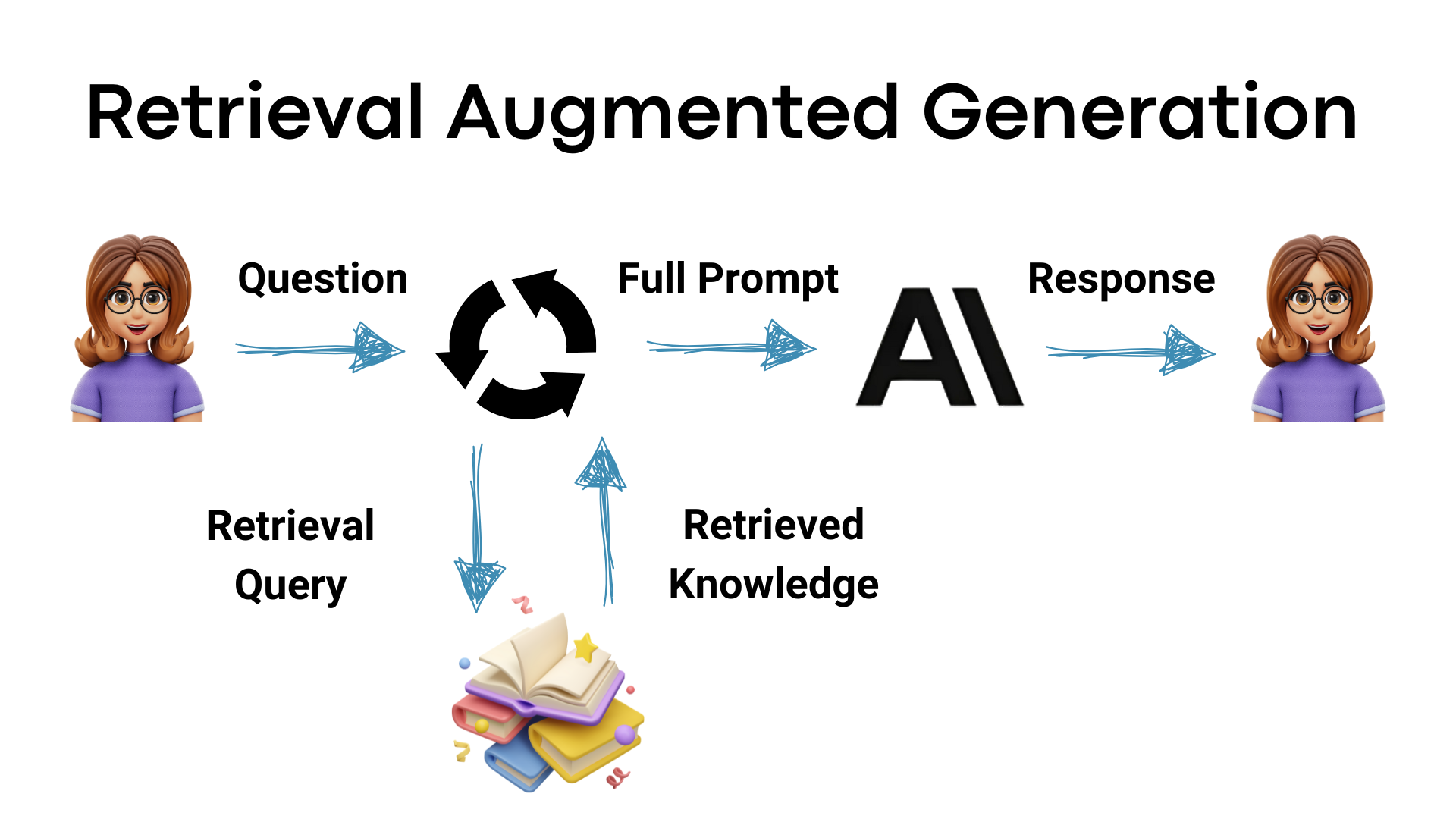
### How RAG Works
1. **Retrieval**: The system takes your query and searches a designated repository or database (e.g., a vector database of client documents, a law library, or recent legislative texts).
2. **Augmentation**: Relevant snippets from the repository are fed into the AI model along with your query.
3. **Generation**: The model produces a response that incorporates the retrieved text, thus “grounding” its answer in real, external data.
With RAG, the AI isn’t forced to rely solely on memory or guesswork—it can cite direct references. This significantly reduces hallucinations and increases factual accuracy.
---
### Naive RAG vs. Enhanced RAG
**Naive RAG** typically follows a straightforward, one-step process: the user’s query triggers a single retrieval pass from the database or document repository, and whatever the system finds is passed directly to the AI model. While this is simpler to implement, it can be limiting for more complex or nuanced questions—especially those that involve multiple issues or require analysis of different types of documents. Because naive RAG doesn’t break the query into sub-queries or refine its search results further, there’s a risk of missing key details, returning irrelevant documents, or failing to fully address multi-part problems.
**Enhanced RAG** can take many forms, but one example is a system that can break down the user’s larger question into smaller **sub-queries**, each targeting a specific piece of information or a distinct part of the user’s overall request. For instance, if the user wants a comparative analysis of two different statutes, the system might run separate searches for each statute, gather the relevant documents, and then synthesize the findings. This approach ensures that each part of a complex question is thoroughly addressed rather than relying on a single search that might overlook critical details.
In addition, enhanced RAG systems may use a technique called **reranking**, where the system retrieves multiple candidate documents but then scores these documents according to how likely they are to be relevant. Only the top-scoring (i.e., most pertinent) documents are ultimately passed along to the AI model. By reranking the results, the system helps filter out irrelevant or lower-quality texts, improving the overall accuracy and clarity of the AI’s final response.
### Practice Pointer:
> When dealing with complex legal queries—like “Compare the privacy regulations of State A and State B, and cite any major changes in the last year”—an enhanced RAG system might be best. It can retrieve the relevant statutes and also locate the legislative history indicating recent amendments.
### Call Out: Key Term – "Vector Database"
> Instead of searching documents by plain-text keywords alone, modern RAG often uses **vector embeddings** to find semantically similar content. This means the AI can locate relevant passages even if the query uses synonyms or related phrases not found verbatim in the document. The system “embeds” both the query and the documents into numerical vectors, then looks for the closest matches.
---
## Why RAG Boosts Accuracy and Reliability
1. **Reduced Hallucinations**
The most obvious benefit of RAG is that the AI can directly quote or paraphrase the retrieved source, lowering the odds of fabricating case names or statutory language. For instance, if the AI’s final output references a specific code section, it likely came from the actual text retrieved, rather than an AI “guess.”
2. **Up-to-Date Information**
Static AI models often have a “knowledge cutoff date” (the year when their training data ended). If you’re researching a brand-new case or statutory amendment, a standard AI model might not have it. RAG taps real-time or frequently updated databases, ensuring the AI’s final answer reflects the latest legal developments.
3. **Domain-Specific Expertise**
Want your AI to become an “expert” in maritime law, family law, or niche local regulations? Provide a curated repository of relevant sources. RAG then uses those domain-specific texts to bolster the AI’s responses, without requiring a specialized, custom-trained model.
4. **Transparent Citations and Verification**
Many RAG-based systems offer references to the exact documents or passages used in generating the answer. Lawyers can then verify each statement. This is vital for professional or academic settings where traceability matters.
---
## Real-World Applications of Prompt Engineering & RAG in Law
### Legal Research Platforms
Several legal technology platforms (e.g., Casetext, Lexis+ AI) now integrate RAG. When you type a query, these platforms *retrieve* relevant cases, statutes, or secondary sources and feed them to the LLM. The answer then weaves in the exact language from those references. This approach helps ensure that you don’t get non-existent or outdated cites—though you should still confirm their validity.
### Example Scenario:
> A user queries, “What is the controlling standard for summary judgment in federal court, and has it changed since 2022?”
> - The system retrieves FRCP 56 and relevant appellate decisions from 2022–2023.
> - The AI references those materials explicitly, quoting the updated clarifications.
> - The user sees footnotes or in-text references to the actual opinions, facilitating a quick check.
---
### Contract Drafting and Review
Law firms use prompt engineering frameworks, often behind a user-friendly interface, to produce standard contract templates (NDAs, employment agreements, etc.). With RAG, the AI can also reference a bank of sample clauses or newly passed laws that must be integrated.
### Practice Pointer:
> When drafting contracts that must align with particular state statutes, use RAG to ensure the exact statutory language is included or cited appropriately. For instance, “AI, retrieve the relevant portion of the California Civil Code governing security deposits, then incorporate it into this lease.”
> **Note:** This only works if your AI platform has access to the text of the California Civil Code as its source of ground truth.
---
### Document Summaries in Litigation
Large-scale litigation often involves mountains of documents. AI-based e-discovery tools can embed these documents in a vector database. Through RAG, an attorney can ask, “Which emails discuss ‘Project Tiger’ and potential budget overruns?” The system retrieves those emails and uses the LLM to summarize them, pinpointing crucial evidence.
This step is typically repeated iteratively:
1. **Find** the relevant documents via retrieval.
2. **Summarize** them with the AI.
3. **Ask** clarifying follow-up questions or refine your queries.
4. Potentially run the process again with narrower or broader criteria.
---
### Brief Analysis
Some advanced tools allow you to upload an opponent’s brief and ask the AI for a critique or identification of weaknesses. RAG helps the AI reference controlling law. The prompt might read:
```
Analyze the attached brief. Identify any misquotes or contradictory points, retrieve relevant cases from the database that challenge the brief’s main arguments, and list them in bullet form.
```
In response, the AI can highlight each contested point, citing the actual case language from your repository.
---
### Example Scenario: RAG in Action – Tenant Law
> A local housing authority wants a Q&A chatbot to handle common tenant-landlord disputes. They embed relevant state statutes and forms in a vector database. The chatbot is then configured with RAG:
> 1. Tenant asks, “What do I do if my landlord never returns my security deposit in Texas?”
> 2. The system retrieves the relevant part of the Texas Property Code.
> 3. The AI references that code in plain English, providing a step-by-step approach and even offering a link to the official tenant complaint form (also stored in the repository).
> The synergy of well-structured prompts (ensuring the AI stays on topic) and RAG (pulling the legal text) creates a far more reliable self-help tool than a generic, free-form chatbot.
---
## Future Directions: Beyond RAG?
While RAG is currently the cutting-edge approach to making AI answers more reliable, some developers are already combining it with **knowledge graph techniques** (sometimes called “Knowledge-Augmented Generation” or KAG) to further reduce hallucinations. Instead of (or in addition to) retrieving raw text, the AI also queries structured data—like a legal knowledge graph that outlines relationships between statutes, regulations, and cases. This structured approach can help the AI “understand” that Case B overruled Case A, or that an amendment changed a certain statute in 2023.
Nevertheless, for most practical legal applications today, a robust RAG pipeline—plus sound prompt engineering—goes a long way toward bridging the gap between a model’s general knowledge and the specific, up-to-the-minute facts lawyers need.
---
## Putting It All Together: Examples and Best Practices
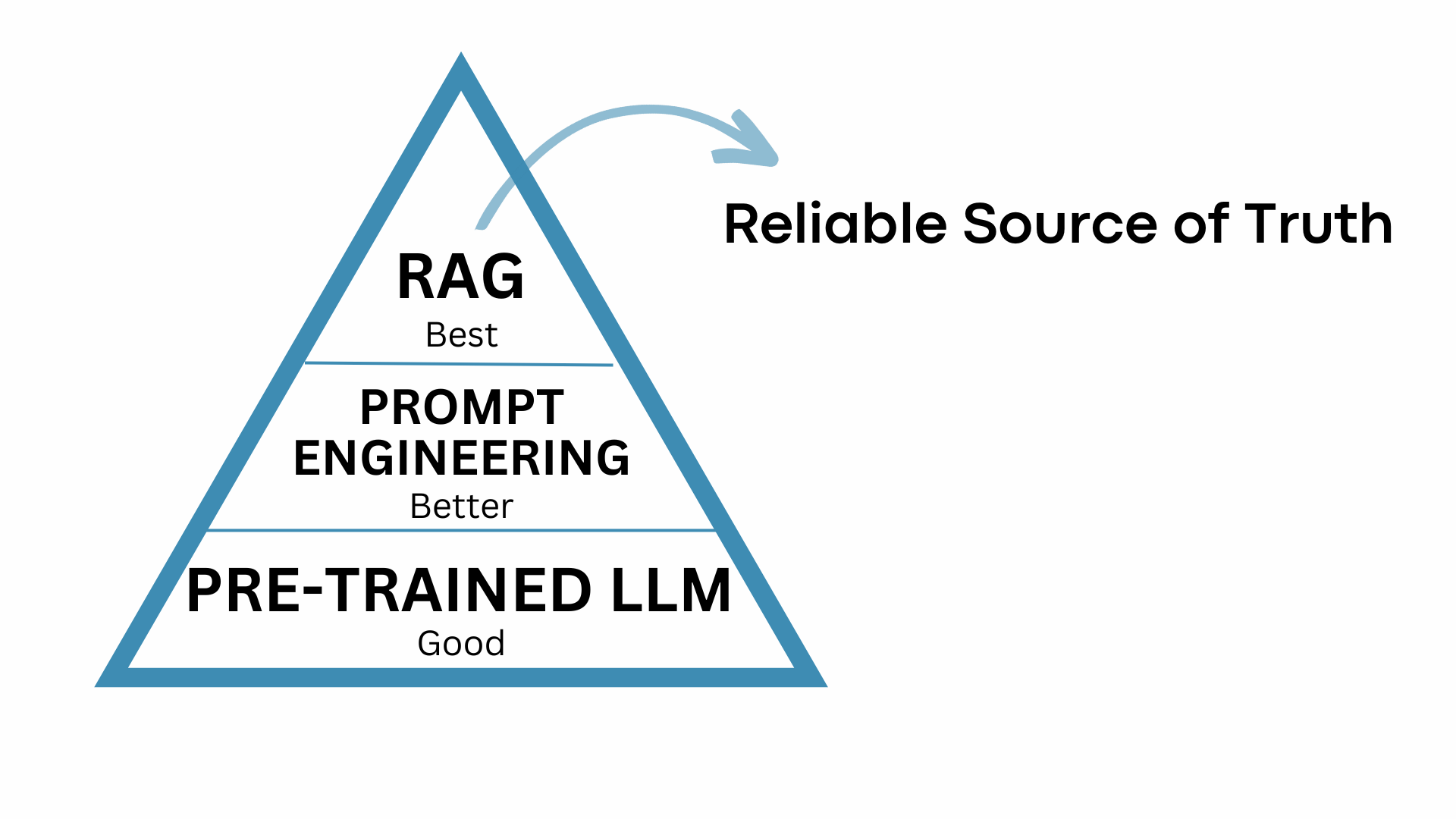
Below is a consolidated workflow for combining **Prompt Engineering** and **Retrieval-Augmented Generation** when tackling a typical legal research or drafting problem:
1. **Define Your Goal and Context**
- *Example*: “I need a memo on changes to landlord-tenant law in Illinois specifically about eviction procedures and notice requirements.”
2. **Craft a Structured Prompt (Using CRAFT, RTF, or RISEN)**
- *Role (R)*: “You are a real estate litigator in Illinois…”
- *Task (T)*: “Draft a 1-2 page memo…”
- *Format (F)*: “Present it in bullet-point paragraphs, include case citations.”
3. **Enable Retrieval**
- Make sure the AI is set to use your Illinois landlord-tenant statutes database or relevant case law.
4. **Check the Output**
- Evaluate the results. Did it mention outdated or inapplicable codes? Ask for self-critique or verify citations.
5. **Refine or Follow Up**
- “Please highlight any major changes enacted after January 2023,” or “Provide direct quotes from the statutory amendments.”
6. **Finalize**
- Accept the final draft, but always confirm critical details independently if used in a real legal context.
### Practice Pointer:
> For important tasks, treat the AI like you would an assistant: review, verify, and correct. Do not assume it’s 100% correct just because it looks well-formatted.
---
## Chapter Recap
In this chapter, we took a close look at **prompt engineering** and **retrieval-augmented generation (RAG)**, two critical building blocks for using AI responsibly and effectively in legal work. We began by discussing how the way you phrase a question (or “prompt”) greatly impacts the AI’s response. Then, we examined frameworks that help structure prompts, explained how meta-prompting can refine them, and explored how RAG leverages external data to reduce errors and stay current. Here are the key takeaways:
- **Prompt Engineering** is vital because how you phrase your question directly influences the AI’s output. Naive prompts yield generic or even incorrect answers, whereas informed prompts guide the AI effectively.
- **Frameworks** like RTF, RISEN, and CRAFT provide simple, repeatable structures for drafting prompts that include role, context, format, and constraints.
- **Meta-Prompting** allows you to use AI to refine your own prompts. Iterative refinement helps you zero in on the best approach for complicated tasks.
- **Retrieval-Augmented Generation (RAG)** grounds the AI’s output in actual documents, reducing hallucinations and enabling up-to-date, domain-specific information.
- **Naive RAG** is a single-shot approach, while **enhanced RAG** breaks down queries or uses advanced ranking to find the most relevant documents.
- **Real-World Use Cases** in legal research, contract drafting, document review, and chatbots show how combining robust prompt design with RAG can significantly improve reliability and efficiency.
- **Looking Ahead**: More advanced methods, including knowledge graphs or “Knowledge-Augmented Generation,” aim to push accuracy and consistency even further, but for now, a well-structured RAG approach plus proper prompt engineering is a powerful baseline.
By blending sound prompt engineering with retrieval-based solutions, lawyers and law students can unlock AI’s potential without sacrificing accuracy or thoroughness.
---
## Final Thoughts
Prompt engineering is about *effective communication*, the same skill lawyers use every day when writing briefs or explaining issues to clients. The difference is that you’re communicating with an AI model, which relies on precise instructions to stay on track. Meanwhile, RAG ensures the AI doesn’t have to rely purely on “memory,” but can consult the actual text of statutes, opinions, or documents.
Think of an AI model as an enthusiastic law clerk who can read and write at astonishing speed but may sometimes misunderstand what you want unless you clarify. It can become your research assistant, summarizing volumes of documents or drafting early versions of memos and contracts. But it’s only as good as the context and direction you provide.
As you move on in your legal career, these tools will likely be refined and become even more integral. Your ability to guide them with well-considered prompts and ensure they draw on the correct sources will be a key differentiator, enabling you to work faster, more accurately, and with greater confidence.
---
## What’s Next?
In **Chapter 7**, we’ll zoom out from the mechanics of AI interaction and look at the broader implications for the legal profession. How are law firms rethinking their business models? What are the ethical and practical concerns around billing clients for AI-assisted work? Could AI disrupt certain practice areas entirely, or will it simply reshape them? We’ll explore these questions and more in subsequent chapters, examining how the rise of AI tools influences everything from client relationships to legal tech startups, access to justice initiatives, and regulatory changes.
---
# References
- Phoenix, J., & Taylor, M. (2024). *Prompt Engineering for Generative AI*. O'Reilly.
- Bourne, K. (2024). *Unlocking Data with Generative AI and RAG*. packt.
- Bouchard, L., & Peters, L. (2024). *Building LLMs for Production*. Towards AI.
# Chapter 7: Impact of AI on the Business and Practice of Law
## Chapter Overview
In Chapter 6, we explored how prompt engineering empowers lawyers to guide AI models more effectively, ensuring that the output aligns with specific legal tasks and contexts. We contrasted naive prompts with more informed ones, examined the difference between single-shot and few-shot strategies, and introduced frameworks like RTF and RISEN to structure queries. We also learned how Retrieval-Augmented Generation (RAG) provides external grounding to reduce errors and keep responses up to date. By applying these techniques, legal professionals can craft more reliable, efficient AI interactions that enhance research, drafting, and client-facing services.
In this chapter, we'll learn how generative AI is transforming the legal profession, reshaping daily practice, business models, and professional roles. We will examine how AI streamlines tasks such as legal research, contract analysis, and litigation preparation, allowing lawyers to focus on higher-level strategic work. We will also explore how lawyers, law firms, and corporate legal departments must adapt by developing new skills and adopting emerging technologies.
By the end of this chapter, you should be able to:
1. **Analyze the impact of generative AI on daily legal practice** by identifying key areas where AI enhances efficiency, such as legal research, contract analysis, and litigation support.
2. **Evaluate the shifting roles and responsibilities of legal professionals** as AI automates routine tasks, and assess how this transformation influences hiring trends, skill requirements, and legal education.
3. **Propose strategic changes in law firm business models** to reflect AI-driven efficiency gains, considering alternative billing structures, workforce optimization, and AI-augmented legal services.
4. **Synthesize insights from real-world case studies** to develop strategies for leveraging AI while maintaining legal integrity and client trust.
Let’s begin by examining AI’s tangible influence on the day-to-day work of lawyers and legal teams.
---
## Impact on Daily Legal Practice
### AI Automation of Legal Tasks
Generative AI is automating a range of routine legal tasks that traditionally consumed significant lawyer time. Tasks that once required painstaking manual effort, such as legal research, document drafting, and contract review, are now significantly streamlined by AI. Here are a few concrete examples:
- **Legal Research.** Many new AI tools can sift through case law and precedents almost instantly, identifying relevant legal principles for an attorney’s query. Instead of manually combing through hundreds of cases, lawyers can rely on AI to produce a short list of citations that may be on point.
- **Document Drafting.** AI language models can produce first drafts of contracts, briefs, and memos by assembling relevant clauses or outlines. For instance, an AI might generate a preliminary nondisclosure agreement for a startup based on a library of standard clauses.
- **Contract Review and Due Diligence.** AI-driven contract analytics platforms can review lengthy agreements or large document sets, flagging key terms and anomalies. This ability to process high volumes of documents efficiently is particularly useful in mergers and acquisitions or compliance audits.
- **Litigation Preparation.** Generative AI can summarize transcripts from depositions, suggest lines of questioning for trial, and help attorneys draft motions. These tools act like tireless research assistants, freeing human lawyers to focus on strategic decisions.
#### Example
> **Scenario:** A mid-sized law firm lands a large due diligence project that involves reviewing over 5,000 commercial contracts. Traditionally, this might have required a small army of junior associates and paralegals, working long hours. Today, the firm uploads the contracts to an AI review platform, which flags unusual clauses and extracts key data in hours. The lawyers then analyze these flags and confirm that the platform has identified the relevant contractual obligations. Instead of spending weeks on routine tasks, the firm can devote its energy to the strategic aspects of the deal, like advising on negotiation points and risk management.
---
### Reducing Lawyer Workload and Boosting Efficiency
Because AI can handle the drudge work of sorting, sifting, summarizing, and drafting, many lawyers are seeing a reduction in day-to-day workload. One study by Thomson Reuters (2024) found that AI-powered tools could save lawyers about four hours per week, translating into an increase in available billable time worth tens of thousands of dollars annually per lawyer.
- **Faster Research.** Immediate search results (e.g., an AI pinpointing a relevant citation) allow lawyers to skip a lot of manual digging, potentially cutting research time in half.
- **Speedier Drafting.** If a contract or memo draft can be generated in five minutes by a trained AI model, a lawyer then only needs to review and refine. The net effect is quicker turnaround and more consistent outputs.
- **Large Caseload Management.** With AI handling repetitive tasks, lawyers can take on more matters without sacrificing quality.
> **Callout: Key Term – “AI as a Force Multiplier”**
> In military contexts, a “force multiplier” is something that dramatically increases the effectiveness of an individual or group. In the legal world, AI is a force multiplier because it lets a single attorney accomplish tasks that might otherwise require an entire team.
**Practice Pointer:**
If you’re working in a law office, consider experimenting with an AI-driven legal research tool to handle the first pass of case-law research. Always double-check the results, but this can be a major time-saver that also reduces the chance of missing relevant precedents.
---
### Moravec’s Paradox (and “Moravec’s Irony”)
**Moravec’s Paradox** is named after Hans Moravec, a roboticist and AI researcher, who highlighted that tasks humans consider “difficult,” such as complex calculations, deep strategic thinking, or abstract legal analysis, can actually be easier for AI, while tasks we consider “easy,” like interacting intuitively with the physical world or applying contextual judgment, prove more challenging for machines. In the legal realm, drafting elaborate briefs or analyzing niche areas of law can be handled swiftly by AI, but the nuanced art of negotiation, reading clients’ emotional cues, or applying real-time moral judgment remains far harder to automate.
A related twist, which I call **Moravec’s Irony**, is the tension between lawyers’ fear of AI-driven job displacement and their simultaneous desire for effortless automation. Many attorneys voice concerns that technology will eventually replace them, yet they also want the push “easy button” solution that instantly handles time-consuming tasks. This contradictory stance reveals how lawyers value their professional autonomy and expertise, while also wishing to offload tedious work to AI. Ultimately, it underscores the reality that, despite massive gains in efficiency, law still benefits from the uniquely human ability to interpret context, deliver empathy, and exercise holistic judgment. Lawyers who embrace technology as a collaborator rather than a threat can harness AI’s strengths without losing the professional skills that remain distinctively human.
---
### Shifting Lawyer Roles and Responsibilities
As routine tasks become automated, the roles and responsibilities of lawyers are shifting in noticeable ways.
1. **Junior Lawyers.** Tasks that used to occupy new associates, like cite-checking and initial drafting, may be done by AI. Junior lawyers, however, can benefit by focusing sooner on strategic work. Rather than spending hours reviewing documents for small details, they can concentrate on legal analysis, developing client relationships, and deeper case strategy.
2. **Senior Lawyers.** Lawyers with more experience are becoming quality controllers and project managers, overseeing AI output rather than delegating to a large team. They exercise judgment to correct any AI-generated errors, adapt the drafts for specific client needs, and ensure that any final documents meet professional standards.
3. **Paralegals and Support Staff.** The immediate effect of AI might reduce the overall headcount needed for tasks like e-discovery or basic document review. However, many professionals in these roles will find their job descriptions evolving: they might become “AI system operators,” helping to validate AI outputs or manage data for AI training.
4. **Impact on Hiring.** Some experts predict that law firms will reduce the intake of junior associates or contract attorneys if AI can perform many of the same tasks. However, those who do enter the field will be expected to have “tech literacy” skills.
> **Callout: Key Term – “Human in the Loop”**
> In AI-enabled processes, the phrase “human in the loop” describes a workflow where human judgment remains essential. For instance, the AI may draft a brief, but a lawyer must review and finalize it before it goes to the client or the court.
**Practice Pointer:**
When drafting a document with the assistance of AI, always triple-check citations, quotes, and references. Recent incidents have demonstrated that AI systems can “hallucinate” or fabricate references. Maintaining accuracy remains the lawyer’s ethical responsibility.
---
### New Skills and Expertise for Legal Professionals
With AI integrated into practice, lawyers increasingly need:
1. **Technological Fluency.** While you don’t need to be a programmer, you should understand how to operate AI tools responsibly and how to interpret their outputs.
2. **Prompt Engineering.** Lawyers must learn how to frame queries or “prompts” effectively so that AI systems provide the most relevant, helpful answers.
3. **Critical Evaluation.** AI can quickly produce an answer, but it may be wrong or incomplete. Lawyers must develop refined judgment to spot potential inaccuracies, bias, or missing context.
4. **Soft Skills – Creativity, Empathy, Communication.** As AI picks up many mechanical tasks, the attorney’s unique human traits, like creativity in argumentation, empathetic client communication, and moral reasoning, become even more important.
5. **Risk Management.** Lawyers need to understand data security, confidentiality obligations, and ways to ensure AI does not compromise privileged information.
> **Example:**
> A commercial litigator might ask an AI tool to draft a motion. The AI quickly composes a thorough legal argument, but includes references to two cases that don’t actually exist. The lawyer, trained to be a “critical evaluator,” checks each citation carefully. Detecting the error, they correct the references, and finalize the motion. The final work product is high-quality and delivered at record speed, but this success depends on the lawyer’s diligence in verifying AI output.
---
## Impact on the Business of Law
Beyond daily legal tasks, AI is driving broader changes in how legal services are delivered, priced, and valued.
### Changing Law Firm Business Models
**1. Hourly Billing Under Pressure.**
AI makes many tasks faster, so the traditional “billable hour” model is under scrutiny. Clients push back on paying for time if the task can be done more efficiently by a machine. As a result, many firms anticipate a decline in hourly billing for routine work.
**2. Alternative Fee Arrangements (AFAs).**
Instead of billing by the hour, some firms offer flat fees, subscription-based services, or performance-based pricing. If a contract review can be completed in minutes by AI, charging a predictable flat fee might be more appealing to clients, and also profitable for the firm, thanks to efficiency gains.
**3. Internal Staffing Changes.**
Law firms have historically relied on a pyramid structure with many junior associates doing repetitive work. AI could flatten this pyramid. Fewer junior associates may be needed for tasks like discovery or contract review. Meanwhile, mid- and senior-level attorneys may shift to more complex strategic tasks.
**4. Productized Legal Services.**
Some firms develop in-house AI tools and sell them to clients as subscription products. For example, a law firm might create an automated contract management solution that monitors a client’s vendor agreements and flags any compliance issues.
> **Practice Pointer:**
> If you’re exploring law firms for employment or partnership, inquire about their approach to AI. Ask how the firm prices AI-augmented services and what opportunities exist for attorneys to learn and work with new technology.
---
### Cost Savings and Revenue Implications
AI adoption often means substantial cost savings for law firms and clients alike:
- **Reduced Labor Costs.** Automated document review can replace a team of contract attorneys or paralegals.
- **Higher Throughput.** Firms can handle more cases or transactions simultaneously, boosting revenue if they adopt value-based or project-based fees.
- **Competition and Pressure on Fees.** As AI usage spreads, firms that cling to hourly billing without adding significant value could lose clients to competitors offering more efficient solutions at a lower cost.
For instance, if a task that used to require 10 billable hours can be done in 2 hours with AI, the firm might charge a flat rate reflecting high-quality output rather than the old 10-hour rate. The client pays less overall, but the firm remains profitable because it requires far fewer attorney hours to complete the work.
**Case in Point: SmartEsq**
A startup called SmartEsq, founded by former BigLaw partners, is using AI to streamline private equity fund formation. Traditionally, creating a $1 billion fund could cost millions in legal fees and consume thousands of lawyer hours. By applying AI to many core workflows, SmartEsq aims to cut that workload by 80% and reduce costs by 75%. This kind of disruption shows how AI can reshape entire segments of legal practice, forcing traditional firms to adapt (ArtificialLawyer, 2025).
---
### Jevons’ Paradox: More Efficiency, More Demand
Jevons’ Paradox suggests that when technology makes a process more efficient (and thus cheaper), the total use of that process can actually go **up**, not down. In other words, increasing efficiency sometimes stimulates new demand that can exceed any immediate cost savings.
**Illustrative Example**
Consider the ATM story in banking. When ATMs first appeared, many assumed bank teller jobs would vanish; ATMs could handle routine transactions, thus reducing the need for human staff. However, because ATMs made it cheaper to open and operate branches, banks **expanded their branch networks**. With more branches came *more* opportunities for face-to-face customer service, and in turn, teller employment actually increased in many regions.
**How It Might Apply to Law**
- **Cheaper Service Delivery**: If AI drives down the cost of routine legal tasks (research, document review), firms may be able to **serve more clients** (including those who previously couldn’t afford legal representation).
- **Expanding Access**: AI’s efficiency gains might spur law offices to **open satellite branches** or offer specialized microservices, creating *new* roles for attorneys, paralegals, and tech-competent legal professionals.
- **Rising Demand for Oversight**: With AI handling more tasks, **quality control and strategic oversight** become paramount, roles that require experienced lawyers to validate AI outputs, address novel cases, or serve niche client needs.
In this light, while many fear AI will reduce legal headcount, Jevons’ Paradox offers a counterpoint: if AI boosts productivity and lowers costs, the net result may be **increased overall demand** for legal services, potentially leading to *more* specialized roles, new market segments, and thus *more* employment within the legal sector.
---
### Evolving Client Expectations
Clients, both corporate and individual, are increasingly tech-savvy and expect their lawyers to use the most efficient methods available. This “first wave of change” driven by client demand includes:
1. **Greater Speed and Responsiveness.** Corporations with high-stakes deals want documents reviewed and drafted quickly. AI can deliver near-instant results, placing pressure on firms to maintain faster turnaround times.
2. **Cost Control and Predictability.** Clients prefer more predictable billing arrangements like flat fees, especially for standard tasks. AI enables that by reducing the unknown labor component.
3. **Transparency About AI Use.** Some clients specifically request that their law firms leverage AI to lower costs. Others may want to know precisely how AI is used and whether it affects confidentiality or data privacy.
4. **Integration with Corporate Systems.** In-house legal departments may have AI tools for intake or compliance, and they expect outside counsel to collaborate seamlessly. This creates a push for standardized platforms and formats.
> **Practice Pointer:**
> When working with clients, outline how AI will be used on their matters, especially if it will speed up processes or reduce costs. This kind of proactive communication can build trust and demonstrate that you are using cutting-edge technology responsibly.
---
### Alternative Fee Structures and Pricing Models
Because AI transforms the time required for many tasks, law firms are experimenting with new ways to charge for their services:
1. **Flat Fees** for routine services like contract drafting or reviews.
2. **Subscription Models** where a client pays a monthly or yearly rate for ongoing access to AI-powered legal support.
3. **Success Fees** or performance-based pricing, common in litigation, but now also emerging in transactional matters where speed or outcome can be measured.
4. **Unbundled Services** in which clients pay only for specific AI-supported tasks, such as an AI-generated research memo, and then decide if they need additional human-driven legal support.
**Case Study: Wilson Sonsini’s Fixed-Fee AI-Powered Contract Offering**
Wilson Sonsini, a major tech-focused law firm, launched an AI-assisted commercial contract review service through its Neuron platform. They charge a set fee rather than billing by the hour. This approach allows startups and mid-market clients to budget easily while still getting expert lawyer review of AI-generated suggestions (Wilson Sonsini, 2024). As a result, Wilson Sonsini can handle many more contracts, maintain profitability, and make their clients happy.
---
## Recent Statistics and Case Studies
### Adoption of Generative AI in Law – Key Statistics
Over the past two years, the legal sector has seen a massive surge in generative AI adoption:
- **Wolters Kluwer (2024)** found that 76% of corporate legal professionals and 68% of law firm lawyers use generative AI at least weekly.
- **Clio (2024)** reported that AI usage in law firms jumped from 19% in 2023 to 79% in 2024.
- **Thomson Reuters (2024)** indicated that 77% of legal professionals believe AI will have a “high or transformational” impact on their practice in the next five years.
Despite this enthusiasm, some lawyers remain cautious. A significant minority worry about AI’s potential mistakes or bias. Still, the prevailing trend is toward rapid, widespread integration.
> **Callout: Key Term – “Hallucination”**
> In AI, a “hallucination” refers to an output that seems plausible but is factually wrong or fabricated. This can include made-up case citations or invented clauses. Always verify AI-driven content!
---
### Case Studies: AI in Practice for Efficiency and Growth
#### 1. Allen & Overy’s “Harvey” Deployment
Allen & Overy integrated a GPT-based AI assistant called “Harvey” into its workflow, making it available to thousands of lawyers across multiple jurisdictions. Harvey assists with tasks such as quick legal research and first-draft document generation. Lawyers still review everything, but the speed and efficiency gains have been significant. The firm provided training on best practices and instituted policies requiring that all AI output be validated, especially in litigation contexts (A&O Shearman, 2024).
#### 2. PwC Legal’s AI Rollout
In 2023, PwC gave 4,000 of its legal professionals access to an AI platform (also named “Harvey”). This tool is used for contract analysis, due diligence, and regulatory compliance. By automating the repetitive portions of a merger review, PwC’s attorneys can handle more clients simultaneously and focus on risk assessment and negotiation strategies (PwC, 2023).
#### 3. Wilson Sonsini’s Neuron Platform
Wilson Sonsini’s fixed-fee AI service for commercial contracts uses an AI system trained on the firm’s standard clauses and negotiating positions. The AI flags deviations and suggests language. Lawyers finalize the work product, ensuring it meets client needs. This model represents a new revenue stream, charging a predictable price for sophisticated document review that used to be billed hourly (Wilson Sonsini, 2024).
---
## Regulatory and Ethical Considerations Shaping AI Adoption
As exciting as AI’s capabilities are, lawyers must remain vigilant about potential ethical and regulatory pitfalls. Key considerations include:
1. **Duty of Technological Competence.**
- The American Bar Association (ABA) states lawyers must understand the “capabilities and limitations” of AI tools they use (ABA, 2023). This implies ongoing education, not just a one-time tutorial.
2. **Confidentiality and Data Security.**
- Attorneys must ensure client data is protected. Public AI platforms could store or reuse uploaded information. Many firms now use private instances of AI systems to mitigate these risks.
3. **Accuracy and “Hallucinations.”**
- Submitting AI-generated content that includes fabricated citations can violate the duty of candor to the court. Lawyers must verify the output of AI before filing anything in court.
4. **Supervision (“Human in the Loop”).**
- AI is treated akin to a nonlawyer assistant. Lawyers remain responsible for reviewing and signing off on AI outputs, ensuring the final work meets ethical standards.
5. **Unauthorized Practice of Law (UPL).**
- AI itself cannot be the legal service provider. The attorney or law firm must be the responsible entity. Offering AI-only legal advice to clients could cross into UPL territory in many jurisdictions.
6. **Regulatory Environment.**
- Some judges and courts now require disclosure if filings are AI-assisted. Lawyers should stay abreast of emerging rules in their jurisdictions.
> **Example:**
> A lawyer in New York used ChatGPT to write a brief but failed to check the cases cited. The AI fabricated non-existent precedents, leading to sanctions when the judge discovered the error. This underscores the non-negotiable requirement that lawyers must independently validate AI outputs.
---
## Larger Economic Impact of Generative AI
Beyond the legal sector, AI is reshaping the global economy. According to an Anthropic report (Anthropic, 2025):
- **AI Adoption Across Occupations.** AI is used in 36% of occupations for at least 25% of tasks. The biggest adopters? Software development, writing, and analytical roles. But AI’s reach is expanding beyond just tech-heavy jobs.
- **Augmenter vs. Automator.** AI is more of a collaborator than a replacement. The data shows that 57% of AI usage is augmentative (helping humans refine, iterate, and learn), while 43% is fully automated. This suggests AI is enhancing productivity rather than outright replacing workers, at least for now.
- **Mid-to-High Wage Work.** Adoption is concentrated in mid-to-high wage jobs. AI is seeing the most use in occupations requiring considerable preparation (like a bachelor’s degree), but less in both low-wage and extremely high-wage jobs. This could be a sign of where AI is creating the biggest competitive advantages or exposing the biggest risks.
- **Selective Integration.** High-skill, cognitively intense jobs see the most AI integration (e.g., software development, legal writing), while jobs requiring physical labor remain largely unaffected.
This broader economic context suggests that AI is not yet displacing entire professions but is reshaping many job roles from the inside out: law is no exception. For lawyers, this reinforces the reality that while routine tasks can be automated, the profession’s core strategic and interpersonal elements will likely remain vital for the foreseeable future.
---
## Political Context
In early 2025, AI regulation has become a hot political topic:
- **AI Executive Order Revocation.** President Donald Trump revoked a 2023 Biden-era executive order that required developers of advanced AI systems to submit safety test results for government review. This removal signaled a shift in the U.S. to a less regulated AI environment, with the administration stating that such regulation hindered innovation (Reuters, 2025).
- **Paris AI Summit.** Leaders from around the world met in Paris in February 2025 to discuss the future of AI. France pledged to reduce regulatory barriers to speed AI development. U.S. Vice President JD Vance advocated for an even more lenient approach regulation to avoid hindering technological progress. The U.S. and Britain abstained from a declaration on “Inclusive and Sustainable AI,” revealing differing views on how much oversight is necessary (Reuters, 2025).
For lawyers, these shifting regulatory sands mean that the legal frameworks around AI could change quickly. The best practice is to stay informed about emerging legislation, court decisions, and ethical guidelines. Law firms with international operations, in particular, must navigate different regulatory climates.
---
## Tomorrow’s Lawyers: What Do They Do?
Richard Susskind, a renowned authority on the future of legal services, delineates 15 emerging roles for legal professionals in his seminal works, *Tomorrow's Lawyers*. These roles reflect the evolving landscape of the legal industry, driven by technological advancements and changing client demands.
**1. Legal Design Thinker**
Focuses on applying design principles to legal services, aiming to make them more user-centric and accessible. This role involves reimagining legal processes and documents to enhance clarity and client engagement.
**2. Legal Knowledge Engineer**
Specializes in structuring and modeling complex legal knowledge for use in automated systems. These professionals develop frameworks that allow legal information to be processed by AI and other technologies.
**3. Legal No-Coder**
Utilizes no-code or low-code platforms to create legal applications and automate processes without traditional programming. This role enables the rapid deployment of tech solutions within legal contexts.
**4. Legal Technologist**
Integrates technology into legal practice to improve efficiency and service delivery. Legal technologists assess, implement, and manage tools such as AI, blockchain, and legal research databases.
**5. Legal Hybrid**
Combines legal expertise with another professional domain, such as technology, project management, or data science. This interdisciplinary approach allows for more comprehensive solutions to complex legal issues.
**6. Legal Process Analyst**
Examines and optimizes legal workflows and processes. By analyzing existing procedures, they identify inefficiencies and implement improvements to enhance productivity.
**7. Legal Project Manager**
Applies project management methodologies to legal cases and transactions. This role ensures that legal projects are completed on time, within scope, and on budget.
**8. Legal Data Scientist**
Analyzes large datasets to extract insights relevant to legal matters. Legal data scientists use statistical tools and machine learning to inform case strategies, predict outcomes, and identify trends.
**9. Legal Data Visualizer**
Transforms complex legal data into visual formats like charts and infographics. This role aids in the comprehension of intricate information by clients and legal teams.
**10. Research and Development (R&D) Worker**
Focuses on innovating and developing new legal products, services, and technologies. R&D workers experiment with emerging tech to create cutting-edge legal solutions.
**11. Digital Security Guard**
Ensures the protection of sensitive legal information against cyber threats. This role involves implementing security protocols and monitoring systems to safeguard data.
**12. Online Dispute Resolution (ODR) Practitioner**
Specializes in resolving disputes through online platforms. ODR practitioners facilitate negotiations and mediations in virtual environments, offering alternative avenues to traditional court proceedings.
**13. Moderator**
Oversees and manages online legal forums, communities, or platforms. Moderators ensure discussions remain productive, informative, and adhere to established guidelines.
**14. Legal Management Consultant**
Advises law firms and legal departments on business strategies, operational improvements, and technology adoption. This role focuses on enhancing the overall performance and competitiveness of legal service providers.
**15. Legal Risk Manager**
Identifies, assesses, and mitigates potential legal risks within organizations. Legal risk managers develop strategies to minimize exposure and ensure compliance with relevant laws and regulations.
These roles signify a paradigm shift in the legal profession, emphasizing the integration of technology, interdisciplinary collaboration, and innovative service delivery models. For law students and emerging legal professionals, Susskind advocates for the cultivation of diverse skill sets, technological proficiency, and a proactive approach to embracing these new opportunities.
---
## Advice for Law Students
Drawing from Susskind and other experts, here are some strategies for students preparing to enter an AI-transformed legal profession:
1. **Embrace Technology.**
- Familiarize yourself with popular AI research tools, e-discovery platforms, and document automation software. Basic tech fluency is increasingly mandatory.
2. **Build Interdisciplinary Skills.**
- Consider electives or certificates in business, computer science, or data analytics. Understanding these fields will expand your career options.
3. **Pursue Lifelong Learning.**
- Technology evolves quickly, so keep up with new releases, attend webinars, and join legal tech communities.
4. **Explore Alternative Paths.**
- Be open to roles like legal tech developer, legal data scientist, or process analyst. These specialized roles can be highly sought after by forward-thinking firms.
5. **Assess Future-Readiness.**
- When interviewing with potential employers, ask about their AI strategy. If a firm seems averse to technology, consider whether that aligns with your professional goals.
6. **Adopt an Entrepreneurial Mindset.**
- Think creatively about how to deliver legal services more efficiently. You might launch a startup or become an “intrapreneur” within a larger firm, driving innovative solutions.
7. **Focus on Client-Centric Services.**
- Clients care most about outcomes and value. Use AI tools to address client pain points—like cost, accessibility, or speed.
8. **Engage with Professional Communities.**
- Join legal tech forums, attend conferences, and collaborate with classmates. Networking can reveal emerging job opportunities and keep you on the cutting edge of the profession.
> **Callout: Key Term – “T-Shape Lawyers”**
> A “T-shaped professional” has deep knowledge in one area (legal expertise) plus broad skills in complementary areas (technology, design, communication). Law schools increasingly encourage students to become T-shaped lawyers.
---
## Chapter Recap
The chapters leading up to this point laid the groundwork for understanding how AI technologies work and how they are becoming integral to legal practice. In this chapter, we investigated the specific ways generative AI is transforming the nature of legal work, from daily tasks to the structures and systems that underpin the broader industry. Below are the key takeaways:
- **How AI automates tasks** like research, drafting, and review, freeing lawyers to focus on strategic and creative work.
- **The efficiency gains** law firms experience and how this changes their staffing models and roles.
- **Shifts in business models**, pricing, and client expectations, as tech-savvy clients demand faster service and predictable fees.
- **Real-world case studies** of firms deploying AI to reduce costs, improve turnaround times, and create new revenue streams.
- **Ethical and regulatory considerations**, including data security, confidentiality, and the duty to ensure accuracy when using AI-generated work.
- **Emerging job roles** described by Richard Susskind, and practical advice for law students who want to thrive in this evolving market.
Together, these insights highlight how generative AI is shaping a more efficient, client-centric, and technologically integrated future for legal services.
---
## Final Thoughts
Generative AI is here, and it’s rapidly changing how attorneys deliver services and grow their practices. By recognizing which tasks are suited to AI and which still require the human touch, today’s lawyers and law students can position themselves as leaders in this new era. Technological competence is quickly becoming as fundamental to legal practice as knowing how to write a persuasive brief.
At the same time, ethical safeguards and regulatory frameworks must continue to evolve to ensure the responsible use of AI. Lawyers remain gatekeepers of quality and fairness, responsible for verifying AI’s outputs and protecting client interests.
Overall, generative AI should be seen as an opportunity: it can make legal services more efficient, accessible, and cost-effective, and it can free lawyers to do higher-level work that AI simply cannot handle. Embracing this mindset, while vigilantly managing the risks, is the hallmark of a modern, forward-thinking legal professional.
---
## What’s Next?
In **Chapter 8**, we’ll bring to light some of the most pressing issues that arise when legal advice and technology intersect. We’ll consider concrete scenarios—for instance, whether uploading client documents into a public AI tool could violate privilege, or how law firms should respond if a model inadvertently “fabricates” citations. We’ll also discuss the unauthorized practice of law as it relates to AI systems providing direct legal advice, examine new guidelines aimed at preventing discriminatory outcomes, and explore strategies to ensure robust data protection.
---
# References
- Anthropic. (2025). Which Economic Tasks are Performed with AI? Evidence from Millions of Claude Conversations. Anthropic Research Publication.
- Clio. (2024). Legal Trends Report. Clio.
- Thomson Reuters. (2024). Future of Professionals Report. Thomson Reuters.
- Wolters Kluwer. (2024). Future Ready Lawyer Survey Report. Wolters Kluwer.
- Susskind, R. (2023). Tomorrow’s Lawyers: An Introduction to Your Future (3rd ed.). Oxford University Press.
- Susskind, R., & Susskind, D. (2022). The Future of the Professions. Oxford University Press.
# Chapter 8: Ethical and Regulatory Implications of AI in Law
## Chapter Overview
In Chapter 7, we explored how generative AI is reshaping the legal profession by streamlining day-to-day work, adjusting law firm business models, and influencing professional roles. We discussed how automation can free attorneys from certain routine tasks, giving them more time for higher-level strategic thinking. We also examined how law firms are managing these changes, often by encouraging new skill development and adopting emerging technologies, while adhering to professional obligations.
In this chapter, we shift our focus to the ethical and regulatory frameworks governing lawyers’ use of generative AI in the United States. You will analyze how existing professional rules, such as those emphasizing competence, confidentiality, and candor, apply to AI-assisted legal practice. We will examine formal ethical opinions from the American Bar Association (ABA) and various state bars, newly minted court rules requiring lawyers to disclose their AI usage, and real-world disciplinary cases imposing sanctions for AI-related missteps. By the end of this chapter, you should have a solid understanding of how to use AI responsibly under today’s ethical codes, and you will be prepared to develop responsible AI-use policies in any legal setting.
Upon successful completion of this chapter, students should be able to:
1. **Identify key ethical obligations** relevant to using generative AI in legal practice, including competence, confidentiality, candor to the court, and supervision.
2. **Explain how ethics opinions, court rules, and regulations** apply to lawyers’ use of AI, enabling a clear interpretation of professional requirements.
3. **Analyze real-world disciplinary actions** and case law involving the misuse of AI, learning how ethical violations occur and how to avoid them.
4. **Evaluate both risks and benefits** of integrating AI into legal workflows, with special consideration for accuracy, bias, and client communication.
Let's begin with a thought experiment, but one that's not too far removed from your experience.
---
## How Do Existing Ethical Rules Apply to AI?
Imagine you’re a new associate at a law firm, and you’re up against a tight deadline to draft a legal memo. Someone suggests using a generative AI tool like ChatGPT to produce the first draft. You type in the prompt, wait a few seconds, and get a polished write-up. It seems miraculous: you saved hours of work. But you might pause and ask: **Is it ethically acceptable to use this tool?** Could you accidentally violate confidentiality or produce an inaccurate document? Could you mislead a court if you submit the AI’s text without checking it?
Over the past two years, legal regulators have wrestled with these questions, publishing guidance on how lawyers can (or cannot) incorporate AI into their everyday practice. The underlying principle is that **technology doesn’t change a lawyer’s core ethical duties**. Whether you’re typing with pen and paper, using an online research engine, or harnessing a cutting-edge AI, you remain responsible for competent representation, confidentiality of client information, and honesty in communications.
In this chapter, we’ll walk through the primary sources of AI-focused ethical guidance:
1. **Formal ethics opinions** from the American Bar Association and state bars, clarifying how existing rules apply to AI.
2. **Court orders** that require lawyers to disclose when they use AI or to certify the accuracy of AI-derived information.
3. **Relevant statutes** and regulations, such as new state laws broadly governing AI and any federal initiatives that might affect legal practice.
By examining real-world cases where attorneys have been sanctioned for AI misuse, we’ll see that these rules have teeth. We’ll also explore best practices, like verifying all AI-generated citations, to ensure compliance.
Our goal is not to scare you away from AI; in fact, when used appropriately, AI can offer substantial benefits, such as faster research and automated drafting. But it must be wielded with a keen awareness of ethical obligations.
---
## ABA Guidance on Generative AI
### Duty of Competence and “Tech Competence”
Since 2012, the ABA’s Model Rule 1.1 (Competence) has included Comment 8, stating that lawyers must keep abreast of “the benefits and risks associated with relevant technology” (ABA Model Rules, 2012). While it never specifically mentions “AI,” this language has been interpreted to require a basic understanding of any technology a lawyer uses in practice.
**[ABA Formal Opinion 512 (July 2024)](https://www.americanbar.org/content/dam/aba/administrative/professional_responsibility/ethics-opinions/aba-formal-opinion-512.pdf)**, titled "Generative Artificial Intelligence Tools," elaborates that competence involves understanding an AI tool’s capabilities and limits (ABA Formal Opinion 512, 2024). This does not mean you must become a data scientist. Rather, you must use the tool intelligently, recognizing, for example, that generative AI can sometimes produce entirely fabricated statements (the so-called “hallucinations”). If you can’t properly evaluate or supervise the AI’s output, it’s safer not to use it, or you must seek additional training.
> **Key Term**
> **Technological Competence:** Refers to a lawyer’s duty under Model Rule 1.1, Comment 8 to stay updated on how technology (including AI) affects legal practice. This includes knowing enough to understand a given tool’s risks (like “hallucinations”) and benefits (like faster research).
### Confidentiality and AI
Model Rule 1.6 obligates lawyers to safeguard client confidences. According to ABA Formal Opinion 512, if an AI platform stores or uses any input data to further train its models, that could expose client secrets (ABA Formal Opinion 512, 2024). Before you type confidential information into a public AI tool, you must (1) carefully review the platform’s privacy policy to see if data is retained or visible to others, and (2) obtain client consent if there’s any risk of disclosure.
In practical terms, many law firms now direct attorneys to “anonymize or redact” client details before using AI. Some enterprise AI solutions promise that data remains private and will not be used for any training. Even then, you remain responsible for taking reasonable steps to protect the client’s information.
> **Practice Pointer**
> If you must input client-related text into an AI tool, strip out identifying details first. For instance, replace the client name and specifics with placeholders. Then incorporate the tool’s suggestions manually into your final document, ensuring no confidential data travels outside your secure environment.
### Communication and Informed Consent
Under Model Rules 1.4 and 1.0, attorneys generally should keep clients informed about any significant aspect of the representation. If using generative AI is a core part of your strategy, particularly if you plan to share confidential data or rely on the AI’s results, it may be wise or even mandatory (in some states) to obtain the client’s informed consent.
The ABA stops short of requiring universal disclosure each time you use AI for routine tasks (like basic proofreading). However, if the AI use could materially affect your client’s case or reveal sensitive info, it is prudent to let them know. Several state bar opinions (such as in Florida, Pennsylvania, and West Virginia) explicitly encourage or require more robust client disclosure.
### Supervision of AI Tools
Model Rule 5.1 requires supervising attorneys to ensure that lawyers under them comply with ethical rules, and Model Rule 5.3 extends this duty to nonlawyer assistants. When it comes to AI, the ABA says to treat these tools as you would a human assistant, meaning you cannot delegate ultimate responsibility. If your firm’s paralegal or junior associate uses an AI tool to draft a brief, you must confirm that all content is accurate and that no client confidences were improperly disclosed.
> **Example**
> **Scenario:** A senior partner instructs a junior associate to “use ChatGPT” to draft a motion. The associate does so but fails to fact-check the resulting citations, which turn out to be bogus. The senior partner is also on the hook for failing to supervise properly and not reviewing the AI-generated content.
### Candor and Truthfulness
Lawyers must always be honest with tribunals (Rule 3.3) and with others (Rule 4.1). ABA Formal Opinion 512 emphasizes that attorneys remain fully responsible if an AI tool outputs false statements. There is no “it was the AI’s fault” defense. If you cite a case or factual claim generated by AI, you must confirm it actually exists and is accurate.
The surge of “hallucinated” cases in real court filings (e.g., *Mata v. Avianca*) underscores how critical verification is. Submitting an AI-created brief with fake citations violates your duty of candor and can lead to severe sanctions.
### Billing and Reasonable Fees
Model Rule 1.5 requires legal fees to be “reasonable.” If AI dramatically reduces the time needed to complete a task, you cannot bill clients for the hours you would have spent without AI. At the same time, you can bill for the value of your services, expert oversight, strategic guidance, or editing. The ABA notes you may also need to disclose to clients any cost associated with using a paid AI platform. Transparency helps avoid disputes and protects you from allegations of overbilling.
---
## State Bar Ethics Opinions
Although the ABA opinions set a framework, each state bar can and does refine these guidelines. Let’s highlight some of the most influential or detailed state bar opinions on AI.
### Florida
**[Florida Bar Advisory Ethics Op. 24-1 (Jan 2024)](https://www.floridabar.org/etopinions/opinion-24-1/)** explicitly permits generative AI usage, but only if the lawyer can comply with the duty of confidentiality, verify all citations, and ensure the client is not overcharged. If using a third-party AI tool might risk disclosing sensitive info, Florida lawyers must obtain the client’s informed consent. Florida also warns that “AI cannot be allowed to make final decisions.” The attorney must review the AI’s output and incorporate legal judgment before filing or finalizing documents.
### District of Columbia
**[D.C. Bar Ethics Op. 388 (Apr 2024)](https://www.dcbar.org/for-lawyers/legal-ethics/ethics-opinions-210-present/ethics-opinion-388)** focuses on the lawyer’s responsibility to understand AI’s limitations. For example, an attorney who does not know that AI can hallucinate is already failing the duty of technological competence. D.C. also suggests lawyers consider saving AI prompts and outputs in the client file, like you would with any legal research, to document how the final work product was formed.
### Pennsylvania–Philadelphia
**[Joint Formal Opinion 2024-200](https://www.pabar.org/Members/catalogs/Ethics%20Opinions/Formal/Joint%20Formal%20Opinion%202024-200.pdf)** from the Pennsylvania Bar and Philadelphia Bar is noteworthy for requiring explicit verification of every citation AI suggests. Because of real-world examples of nonexistent case citations, Pennsylvania lawyers are told they must pull and read each cited case. The opinion emphasizes that if a client’s confidential information might be input into an AI tool with uncertain data practices, the lawyer must proceed only with informed consent or ensure the data is properly protected.
### Kentucky
**[Kentucky Bar Ass’n Ethics Op. KBA E-457 (Mar 2024)](https://cdn.ymaws.com/www.kybar.org/resource/resmgr/ethics_opinions_(part_2)_/kbae457artificialintelligenc.pdf)** underscores that lawyers have a duty to stay educated on how AI might affect their practice. If AI drastically reduces the time needed for a particular task, the attorney must adjust the fee to remain reasonable. Kentucky also suggests that minor AI usage (like using a grammar-check tool) does not require client notification, but more substantial involvement might.
> **Practice Pointer**
> If you are considering a new AI tool at your firm, create a short “due diligence” checklist. Evaluate:
> 1. **Data Security**: Does the tool store or share inputs publicly?
> 2. **Accuracy**: Are there disclaimers about “hallucinations”?
> 3. **Cost**: How will fees be passed on to clients, if at all?
> 4. **User Training**: Have lawyers and staff received guidance on verifying AI output?
### Texas
**[Ethics Op. 705 (Feb 2025)](https://www.legalethicstexas.com/resources/opinions/opinion-705/)** from the Texas Center for Legal Ethics affirms that generative AI is within the scope of “technological competence” under Texas Rule 1.01. Lawyers can use AI but must do so in a manner consistent with confidentiality and candor. Similar to other states, Texas explicitly warns that “the attorney’s ultimate responsibility for the final work product remains undiminished” (Texas Center for Legal Ethics, Opinion 705).
### Other States
- **Missouri (2024-11)** advises lawyers to perform internal due diligence on AI tools.
- **West Virginia (June 2024)** states that AI must “supplement, not replace” a lawyer’s own reasoning and mandates obtaining written informed consent if the AI is used extensively.
- **North Carolina** is circulating a draft opinion on AI. Though not final, it signals the same trend: emphasize diligence, confidentiality, and truthfulness.
- **Illinois** has not issued a formal opinion but published committee reports offering similar cautionary themes.
Across these states, **the pattern is clear**: AI is not banned, but lawyers must be careful, verifying output and protecting client data.
---
## Court Rules and Judicial Guidance
While bar associations regulate attorney conduct, courts have also begun to impose their own directives. This section reviews some groundbreaking court orders that require attorneys to disclose or certify their use of AI in litigation.
### Federal Judges’ Standing Orders
1. **Judge Brantley Starr (N.D. Texas)** – In May 2023, Judge Starr’s standing order set the tone. Any filing in his court must include a certificate stating either (a) no AI was used, or (b) if AI was used, a human has thoroughly checked every citation and fact (N.D. Texas Standing Order, 2023). Noncompliance can get the filing struck from the record.
2. **Judge Gabriel Fuentes (N.D. Illinois)** – Requires that parties disclose if they used a generative AI tool to prepare any part of a filing, specifying the tool (e.g., ChatGPT). This is purely about transparency.
3. **Judge Stephen Vaden (U.S. Court of Int’l Trade)** – Goes further by insisting lawyers identify which exact portions of a filing were produced by AI and certify that no confidential information was compromised.
4. **Judge Michael Baylson (E.D. Pennsylvania)** – Implements an even broader rule: attorneys must disclose all AI use, including older tools used for e-discovery or research. This covers more than just ChatGPT-type platforms.
5. **Judge Peter Kang (N.D. California)** – Similar disclosure requirement but explicitly excluding standard software like word processors and typical legal research databases.
> **Example**
> **Scenario:** You’re in federal court in N.D. Texas. You decide to have ChatGPT draft a summary of the facts for your motion. According to Judge Starr’s rule, you now must attach a certification that you verified the entire text thoroughly. If you fail to do so, your filing might be rejected.
### State Courts
While no state supreme court has adopted a statewide AI rule, some state trial judges have begun issuing individual orders mirroring the federal approach. It is essential to check local court websites or standing orders before filing. This rapid judicial response was largely triggered by the widely publicized AI-generated “fake citations” fiascos.
---
## State and Federal Laws & Regulations
Beyond ethics codes and court orders, legislatures at the state and federal levels are grappling with how to regulate AI. Although most of these laws apply broadly to AI in various industries, they can indirectly impact lawyers.
### State Legislation
- **Colorado AI Act (Bill 24-205, May 2024)**: Requires organizations that deploy “high-risk AI systems” to perform risk assessments and comply with transparency rules. While not aimed solely at law firms, it could apply if your firm develops AI to make legally significant decisions.
- **California**: Passed multiple bills covering deepfakes, AI in financial services, and state agency use of AI. Law firms representing clients in these regulated areas need to stay informed.
- **Texas, Connecticut**: Enacted laws requiring state agencies to catalog their AI usage or follow certain standards. These do not typically govern private law firms directly but could influence how you litigate against a state agency reliant on AI-driven processes.
### Federal Initiatives
Currently, **no comprehensive federal law** specifically regulating attorneys’ use of AI exists. However:
- **Proposed Bills in Congress**: Numerous AI-related bills have been introduced. Some target consumer protection or national security, while others propose risk-management frameworks for government AI usage (NIST’s AI Risk Management Framework).
- **FTC and Other Agencies**: The Federal Trade Commission, under the Biden administration, has warned that using AI tools does not excuse companies (or law firms) from adhering to consumer protection laws. If a firm’s marketing or client intake chatbot makes misleading claims, the FTC could investigate. The FTC's position on AI may change under the new administration.
- **Executive Actions**: The White House, under President Biden, issued an “AI Bill of Rights” blueprint and the NIST framework. However, President Trump has rescinded Biden's order and issued his own: “Removing Barriers to American Leadership in Artificial Intelligence” (Trump AI Executive Order, January 23, 2025).
Lawyers ignoring technological developments and their implications might be deemed “technologically incompetent” in future ethics or malpractice disputes.
---
## Case Law and Enforcement Actions
The past two years have seen a handful of disciplinary actions that show how seriously courts and bar authorities treat AI-related misconduct. Let’s look at three key cases.
### [Mata v. Avianca (S.D.N.Y.)](https://casetext.com/case/mata-v-avianca-inc-3)
In early 2023, a lawyer filed a brief citing six supposed precedents that did not exist: ChatGPT had fabricated them. When opposing counsel couldn’t locate these cases, the court (Judge P. Kevin Castel) discovered they were “hallucinated” by ChatGPT. The lawyer admitted he was unaware AI could generate fake citations. The court sanctioned him with a fine and required letters of apology to the judges named in the fake citations. This was the first high-profile “ChatGPT meltdown,” sparking many judges’ standing orders on AI disclosure.
> **Callout: Lesson from *Mata v. Avianca***
> Never assume AI output is correct or real. Double-check each citation in a reliable database. Failing to do so can result in sanctions and career-damaging headlines.
### [Park v. Kim (2d Cir.)](https://law.justia.com/cases/federal/appellate-courts/ca2/22-2057/22-2057-2024-01-30.html)
Just months later, another lawyer faced discipline for citing a fictitious case generated by ChatGPT. The Second Circuit discovered the citation didn’t exist and referred the attorney for a disciplinary investigation. The court emphasized that no new rule is needed to explain you must verify your filings, “every attorney should already know this.” This underscores how reliant some lawyers had become on AI without verifying results.
### [People v. Crabill (Colorado Disciplinary Court)](https://www.coloradolegalregulation.com/wp-content/uploads/PDJ/Decisions/Crabill,%20Stipulation%20to%20Discipline,%2023PDJ067,%2011-22-23.pdf)
In Colorado, an attorney received a one-year suspension (with a portion stayed) for filing a motion containing AI-fabricated law. He eventually realized the error but failed to promptly notify the court or correct the record, violating rules on candor. This case reveals that bar disciplinary bodies (not just courts) are prepared to impose sanctions.
### Other Incidents and Trends
- At least one attorney for Michael Cohen (in the Southern District of New York) nearly faced sanctions for AI-made-up cases.
- Courts are also evaluating whether they need to track any usage of AI in filings, not just generative AI.
- There have been no major malpractice lawsuits solely about AI usage, yet. But these disciplinary cases illustrate that regulators are watching closely.
---
## Mitigating Bias in Generative AI
Technological innovation offers many benefits to the legal profession, but it also carries inherent risks: one of the most significant being bias within AI systems. Bias can arise at multiple stages of AI development and deployment, leading to unfair or skewed outcomes. In a field like law, which impacts people’s fundamental rights and opportunities, such bias can have serious ethical and legal consequences. Understanding why AI systems exhibit bias and how to mitigate it is crucial to ensuring these tools remain not only effective but also just.
### Examples of Bias in Law
In legal contexts, AI-powered tools, particularly those used for **predictive policing**, provide a stark illustration of how bias can manifest. Many municipalities use algorithms to forecast where crime is most likely to occur, basing these predictions on historical arrest and incident data. However, if earlier policing practices were influenced by racial profiling or disproportionate targeting of certain neighborhoods, then the AI tool essentially learns and perpetuates those patterns. Instead of offering a fair, evidence-based assessment, the algorithm may repeatedly direct law enforcement toward already over-policed communities, reinforcing a cycle of inequality.
### Sources of Bias
Bias in AI typically originates from one (or more) of three main sources: **training data bias, algorithmic bias, and cognitive bias**. Understanding these sources helps attorneys and developers identify where and how to intervene.
1. **Training Data Bias**
- **Data Sampling Imbalances**: If the AI’s training data over-represents some groups while under-representing others, the model develops an uneven perspective on real-world situations. For instance, if a legal AI is only fed case data from large urban areas, it might fail to capture nuances from rural jurisdictions.
- **Data Labeling Errors**: Human annotators, tasked with labeling or categorizing data, can make mistakes or hold prejudices. These errors become “facts” embedded in the training set, and the resulting model inherits these flawed views.
2. **Algorithmic Bias**
- **Flawed Training Data → Biased Algorithms**: Even with the best intentions, if your dataset carries historical or societal biases, the AI’s outputs will replicate them.
- **Programming Errors**: Developers can inadvertently incorporate assumptions or thresholds that disadvantage certain demographic groups. For example, a model might rely on income-related or vocabulary-based indicators, which correlate more strongly with specific racial or socio-economic groups.
3. **Cognitive Bias**
- **Human Bias in Decision-Making**: The individuals who select and weight the training data can pass along their unconscious beliefs and judgments, often referred to as “automation bias.”
- **Overlooked Sources of Bias**: Because AI can be complex, data scientists or lawyers might not spot the subtle ways prejudice creeps into a dataset or an algorithm’s logic.
### Learning from “Coded Bias”
Researcher Joy Buolamwini from MIT, featured in the documentary *Coded Bias*, discovered that many facial recognition systems performed poorly on women and people of color due to a lack of diverse training images. Although this example often focuses on facial recognition, the broader lesson applies to any AI: **if the initial dataset fails to reflect the diversity of real-world conditions, the AI will struggle to produce fair and accurate results.** For legal professionals, Buolamwini’s findings underscore the importance of scrutinizing the data behind AI platforms and advocating for inclusive development practices.
### Implications for Legal Practice
For attorneys, mitigating bias in generative AI means **knowing the data** that informs your tools and **asking the right questions** about how that data was compiled. Courts are increasingly aware of algorithmic biases and may challenge or dismiss evidence that comes from tools deemed unreliable or discriminatory. Furthermore, bar associations emphasize that **technological competence** includes understanding the risk of biased outcomes and taking reasonable steps to address them, through transparent data practices, routine audits, and ongoing collaboration with technologists and ethicists. By approaching AI with both enthusiasm and caution, legal professionals can harness its potential while safeguarding the fairness and integrity of our justice system.
---
## Practical Implications and Best Practices
**So what does this mean for you?** Here are the top takeaways and strategies for ethically integrating AI into your legal work.
### Verification is Mandatory
**“Trust, but verify”** is the mantra. When AI suggests a case, a statute, or a summary of facts, you must confirm it in recognized sources. Some attorneys now designate a second person, like a paralegal, to do a final citation check whenever AI is used to generate legal analysis.
> **Practice Pointer**
> Always keep a secure path back to original sources. If ChatGPT references “Smith v. Jones, 457 U.S. 300,” immediately pull that case on Westlaw or Lexis. Confirm it exists, confirm the quotes, and confirm the holding is correctly described.
### Confidentiality Safeguards
Never input confidential data into an AI tool without first checking the platform’s data usage policy. If the policy is unclear or if you suspect your inputs may be used to train the model, consult the client or anonymize the details.
**Consider** using a subscription-based or enterprise AI solution that guarantees data privacy rather than free consumer versions.
### Informed Consent
Not every minor usage of AI requires telling your client, but if the use is significant, especially if it could reveal sensitive details or substantially affect the representation, best practice is to talk with your client and obtain informed consent. Some state bar opinions explicitly require this for certain AI uses.
### Maintain Human Oversight
Remember that no matter how sophisticated AI becomes, **it cannot replace your professional judgment**. The final say on strategy, arguments, and the interpretation of law must come from a licensed attorney. Think of AI as an “assistant” that needs close supervision.
> **Example**
> **Scenario:** You represent a client in a contract dispute. You let AI draft the entire motion to dismiss. If you just copy-paste it without thorough review, you violate your duty to supervise. If the motion contains a misstatement of law, you own that error.
### Supervising Others Who Use AI
Under Model Rules 5.1 and 5.3, partners and supervising attorneys must ensure their associates and staff follow ethical guidelines. This may require drafting a **firm-wide policy** on AI usage, offering training, and monitoring compliance.
### Comply with Court Requirements
Check local rules and judge-specific standing orders. If they require an AI disclosure or a certificate of verification, follow it precisely. Missing these steps can lead to your filing being rejected or other sanctions.
### Billing Ethics
If AI saves you significant time, **don’t bill as if you spent the old, longer hours.** This also means you should be transparent with clients about how the technology benefits them. Some firms are moving to **flat fees** for tasks heavily assisted by AI to avoid complications with hourly billing.
> **Callout: Example of Ethical Billing**
> If you previously spent 10 hours on a memo but now can do a better first draft in 3 hours (with AI’s help), you shouldn’t charge 10 hours. Instead, you could bill 3 hours plus a modest AI “platform cost” or incorporate a flat rate that reflects the actual value to the client.
### Staying Informed
AI technology evolves quickly, as do the rules governing its use. Regularly check for updates from your state bar, local courts, and the ABA. Many firms circulate internal memos on new AI developments to ensure compliance.
### Documentation of AI Use
Some bar opinions recommend saving your AI prompts and outputs in the case file, especially for critical tasks. This “paper trail” can demonstrate you acted diligently. Of course, if the prompts reveal strategy or client details, secure them as part of your confidential work product.
### Leveraging AI Effectively
Finally, don’t forget the **benefits**. AI can help you quickly generate outlines, summarize discovery documents, or propose contract language. Used wisely, it can enhance efficiency and reduce repetitive tasks, freeing you up for higher-level tasks that require human nuance.
> **Practice Pointer**
> Consider training AI on your **internal knowledge base** (like anonymized sample briefs, motions, or memos). This can yield more tailored results while controlling confidentiality risks, if your firm’s IT department sets it up securely.
---
## Chapter Recap
In this chapter, we explored the ethical and regulatory implications of using generative AI in legal practice. Major takeaways include:
- **ABA and State Bar Opinions**: All emphasize that existing ethical rules (competence, confidentiality, candor, supervision) fully apply to AI.
- **Court Directives**: An increasing number of federal judges now require certifications or disclosures whenever attorneys use generative AI in submissions.
- **Legislative Landscape**: States like Colorado and California are passing broad AI laws that can indirectly affect law practice. At the federal level, no specific AI-lawyer statute exists yet, but agencies like the FTC are scrutinizing AI usage for consumer protection issues.
- **Real-World Sanctions**: The *Mata v. Avianca* case and others highlight that lawyers can face severe penalties for relying on AI-generated “fake” cases or misrepresentations.
- **Practical Strategies**: Verify all AI outputs, check for bias, maintain client confidentiality, consider informed consent, supervise subordinates, respect court rules, and remain transparent in billing.
By weaving these insights into your practice, you can reap AI’s benefits while navigating the ethical pitfalls. AI can be a powerful tool, provided you stay alert, well-informed, and accountable.
---
## Final Thoughts
The deeper we dive into the ethical and regulatory frameworks around generative AI, the clearer it becomes that each new development, be it a groundbreaking court order or a cautionary case, ultimately stands for the same principle: **technology might change how we practice law, but not our responsibility to uphold professional standards.** If there’s one message that resonates through every ethics opinion and judicial directive, it’s that lawyers themselves remain the gatekeepers of accuracy, candor, and confidentiality. AI can draft, summarize, and innovate, but it’s still the human attorney who must stand behind every word.
I find this balance between human judgment and artificial intelligence both exciting and reassuring. Exciting, because it signals a future where technology can reduce drudgery and free us to focus on more nuanced, strategic, and client-centered work. Reassuring, because the heart of legal practice, our commitment to truth, justice, and advocacy, remains firmly in our hands. AI cannot supplant the empathy, creativity, and moral compass that define truly effective lawyering; it’s there to support us, not replace us.
From these insights, I see an immense opportunity for our profession. If we integrate AI responsibly, verifying information, securing client data, and staying transparent about how we use these tools, we can usher in a more efficient and perhaps even more just legal system. But that promise hinges on the choices we make today: whether we choose to learn AI’s capabilities, to anticipate its pitfalls, and to uphold the standards our clients and the courts expect. By embracing this technology with both enthusiasm and caution, we can shape the future of legal practice rather than be shaped by it.
---
## What's Next?
In **Chapter 9**, we will explore how generative AI might help address **Access to Justice** issues and expand pro bono opportunities. We will discuss potential ways AI can automate routine tasks for legal aid organizations, the ethical considerations of providing AI-driven legal services to underserved communities, and the creative ways that technology might help close the justice gap. Keep the lessons of this chapter in mind as you consider the risks and rewards of using AI to expand legal services to broader populations.
---
## References
American Bar Association (2024). *ABA Formal Opinion 512: Generative Artificial Intelligence Tools.* ABA Standing Committee on Ethics and Professional Responsibility.
American Bar Association (2012). *Model Rules of Professional Conduct.* Rule 1.1, Comment 8 (Tech Competence).
California Lawyers Association (2024). *Is California Leading the Way on AI or Just Causing Chaos?*
‘Coded Bias,’ Joy Buolamwini, MIT
Colorado AI Act (2024). *SB 21-169.* Colorado Legislature.
D.C. Bar (2024). *Ethics Op. 388: Use of AI in Law Practice.*
Florida Bar (2024). *Advisory Ethics Op. 24-1.*
Kentucky Bar Ass’n (2024). *Ethics Op. KBA E-457.*
Missouri Bar (2024). *Informal Advisory Ethics Op. 2024-11.*
N.D. Texas (2023). *Judge Brantley Starr’s Standing Order on Generative AI.*
Park v. Kim, 2024 WL 332478 (2d Cir. Jan. 30, 2024).
Pennsylvania & Philadelphia Bar (2024). *Joint Formal Op. 2024-200.*
People v. Crabill, 2023 WL 8111898 (Colo. O.P.D.J. Nov. 22, 2023).
State Bar of Texas (2025). *Texas Center for Legal Ethics Op. 705.*
U.S. Court of International Trade (2023). *Judge Stephen Vaden’s AI Order.*
White & Case (2024). *AI Watch: Global Regulatory Tracker – United States.* Retrieved from White & Case website.
---
## Summary Table of Key AI-Ethics Developments
Below is a high-level snapshot of some important ethical developments, standing orders, and cases from 2023 to 2025. Each entry highlights the authority, the rule or opinion, and the date. Keep in mind that new orders and opinions continue to emerge quickly.
| **Authority** | **Rule/Opinion/Case** | **Date** | **Key Points** |
|-----------------------------------|--------------------------------------------------------------------------------------------|--------------|---------------------------------------------------------------------------------------------------------------------------------------------------------------------------------------------------------------------------------------------------------------|
| **ABA – Model Rules** | Model Rule 1.1, Comment 8 (Tech Competence) | Aug 2012 | Lawyers must maintain technological competence, understanding “the benefits and risks associated with relevant technology.” Adopted by most states into their own rules. |
| **ABA** | Formal Opinion 512, _Generative Artificial Intelligence Tools_ | July 2024 | Emphasizes existing ethical duties (competence, confidentiality, communication, candor, supervision) fully apply to AI use. Warns of AI “hallucinations” (false output) and the need to verify all results. |
| **Florida Bar** | Advisory Ethics Op. 24-1 | Jan 2024 | Lawyers may use GenAI with safeguards for confidentiality. Must protect client info, supervise AI, ensure accurate citations. Requires disclosure and client consent if there is a risk of exposing confidential data. |
| **Kentucky Bar** | Ethics Op. KBA E-457 | Mar 2024 | Stresses the duty to remain educated about AI tools, verify AI outputs, and handle confidentiality. Mentions adjusting fees if AI dramatically reduces attorney time. |
| **D.C. Bar** | Ethics Op. 388 | Apr 2024 | Attorneys must understand AI’s limits and verify outputs. If confidential data is provided to AI, must confirm the tool’s security. Recommends attorneys keep records of AI prompts and responses as part of client files. |
| **Pennsylvania & Philadelphia Bar** | Joint Formal Op. 2024-200 | 2024 | Lawyers must verify all AI-suggested citations. Informed client consent recommended. AI cannot replace attorney judgment. |
| **Texas Center for Legal Ethics** | Ethics Op. 705 | Feb 2025 | Clarifies generative AI falls under “technological competence.” Requires due diligence on confidentiality. Suggests if AI significantly shortens a task, attorneys should not overbill clients. |
| **Missouri** | Informal Ethics Op. 2024-11 | Apr 2024 | Encourages lawyers to vet AI platforms for confidentiality and accuracy. Advocates implementing internal firm AI policies. |
| **West Virginia** | LDB Opinion on AI in Law | June 2024 | AI should supplement, not replace, a lawyer’s reasoning. Strongly advises informed client consent. |
| **Federal Courts – N.D. Texas** | Judge Brantley Starr’s Standing Order | May 2023 | Requires attorneys to certify whether filings were drafted by AI, and if so, that a human checked all references and quotations. Noncompliance can lead to striking the filing. |
| **Federal Courts – N.D. Illinois** | Judge Gabriel Fuentes’ Standing Order | June 2023 | Mandates disclosure of any generative AI use in drafting court filings. Attorneys must specify the AI tool used. Aims for transparency to the court. |
| **Federal Courts – U.S. Ct. of Int’l Trade** | Judge Stephen Vaden’s AI Order | Oct 2023 | Requires disclosure of any AI tool used, which portions of text are AI-generated, and a certification that no confidential or privileged info was disclosed to the AI. |
| **Federal Courts – E.D. Pennsylvania** | Judge Michael Baylson’s Standing Order | Nov 2023 | Broad AI disclosure rule: attorneys must disclose any AI usage in court filings, including more traditional e-discovery or research algorithms. Seeks maximum transparency. |
| **Federal Courts – N.D. California** | Mag. Judge Peter Kang’s Standing Order | Jan 2024 | Requires disclosure only for generative AI, not ordinary tools like word processors or standard legal research. Also warns attorneys about confidentiality concerns. |
| **Notable Case** | _Mata v. Avianca_ (S.D.N.Y.) | June 2023 | Two attorneys sanctioned for citing nonexistent cases generated by ChatGPT. Sparked a wave of new AI-disclosure orders. |
| **Notable Case** | _Park v. Kim_ (2d Cir.) | Jan 2024 | Another AI-fabricated case citation surfaced. The attorney was referred to the court’s Grievance Panel. |
| **Notable Case** | _People v. Crabill_ (Colo. Disc. Ct.) | Nov 2023 | Colorado attorney disciplined (suspension) for filing a motion containing fake case law from ChatGPT. |
| **State Legislation** | e.g., Colorado AI Act (SB 21-169) | May 2024 | States enacting AI laws that can impact “high-risk AI systems.” Not specifically directed at lawyers, but attorneys advising clients or using AI in regulated contexts must be aware. |
| **Federal Activity** | Various proposals; no law yet | 2023–2024 | No comprehensive federal statute regulating lawyers’ use of AI. FTC and other agencies monitoring AI for unfair or deceptive practices. |
This table offers a glimpse into the rapidly growing patchwork of AI-related ethics opinions, court orders, and legislative actions.
# Chapter 9: Rethinking Access to Justice and Pro Bono
## Chapter Overview
In Chapter 8, we explored how existing ethical and regulatory frameworks apply to lawyers’ use of generative AI, highlighting the duties of competence, confidentiality, candor, and supervision in this evolving landscape. We examined new court orders requiring AI disclosure, bar opinions emphasizing the need to verify AI-generated work, and real-world disciplinary cases that underscore the high stakes of failing to meet professional obligations. We also addressed the risk of bias in AI systems and how flawed training data or assumptions can lead to unjust outcomes. Overall, the chapter underscored that technology may change legal tools, but it does not alter a lawyer’s core responsibilities.
In this chapter, we examine one of the legal profession’s most important yet longstanding challenges: bridging the gap between people’s legal needs and the resources available to help them, often referred to as the “justice gap.” We explore the realities of access to justice (A2J) in the United States, highlighting how insufficient funding, heavy caseloads, and complex procedures can leave millions without the legal help they need. We then examine how generative AI, a type of artificial intelligence that can generate text and other content, offers new tools to transform access to justice, from legal chatbots that guide litigants through court forms to AI-powered research systems that assist pro bono attorneys.
By the end of this chapter, you should be able to:
- **Identify** key challenges in traditional access to justice and pro bono models, including funding constraints, legal complexity, and gaps in representation.
- **Analyze** how generative AI tools (e.g., legal chatbots, document automation, AI-assisted legal research) are transforming the delivery of legal aid and pro bono services.
- **Compare** AI-powered legal assistance models with traditional pro bono approaches, evaluating efficiency, scalability, and equity outcomes.
- **Apply** AI-driven tools to real-world legal aid scenarios, illustrating how automation can streamline intake, case management, and client interactions.
Let's begin with understanding what is access to justice, the justice gap and how generative AI may help.
---
## Defining “Access to Justice” (A2J)
“Access to justice” means ensuring that people can obtain fair, effective assistance for legal matters, whether through a lawyer, legal aid services, or user-friendly court processes. In criminal cases, we often refer to the constitutional right to counsel for defendants who cannot afford an attorney. In civil cases, there is no universal right to a free lawyer, and navigating the legal system can be daunting for those without resources. When people talk about the “justice gap,” they usually describe the mismatch between the legal needs of low- and middle-income individuals and families, and the limited resources available to help them.
### Why the Justice Gap Matters
- **Fairness**: If someone cannot find or afford a lawyer, they might lose a home, child custody, or critical benefits simply because they do not understand the law or legal procedures.
- **Court Efficiency**: High numbers of unrepresented litigants can slow down court dockets and overwhelm judges and clerks who must explain procedures to people who have no legal background.
- **Social Impact**: Lack of legal representation often exacerbates other problems, such as homelessness, debt cycles, and family instability.
> **Key Term**
> **Justice Gap**: The mismatch between the number of people needing legal help and the resources available to provide it, often resulting in individuals going unrepresented or not receiving any meaningful assistance for critical legal issues.
### How Generative AI Fits In
Generative AI tools are emerging that can automate routine tasks like drafting documents, summarizing cases, and answering frequently asked questions. If used ethically, these tools can help legal aid organizations, pro bono lawyers, and court systems reach more people and offer faster, more affordable services.
---
## The Current State of Access to Justice in the United States (2021–2023)
To understand how AI might help, it is essential to grasp the challenges that make access to justice so difficult in America. Recent studies and other data paint a clear picture of systemic underfunding, overwhelming caseloads, and emerging issues following the COVID-19 pandemic.
### Overview of the U.S. “Justice Gap”
Over the past three years, multiple studies and reports have indicated that millions of people in the United States continue to be left behind when it comes to legal representation. Many of those at the lowest income levels find themselves shut out of an increasingly complex court system, a problem exacerbated by the COVID-19 pandemic and by structural underfunding of legal aid programs.
A recent Legal Services Corporation (LSC) study revealed two alarming statistics:
* **74%** of low-income households faced at least one civil legal problem during the study year
* **92%** of these substantial legal problems received no or inadequate legal assistance
The severity of these statistics cannot be overstated, as they represent hundreds of thousands of Americans being forced to navigate the civil justice system without meaningful help or guidance. The root cause often lies in the cost of professional legal services, something unaffordable for many families who are living paycheck to paycheck or experiencing sudden financial hardships such as job loss. These problems range from housing disputes to family law crises, creating a justice gap that continues to widen for America's most vulnerable populations.
### Legal Aid Availability and Funding
Civil legal aid, typically delivered by nonprofit organizations funded in part by the LSC, remains the only recourse for many low-income individuals dealing with issues like eviction, domestic violence, or consumer debt. Yet the demand for this help far exceeds the supply.
* **In 2024, the LSC documented that its partner organizations had to turn away roughly half of eligible cases simply because there were not enough attorneys or staff to go around**
Although the federal budget appropriation for LSC rose from about 489 million dollars in 2022 to around 560 million in 2023, the organization had requested over one billion dollars for 2022 alone to address what it deemed "pandemic-related surges" in housing, unemployment benefits, and debt collection cases. Legal aid providers continued to handle more than 1.9 million yearly requests for help but could fully resolve only about half of them. In effect, thousands of low-income people were left to fend for themselves despite being income-eligible for assistance.
### Public Defender High Caseloads and Alarming Consequences
Problems in criminal defense have proven daunting. The constitutional right to counsel for indigent defendants has, in theory, established a bedrock principle of fairness, but in practical terms, many public defender offices remain under-resourced and overloaded. Guidelines dating back to 1973 suggested that a single attorney could handle up to 150 felonies or 400 misdemeanors per year.
* **One national study released in this year found that public defenders routinely carried workloads that were _double or triple_ the modern recommended thresholds, leading one expert to describe the state of criminal defense in some places as "legal triage."**
In Oregon, a 2022 shortage of public defenders left over 700 defendants without representation, ultimately prompting courts to dismiss close to 300 cases, including some felony matters. The fact that a serious charge could end up dismissed not because of the case's merits, but due to systemic under-resourcing, calls into question the very integrity of the justice system.
> **Example Scenario**
> **Public Defender’s Office With AI-Enhanced Discovery**
> A public defender’s office receives gigabytes of digital discovery, body cam footage, text messages, social media logs, for a high-stakes felony case. Manually reviewing all this data would take weeks. The office implements an AI platform that highlights suspicious or exculpatory evidence. Lawyers confirm the flagged evidence, cutting review time by 60%.
> **Reflection Question:** What ethical safeguards must be in place to ensure the AI’s recommendations do not overlook critical data or compromise client confidentiality?
### COVID and Court Accessibility
COVID-19 forced courts to shut down or limit in-person hearings. Jury trials were often delayed, creating a mounting backlog in both civil and criminal cases. Virtual hearings, which had been rare before 2020, became widespread. Remote proceedings improved attendance rates because parties no longer needed to travel to courthouses or arrange for childcare, and this shift seemed to expand access for segments of the population.
* **According to a report by the National Center for State Courts, some remote hearings took over a third longer than in-person sessions simply because participants had trouble connecting.**
However, the transition to Zoom and similar platforms also revealed a stark digital divide. Many unrepresented litigants lacked broadband internet, appropriate devices, or the technical know-how to navigate online hearings. This meant that while remote technology opened doors for certain groups, it also forced some people out of the system due to technological barriers, thereby reinforcing existing inequalities.
### Civil Justice Issues: Eviction, Consumer Debt, and Family Law
Within the broader civil justice realm, eviction and consumer debt cases continue to be illustrative of how representation inequities translate into real-world consequences. Even before the pandemic:
* **More than 70% of defendants in debt collection lawsuits did not have legal counsel**
* **Landlords usually enjoyed representation rates upwards of 80%**
Studies have shown that tenants who appear in court with counsel are far more likely to avoid the immediate threat of homelessness and can often secure better agreements with landlords.
Meanwhile, debt collection suits, already one of the fastest-growing categories of civil litigation, continued to surge as pandemic-related financial strains drove more individuals into delinquency on rent, credit cards, or medical bills. Family courts also exhibited deep cracks in access to justice. People seeking divorces, child custody determinations, or protection orders routinely proceeded pro se.
* **In some states, estimates showed that up to 80% or 90% of family cases had at least one self-represented litigant**
During the pandemic, domestic violence cases added new layers of complexity when remote hearings made it difficult to present evidence or ensure safe communication for survivors seeking protective orders. At the same time, court cutbacks and social distancing delayed hearings, creating backlogs and leaving families in limbo over custody arrangements and support orders.
> **Example Scenario**
> **Tenant Facing Eviction**
> Sarah, a single mother, receives a five-day eviction notice. She cannot afford a private attorney. Under **traditional pro bono**, she might spend days calling volunteer hotlines, hoping to find a free lawyer. Under **traditional legal aid**, she faces a waitlist because of staff shortages. Under an **AI-powered model**, Sarah uses a website chatbot at midnight, inputs her case details, and gets a draft defense form to file with the court the next morning.
> **Reflection Question:** How do efficiency, cost, and availability differ among these three approaches?
### Disparities by Income, Race, and Geography
Racial and socioeconomic disparities have also played a critical role in shaping the current state of access to justice. Eviction data revealed that Black and Latino renters, especially women, encountered disproportionate rates of displacement in many urban areas, and language barriers continued to pose challenges for non-English speakers. In rural “legal deserts,” people of all races faced the logistical hurdle of living in counties with few or no attorneys, which forced them to drive long distances for legal aid or rely on underfunded volunteer programs that might only visit occasionally.
---
## Key Challenges in Traditional Access to Justice and Pro Bono
Many people depend on pro bono attorneys or volunteer-based legal services to fill gaps in representation. However, the traditional pro bono model also faces obstacles.
### Funding and Volunteer Constraints
Chronic underfunding of both civil and criminal legal services forces organizations to ration aid, despite modest increases in federal appropriations in recent years. LSC leadership has repeatedly testified that billions, not millions, are needed to adequately serve low-income populations, leading legal aid offices to make difficult case prioritization decisions. While pro bono work provides valuable support, it relies on limited volunteer hours and donations, making it insufficient to address the massive gap in legal resources that leaves many eligible clients without representation.
### Legal Complexity and High Caseloads
Public defenders and legal aid lawyers struggle with overwhelming caseloads that prevent thorough investigation of each client's situation, while simultaneously navigating increasingly complex legal procedures in areas like eviction, consumer credit, and family law. Court forms intended to help self-represented individuals often contain confusing legal jargon, creating additional barriers. Criminal defense faces similar challenges, with outdated caseload standards and complex discovery requirements increasing the risk of oversight and rushed plea deals. Despite judges' potential desire to ensure thorough representation, pressure to clear crowded dockets frequently forces rapid case processing at the expense of careful consideration.
### Representation Gaps and Unfair Outcomes
Millions of Americans with critical legal needs, such as eviction defense or domestic violence protection, proceed without a lawyer. This drastically decreases their likelihood of a fair result. A landlord may arrive to eviction court backed by an attorney who knows the rules, while a tenant comes alone without any sense of how to file a written response or how to argue that the eviction notice was defective.
* **A 2020 study by the Pew Charitable Trusts, focusing on debt collection lawsuits, estimated that more than 70% of such cases ended in default judgments**
This imbalance in legal skill sets virtually guarantees that tenants lose their homes at higher rates, and it has a ripple effect throughout the broader community, from increased homelessness to strained social services. The high rate of default judgments occurs primarily because defendants never responded or did not appear in court. That outcome might have been different if they had understood how to file a basic answer or had access to an attorney to negotiate on their behalf.
### Geographic Hurdles and Underserved Regions
Geographic inequities present yet another stumbling block. In urban settings, legal aid offices often exist but are swamped by the sheer volume of requests. In contrast, rural areas in states such as Montana or large portions of the South might have only a handful of lawyers covering vast geographic regions. The American Bar Association has documented these “**legal deserts**,” noting that **around 1,300 U.S. counties have fewer than one attorney per thousand residents**.
> **Key Term**
> **Legal Desert**: A region (often rural) with extremely few or no practicing attorneys. Residents in these areas may have to travel long distances or rely on intermittent volunteer clinics to receive any legal assistance.
### Pandemic-Exacerbated Shortfalls
The pandemic compounded many of these existing challenges in ways that even the most committed legal advocates could not have predicted. While organizations pivoted to remote service delivery to maintain some level of operation, many offices lost staff or had to scale back in-person clinics that historically drew volunteer attorneys to do pro bono work. With everyone juggling new responsibilities, from child care to caring for sick family members, the pro bono pool itself was strained. Virtual volunteer models emerged, but online training and supervision required for new attorneys unfamiliar with legal aid processes added to the workload of already overstretched staff attorneys, sometimes limiting how effectively that extra help could be deployed.
---
## Potential for Bridging the Justice Gap with Generative AI
While large law firms have invested in AI-assisted document review and contract analysis for years, legal aid organizations, public defender offices, and pro bono programs have often lacked the resources or expertise to do the same. According to a January 2025 field study:
* **90% of legal aid attorneys who tried generative AI found that it reduced their administrative workloads**
* **75% planned to continue using these tools**
Encouraged by such numbers, more nonprofits and court systems are looking to generative AI as a potentially transformative way to scale their assistance to underserved communities. Researchers and advocacy groups nonetheless stress that generative AI is not a panacea. As the technology is relatively new in the legal sector, it must be carefully monitored for inaccuracies (“hallucinations”), bias in training data, and the risk of security breaches when sensitive client information is uploaded.
In most accounts of how AI can help underserved populations, three themes emerge consistently: AI’s capacity to **automate repetitive tasks**, its ability to **operate at scale**, and the promise that these technologies can **make legal help more affordable**. Taken together, these elements could help alleviate the chronic underfunding and staff shortages that have plagued legal aid offices and public defender agencies for decades.
### Automation of Repetitive Tasks
One of the clearest benefits of generative AI for lawyers, particularly those working in nonprofit settings with heavy caseloads, is its power to handle routine work that might otherwise swallow up hours of attorney or paralegal time. For example, automating routine, time-consuming tasks like client intake, form-filling, meeting note summarization, letter drafting, and document analysis.
A San Bernardino, California pilot program demonstrated these tools' transformative potential: after implementing AI-assisted intake and pleading drafting systems, a legal aid agency more than tripled its eviction case capacity from 2,500 to over 8,000 clients annually while reducing staff burnout. Similarly, an innocence project team reported saving hundreds of hours on post-conviction case reviews through AI-powered document analysis, enabling faster screening of wrongful conviction claims and expanding their capacity to serve justice-involved individuals.
### Scalability
Scalability is another key advantage often attributed to generative AI in legal contexts: unlike human staff limited to serving one client at a time, AI chatbots and intake systems can simultaneously handle thousands of requests 24/7. This capability is particularly valuable for nonprofits that routinely turn away eligible clients due to resource constraints.
In 2025, Nevada's judiciary demonstrated this potential by launching an online self-help portal with an AI chatbot supporting over fifty languages. Within months, thousands of users had interacted with the system, often outside normal business hours, and obtained customized forms for small claims and family law matters. A significant achievement in a rural state where geographic distance from legal aid offices creates substantial access barriers.
### Affordability
Affordability is a crucial advantage of AI-assisted legal services, particularly for organizations operating on limited grants, government funding, and donations. While increasing attorney headcount creates ongoing salary and benefit costs, AI solutions may be funded through one-time philanthropic grants or software license purchases. Some law firms contribute their in-house AI resources or offer cost-sharing arrangements as part of corporate social responsibility initiatives.
The affordability benefit extends to individual clients as well: when routine document preparation and screening processes are automated, lawyers can significantly reduce their final bills, making "low bono" services accessible to those who earn just above legal aid eligibility thresholds but cannot afford standard legal fees. For qualifying low-income clients, AI-driven efficiencies allow legal aid offices to maximize limited budgets, serve larger client populations, and address more complex legal matters without requiring additional funding.
In all these ways, automating basic tasks, scaling outreach, and cutting the costs of service delivery, generative AI holds the potential to chip away at the justice gap.
---
## Generative AI Use Cases to Address the Justice Gap
### 1. Document Analysis and Summarization
Legal aid attorneys often deal with massive amounts of paperwork (e.g., trial transcripts, discovery documents, or government records). AI-driven tools can scan these documents, highlight key details, and produce quick summaries. This allows lawyers to spend less time sifting through data and more time building a strong case or counseling clients.
> **Example**: An Innocence Project team used an AI assistant to review hundreds of pages of witness statements, identifying inconsistencies that supported a post-conviction relief motion.
### 2. Drafting and Research Assistance
Generative AI can create first drafts of pleadings, motions, or letters. Lawyers then revise and finalize these drafts, ensuring accuracy. Similarly, AI systems can quickly comb through legal databases to find relevant statutes and cases, dramatically cutting down on research time.
> **Example**: A pro bono attorney might use an AI tool to draft an eviction defense motion. The attorney then carefully edits the document, verifying citations and legal arguments before filing.
### 3. Client Intake and Guidance
Chatbots can guide individuals through initial intake questionnaires, gather facts about their problems, and direct them to relevant forms or resources. This streamlines onboarding for legal aid offices.
> **Example**: In San Bernardino, an AI-powered intake process helped quadruple the number of clients served by automatically collecting key facts, generating draft documents, and scheduling consultations.
### 4. Language Translation and Plain-Language Explanations
Legal jargon and English-only forms are a major barrier. AI translators and “plain-language” generators can convert official documents into understandable text for clients with limited English proficiency or low legal literacy.
> **Practice Pointer**:
> If your client speaks limited English, use AI translation software to provide initial explanations and documents in their native language, then confirm accuracy with a bilingual staff member or translator.
### 5. Administrative and Non-Legal Tasks
AI helps legal aid offices with grant writing, newsletters, and data analysis, allowing staff to focus on direct client services.
> **Key Term: “Force Multiplier”**
> This term means something that multiplies the effect or efficiency of your work. Generative AI is often called a “force multiplier” for legal aid because it helps you do more with limited staff and funding.
### 6. Pro Bono Partnerships
Some tech companies and law firms donate AI tools or licenses to nonprofits. These partnerships aim to reduce the cost barrier and ensure advanced AI systems are not solely available to large, well-funded law firms.
---
## Improving Court Accessibility with Generative AI
### Court-Integrated Chatbots
Courts are embedding chatbots on their self-help websites. Litigants can get guidance 24/7 on filing forms or responding to a lawsuit. This is especially helpful for those representing themselves in small claims, family law, or eviction cases.
### Online Dispute Resolution (ODR)
Some courts use online platforms for small claims or minor civil disputes. AI can facilitate negotiation by helping parties communicate or by identifying common ground. These systems aim to reduce court backlogs and resolve conflicts quickly.
### Real-Time Language Translation
Generative AI that translates spoken words in real time could assist non-English speakers in court proceedings. Although still developing, these tools hold promise for reducing language barriers.
### Self-Service Kiosks and Virtual Assistants
In many places, you can find court kiosks with an AI-driven touchscreen interface, useful for people who lack home internet. The system answers questions about filing fees, hearing schedules, and required documents.
---
## Challenges, Risks, and Ethical Considerations
Generative AI brings hope for expanding access to justice. However, it also raises important concerns:
1. **Accuracy and “Hallucinations”**
AI sometimes produces incorrect or fabricated information. Lawyers must review all AI outputs carefully to ensure factual and legal correctness.
2. **Bias and Fairness**
AI models can learn biases from the data they are trained on. If not checked, these biases could perpetuate unfair treatment, especially for marginalized communities.
3. **Confidentiality and Data Security**
Lawyers are responsible for protecting client information. Using cloud-based AI tools requires caution, ensuring data is not exposed or misused.
4. **Unauthorized Practice of Law (UPL)**
An AI chatbot that crosses from providing “legal information” into specific “legal advice” could be seen as unlicensed practice of law. Developers and lawyers must set boundaries and use disclaimers to prevent confusion.
5. **Transparency and Informed Consent**
Users should know when they are interacting with an AI. Lawyers must also disclose if they used AI to draft filings.
6. **Digital Divide and Accessibility**
Not everyone has internet or the necessary devices. AI-driven solutions must be accompanied by in-person or low-tech services to avoid leaving people behind.
7. **Cost and Sustainability**
High-end AI tools can be expensive. Nonprofits may lack the budget to maintain them. Grants or philanthropic partnerships can help ensure these tools remain available to the public interest sector.
8. **Regulatory Framework and Evolving Bar Guidance**
Bar associations and courts are still issuing opinions on AI usage. Lawyers must stay informed about emerging regulations on data privacy, client consent, and ethical obligations.
> **Practice Pointer: Bias Checks**
> Whenever introducing AI in your legal work, conduct periodic “bias checks.” For instance, if you notice that the AI frequently misses certain cultural references or patterns, you may need to make adjustments to ensure your work product is fair and balanced.
---
## Maintaining Human-Centered Justice
The lawyer’s role as counselor, advocate, and ethical gatekeeper does not vanish with AI. On the contrary, attorneys must stay vigilant, reviewing AI output for mistakes, checking for potential bias, and ensuring confidentiality. A balanced approach, where technology amplifies human expertise, holds the greatest promise for delivering justice.
> **Callout: Human-Centered Justice**
> Always remember that while AI can automate and expedite, empathy and direct human guidance remain crucial in law. Technology can never override lawyers role as fiduciaries to their clients.
---
## Case Studies: AI-Driven Access to Justice Initiatives
Below are some real-world examples of AI in action for pro bono and legal aid:
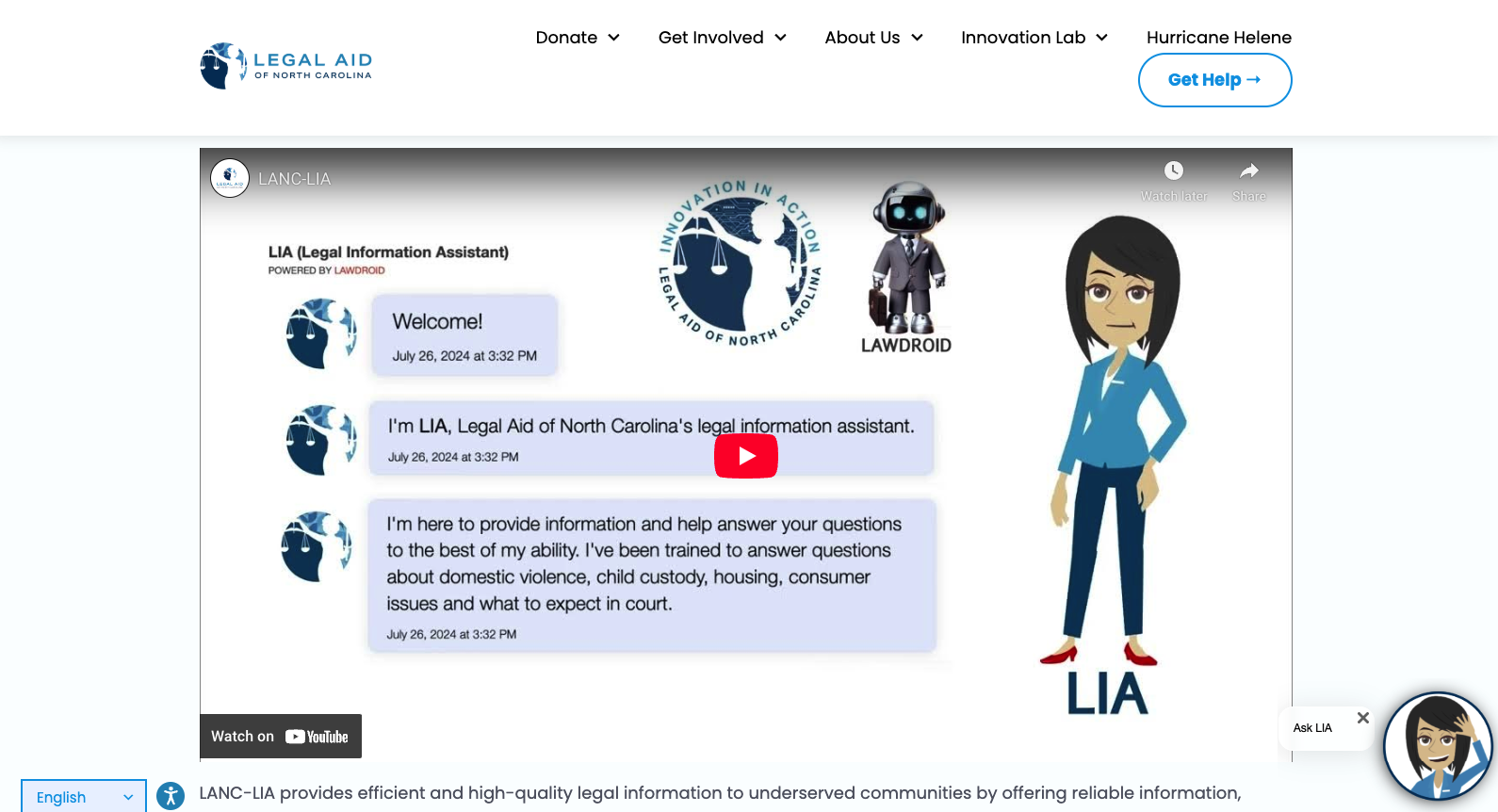
1. **[Legal Aid of North Carolina’s LIA Chatbot](https://legalaidnc.org/)**
- **What It Does**: Offers multilingual legal information on housing, family law, and domestic violence.
- **Impact**: Thousands of users have received 24/7 assistance, freeing attorneys to focus on complex cases.
- **Lesson**: Carefully tested disclaimers and careful oversight are key to maintaining ethical standards.
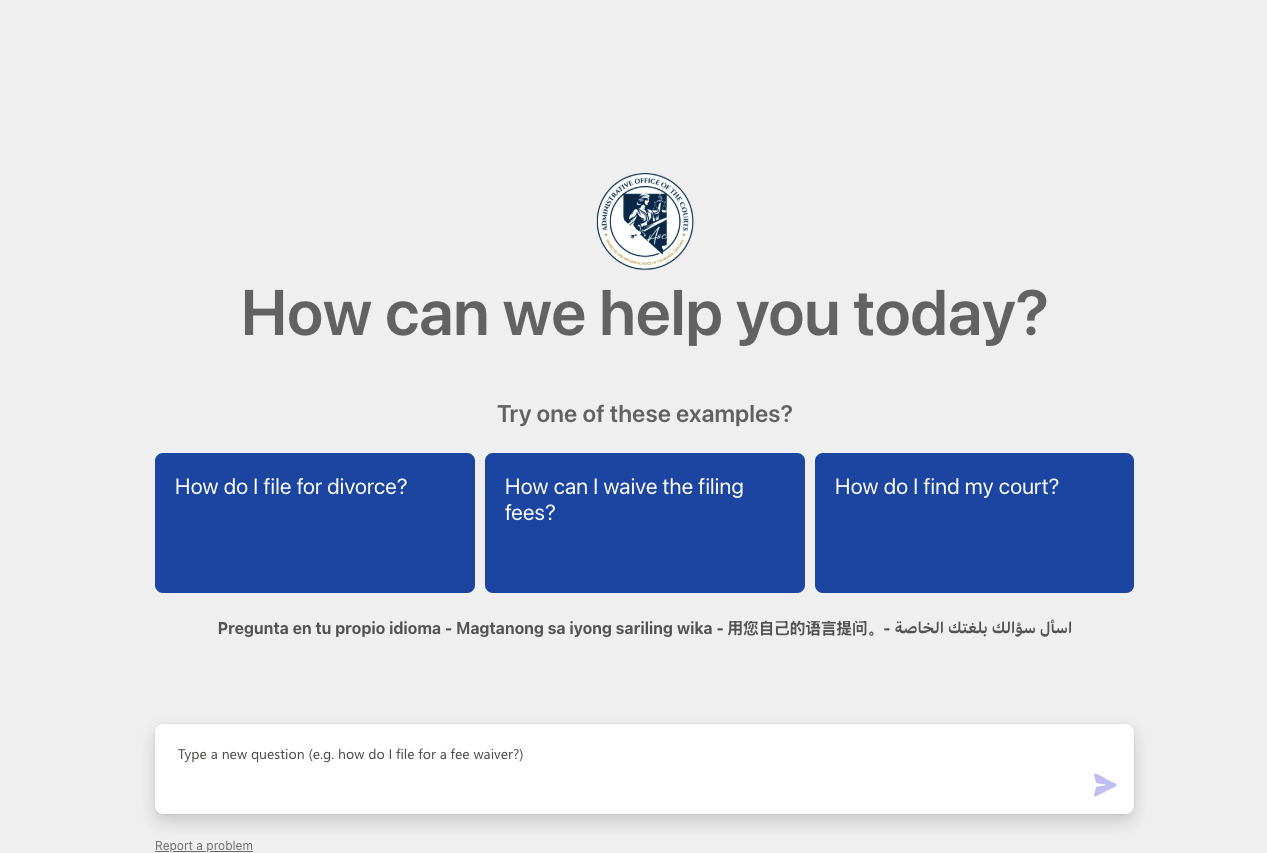
2. **[State of Nevada Courts Self-Help AI](https://app-backend-brnngeqazsnem.azurewebsites.net/)**
- **Features**: Interactive chatbot in 50+ languages, integrated with guided online interviews and e-filing.
- **Reach**: Deployed kiosks in libraries and courthouses for those without home internet.
- **Outcome**: Rapid adoption, hundreds of newly automated filings, and reduced staff burdens.
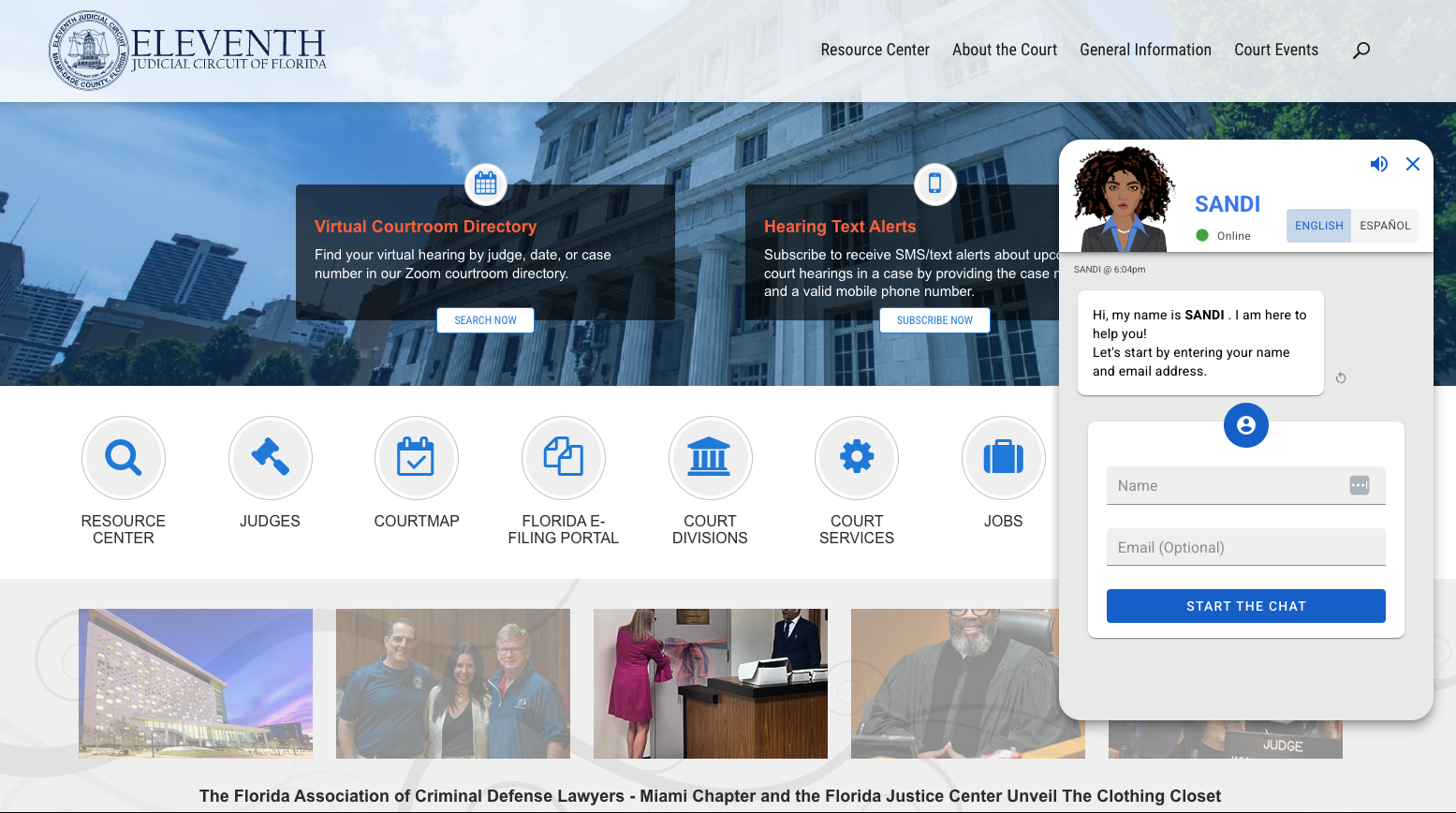
3. **[Florida’s SANDI Court Navigator](https://www.jud11.flcourts.org/)**
- **Role**: A virtual clerk for self-represented litigants (pro se parties) in small claims and family law matters.
- **Result**: Fewer phone calls to the court, more prepared litigants.
- **Takeaway**: Even local courts with limited resources can implement AI effectively with the right planning.
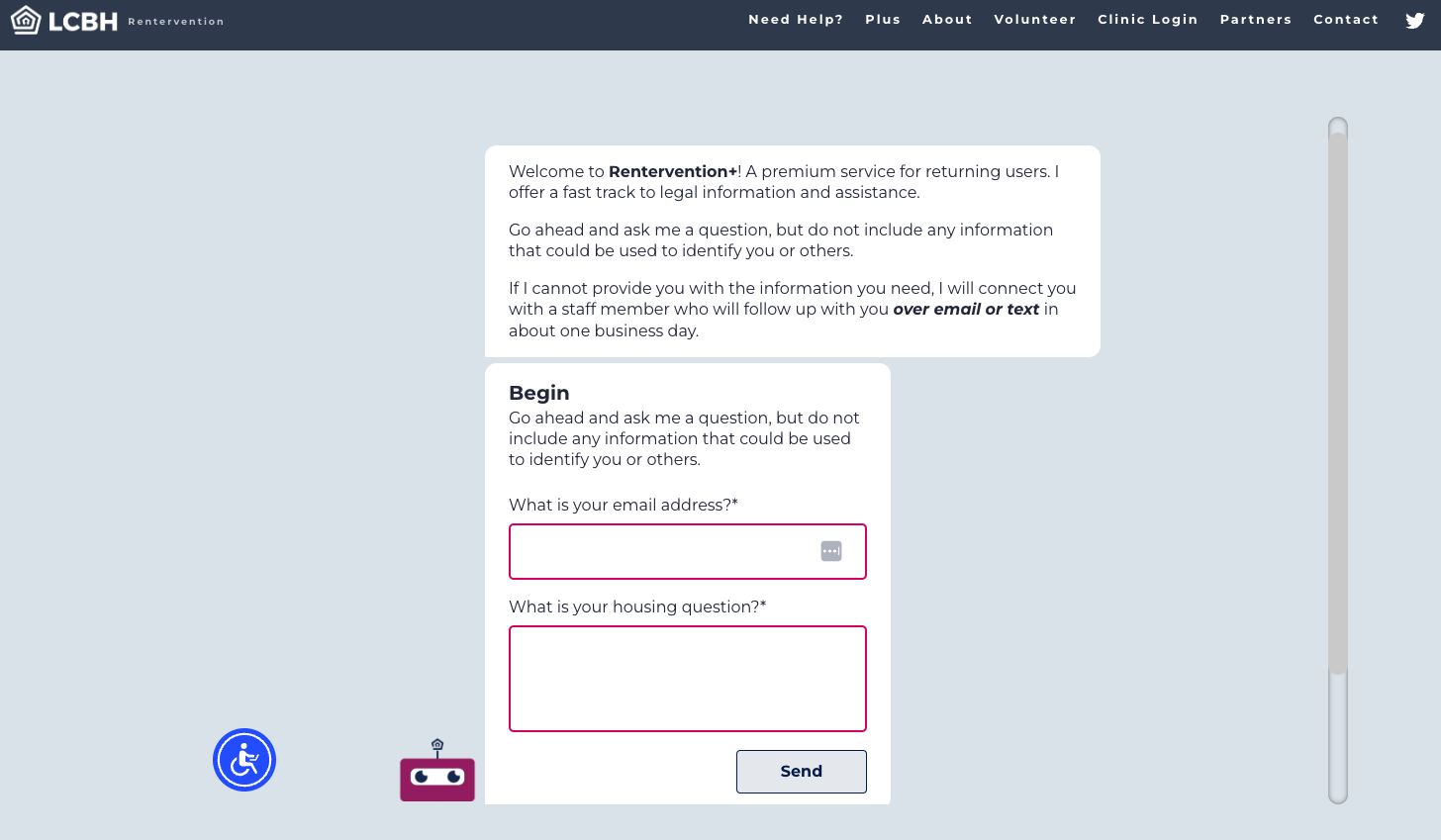
4. **[Rentervention “Renny” in Chicago](https://rentervention.com/)**
- **Focus**: Tenant rights, drafting demand letters, and guiding eviction defenses.
- **Benefit**: Helps individuals address housing issues early, often avoiding formal eviction proceedings.
- **Big Picture**: An example of how specialized, issue-specific AI can empower communities.
---
## Chapter Recap
In this chapter, we explored how generative AI tools can transform access to justice efforts and the delivery of pro bono services, particularly for low-income and marginalized communities. Major takeaways include:
- **The Current State of Access to Justice (2021–2023):** Overburdened courts, underfunded legal aid, and public defender shortages continue to leave millions of Americans without adequate representation. Although the pandemic spurred remote hearings and new innovations, disparities by income, race, and geography persist.
- **Key Challenges in Traditional Models:** Funding gaps, legal complexity, and the inability to serve everyone who qualifies for aid often translate into long waitlists and turn-aways. Rural “legal deserts” exacerbate these inequalities, and even well-organized pro bono programs cannot meet soaring demand for free legal help.
- **Generative AI as a ‘Force Multiplier’:** Advanced chatbots, document automation tools, and AI-assisted research platforms can rapidly handle intake, draft pleadings, summarize case law, and even provide initial guidance to pro se litigants, thereby helping legal professionals focus on high-level advocacy.
- **Potential Future Impact:** AI can increase efficiency and scale, reaching more people through online interfaces and enabling legal aid agencies to serve a greater number of clients with limited staff. Additionally, affordability is improved when routine tasks become automated, lowering overhead for nonprofits.
- **Ethical and Practical Considerations:** AI “hallucinations,” bias in training data, confidentiality risks, and the need for human oversight require careful planning. Lawyers must remain vigilant about verifying AI outputs, complying with unauthorized practice of law rules, and addressing the digital divide so that technology benefits rather than excludes vulnerable populations.
- **Comparisons and Real-World Use Cases:** From chatbots guiding tenants through eviction responses to AI platforms reviewing voluminous evidence for public defenders, practical initiatives across the country illustrate both the promise and the challenges of integrating AI into access to justice work.
With responsible implementation and a focus on user-friendly design, these tools have the potential to significantly narrow the justice gap, while preserving the vital human dimension of lawyering that technology can never fully replicate.
---
## Final Thoughts
Technology alone cannot solve the deeply rooted inequities in our legal system, but generative AI offers a powerful catalyst for change. As the legal profession confronts chronic underfunding, overwhelming caseloads, and widespread underrepresentation, the combination of human insight and technological efficiency shows remarkable promise. Real-world successes, from AI-powered eviction defense chatbots to advanced analytics for discovery review, demonstrate how thoughtful implementation can help us reach more people faster and more affordably.
These tools demand vigilant stewardship to prevent amplifying existing problems. AI "hallucinations," biased training data, and confidentiality risks require consistent supervision and verification. The responsibility falls on legal professionals at all levels to ensure technology serves our ethical obligations rather than undermining them.
The most exciting prospect is how generative AI can help reduce the persistent justice gap when paired with our professional duty and compassion. By cultivating an approach that balances technological innovation with human connection, we can make "justice for all" more achievable. This path, while challenging, offers profound rewards for those committed to the ideals of our profession, scaling our impact while preserving the ethical foundation of meaningful justice.
---
## What’s Next?
In **Chapter 10**, we’ll bring together the major themes and lessons from **Chapters 6–9** in a comprehensive review session. This will give you a chance to reinforce key concepts about generative AI’s technical foundations, ethical obligations, and practical uses in the legal system. We’ll revisit the essential points from each chapter, ranging from prompt engineering, to the impact of AI on the business and practice of law, to ethics and the regulatory considerations that guide responsible deployment.
With the help of your textbook, chatbot tutor, podcast, and minilecture, you will have the structured, focused review you need to walk into the next multiple choice exam with confidence.
---
## References
American Bar Association & National Center for State Courts (2023). *Public Defender Caseload Standards and the Future of Indigent Defense.*
Biron, C. (2024). Legal aid and AI help poor Americans close ‘justice gap’. *Context by Thomson Reuters Foundation*.
Chien, C. & Kim, M. (2025), Generative AI and Legal Aid: Results from a Field Study and 100 Use Cases to Bridge the Access to Justice Gap, *57 Loy. L.A. L. Rev. 903.*
Legal Aid of North Carolina (2024). *Press release: LANC launches AI-powered virtual assistant to enhance access to justice.*
Legal Services Corporation (2022). *The Justice Gap: The Unmet Civil Legal Needs of Low-Income Americans.*
Pro Bono Institute (2024). *AI Ethics in Law: Emerging Considerations for Pro Bono Work and Access to Justice.*
Pew Charitable Trusts (2020). *Debt Collection and the Transformation of State Courts.*
Safdie, L. (2025). AI and legal aid: A generational opportunity for access to justice. *Thomson Reuters Institute.*
Washington Council of Lawyers (2024). *Best Practices in Pro Bono: Using AI to Further Access to Justice.*
ABA Journal (2025). *Access to Justice 2.0: How AI-Powered Software Can Bridge the Gap.*
# Chapter 10: Seeing the Big Picture – A Review of Chapters 6–9
## Chapter Overview
This chapter serves as a thorough review of the key concepts from Chapters 6–9, taking time to highlight the most important lessons, connect overarching themes, and offer reflection points to encourage deeper engagement with the material.
## Purpose of This Chapter
Over the last few chapters (6–9), you’ve explored the nuts and bolts of using AI in the legal profession, with discussions on:
- **Prompt Engineering and RAG (Chapter 6)** – How to communicate effectively with AI models and use external data to make AI outputs more accurate.
- **The Impact of AI on Law Practice (Chapter 7)** – Ways that AI is reshaping the day-to-day roles of lawyers and the business models of law firms.
- **Ethical and Regulatory Concerns (Chapter 8)** – The rules, guidelines, and real-world examples that show how using AI carries serious responsibilities and requires careful oversight.
- **Access to Justice and Pro Bono (Chapter 9)** – How AI might help bridge the gap between people’s legal needs and the available resources, especially for underserved communities.
Chapter 10 is your opportunity to bring all of these ideas together. Specifically, this chapter aims to:
- **Summarize** the main themes, tools, and best practices introduced in Chapters 6–9.
- **Highlight connections** across different AI topics, such as how better prompt engineering leads to more effective pro bono solutions or how ethics rules intersect with AI-driven law firm business models.
- **Pose key reflection questions** that help you link the technical, professional, and social aspects of AI in law.
- **Prepare you** for upcoming exams, projects, or real-world scenarios where integrating AI insights from multiple chapters will be crucial.
## Why This Review Is Important
Taking the time to review chapters 6–9 isn’t just about checking off a task. It’s a chance to:
1. **Strengthen Your Understanding**
By recapping the key points, you’ll ensure that the concepts, like refining AI prompts or navigating ethical pitfalls, stick with you for the long run.
2. **See the Big Picture**
It’s easy to get lost in individual topics such as RAG or court disclosure rules. A careful review helps you see how all these ideas fit together to shape the future of legal practice.
3. **Boost Confidence**
You’ll likely face class discussions, exams, or hands-on tasks that require you to recall what you’ve learned across multiple chapters. Reviewing now sets you up to speak and act with authority.
4. **Improve Real-World Readiness**
As AI becomes more common in law firms, legal aid groups, and the courts, a solid grasp of both the benefits and the ethical responsibilities will set you apart as a forward-thinking yet responsible professional.
Think of this chapter as a guided walkthrough of your newly acquired toolkit. As we revisit each chapter’s highlights, you’ll gain a stronger sense of how to apply AI in your legal work: responsibly, effectively, and with a clear view of the larger social and ethical context.
---
## Summary of Key Concepts (by Chapter)
### Chapter 6: Prompt Engineering and RAG
In **Chapter 6**, we turned our attention to two pivotal ideas: **Prompt Engineering**, the craft of writing effective instructions for AI tools, and **Retrieval-Augmented Generation (RAG)**, a technique that helps AI models cite or incorporate external data. Let’s break it down:
1. **Prompt Engineering 101**
- **Naive vs. Informed Prompts:** Naive prompts are vague (e.g., “Write a summary of contract law”), whereas informed prompts give the AI context, desired format, length, or purpose (e.g., “Write a one-page summary of California contract law focusing on consideration, aimed at a first-year law student”).
- **The ‘Garbage In, Garbage Out’ Principle:** If your prompt is sloppy or missing essential context, the AI’s output is more likely to be off-topic or inaccurate.
- **AI as an ‘Oracle’ vs. AI as a ‘Helpful Assistant’:**
- Oracle Mindset: Believing AI is infallible.
- Helpful Assistant Mindset: Recognizing AI can be extremely useful but also prone to errors or hallucinations, so it must be guided and checked by a human.
- **Prompt Engineering Frameworks:**
- **RTF (Role–Task–Format)**
“You are [Role]. Your task is to [Task]. Produce your answer in [Format].”
- **RISEN (Role–Instructions–Steps–End Goal–Narrowing)**
Breaking down tasks into steps and clarifying the final deliverable.
- **CRAFT (Context–Role–Action–Format–Target Audience)**
Particularly useful for ensuring the AI’s tone and complexity match the intended reader.
2. **Advanced Prompting Techniques**
- **Meta-Prompting:** Using AI to help refine the instructions you feed to the same or another AI.
- **Iterative Refinement:** Sending multiple rounds of prompts, each time clarifying or improving the AI’s output.
- **Bootstrapping:** Employing multiple AI models for different phases of a single process, one for outlining, another for drafting, yet another for critique.
3. **Retrieval-Augmented Generation (RAG)**
- **What RAG Does:** Instead of relying solely on an AI’s internal “memory,” RAG fetches external documents (cases, statutes, client files) and feeds them into the AI’s generation process. This “grounds” the AI’s answers in real data.
- **Naive vs. Enhanced RAG:**
- Naive RAG might do one quick search and feed a chunk of text to the AI.
- Enhanced RAG might refine or break down a complex query into multiple sub-queries, re-rank retrieved documents, and reduce irrelevant info or “hallucinations.”
- **Benefits:**
- **Fewer Hallucinations:** Because the AI can see real documents, it’s less likely to invent them.
- **Up-to-Date Information:** The AI can reference the latest statutes, cases, or facts, even if they occurred after the AI’s training cutoff date.
- **Real-World Applications:**
- Legal research platforms that incorporate RAG for rapid case-law retrieval.
- E-discovery solutions that ground their summarized findings in actual evidence.
- Client onboarding chatbots pulling data from a case-management system.
**Key Takeaways from Chapter 6**
- A well-crafted prompt significantly improves AI output.
- Always treat AI as a capable assistant that still requires your review.
- RAG reduces AI hallucinations and keeps answers current, making it especially critical for legal tasks involving real-time legal changes.
---
### Chapter 7: Impact of AI on the Business and Practice of Law
**Chapter 7** looked beyond how AI functions and instead examined **how AI is reshaping law firms, legal departments, and the profession’s day-to-day business model**:
1. **AI Automation of Routine Tasks**
- **Legal Research:** AI can comb through massive databases in seconds, highlighting relevant precedents or regulations.
- **Document Drafting:** First drafts of contracts, memoranda, or pleadings can be generated quickly, leaving lawyers more time for strategic thinking.
- **Contract Review & Due Diligence:** AI can flag unusual clauses, highlight missing sections, or compare different versions.
2. **Shifting Roles and Responsibilities**
- **Junior Lawyers:** Tasks historically done by new associates (like cite-checking) are increasingly done by AI. Juniors might instead focus on more strategic or client-facing tasks earlier in their careers.
- **Senior Lawyers:** Less time might be spent delegating tasks to large teams. Instead, they oversee AI workflows and refine the content or analysis AI produces.
- **Support Staff:** Paralegals or legal secretaries may transition into roles like “AI tool operator” or “data curator,” ensuring the AI is used effectively.
3. **Changing Law Firm Business Models**
- **Hourly Billing Under Pressure:** If AI completes tasks faster, clients may question the value of hourly rates for that work.
- **Alternative Fee Arrangements (AFAs):** Flat-fee or project-based pricing can become more common as AI improves predictability and efficiency.
- **Productized Legal Services:** Some firms package AI-driven solutions, like a custom contract analyzer, and sell subscriptions, moving from a purely service-based model to a hybrid product-service approach.
4. **Jevons’ Paradox and Increased Demand**
- AI might lower the cost of routine legal tasks, **potentially leading to more overall demand** for legal services.
- The same phenomenon was observed with ATMs in banking, rather than eliminating bank tellers, the lower cost of service increased the number of bank branches and overall jobs.
5. **Evolving Client Expectations**
- **Speed and Responsiveness:** Corporate and individual clients expect answers or documents quickly, AI helps meet these timelines.
- **Cost Control and Predictability:** Clients push for more certainty around legal fees.
- **Integration with Corporate Systems:** In-house legal departments might use AI tools, expecting outside counsel to collaborate seamlessly.
6. **Advice for Law Students and Early-Career Lawyers**
- Familiarity with technology is increasingly vital.
- Cultivate “soft skills” (like empathy and client communication) that machines cannot replicate.
- Experiment with alternative roles in legal tech, legal operations, or data analysis.
**Key Takeaways from Chapter 7**
- AI doesn’t just change how tasks are done; it can **fundamentally shift law firm economics and workflows**.
- Lawyers who embrace AI may handle more strategic matters, while routine tasks become automated.
- New fee structures (flat fees, subscriptions) are emerging, propelled by AI-driven efficiencies.
---
### Chapter 8: Ethical and Regulatory Implications of AI in Law
In **Chapter 8**, we focused on how the legal profession’s ethical duties apply to AI usage:
1. **Existing Rules Apply to AI**
- **Duty of Competence (ABA Model Rule 1.1):** Lawyers must understand the “benefits and risks” of technology. Not knowing how AI hallucinates or retains data could violate this rule.
- **Confidentiality (ABA Model Rule 1.6):** Attorneys are responsible for protecting client information, meaning they must confirm that an AI tool will not expose or misuse the data.
- **Candor (ABA Model Rule 3.3):** Submitting an AI-generated brief with fabricated citations is unethical and can lead to severe sanctions.
2. **Key Ethical Issues**
- **Hallucinations:** AI making up facts, citations, or references can mislead courts and clients.
- **Informed Consent:** If an attorney shares client data with a cloud-based AI platform, the client may need to consent (especially if there’s a risk of data retention by the AI provider).
- **Unauthorized Practice of Law (UPL):** If an AI chatbot gives specific legal advice directly to a client without attorney oversight, it might be seen as unauthorized practice.
- **Bias:** AI models trained on skewed data might produce results that disadvantage minority groups or replicate historical inequalities.
3. **Court Orders and Disclosures**
- Some federal judges (e.g., in the Northern District of Texas) now require attorneys to disclose if they used AI in drafting documents.
- Attorneys who rely on AI must **certify** they verified each citation and fact.
4. **Real-World Disciplinary Cases**
- **Mata v. Avianca (S.D.N.Y.):** A lawyer was sanctioned for citing six non-existent cases invented by ChatGPT.
- **Park v. Kim (2d Cir.):** Another instance where an attorney faced disciplinary action for AI-fabricated citations.
5. **Mitigating Risks**
- **Verification Steps:** Always check AI-suggested cases in a reputable legal database.
- **Confidentiality Protections:** Redact client details before feeding text to a public AI platform, or consider a private/enterprise solution.
- **Clear Policies:** Many law firms create internal guidelines on AI usage, covering data security, disclaimers, and mandatory human review.
6. **Bias and Fairness**
- **Sources of Bias:** Datasets with historical discrimination or incomplete representation.
- **Practical Mitigation:** Regular audits, “bias checks,” and combining AI outputs with human oversight to prevent discriminatory or unjust results.
**Key Takeaways from Chapter 8**
- AI use in law must be guided by **existing ethical rules** and **heightened diligence** due to AI’s tendency to hallucinate.
- **Transparency** about AI usage, when it was used, how citations were verified, is crucial in many jurisdictions.
- Lawyers remain fully responsible for their filings and client data, even when assisted by AI.
---
### Chapter 9: Rethinking Access to Justice and Pro Bono
Finally, **Chapter 9** explored how generative AI might address **one of the largest problems in the legal world: the justice gap**. Millions of people cannot afford lawyers, while legal aid organizations and public defender offices are chronically underfunded.
1. **The Justice Gap**
- Many low-income individuals, facing urgent civil cases (evictions, domestic violence, consumer debt), go without legal representation.
- Public defenders often carry enormous caseloads, limiting time for proper client support.
2. **Constraints on Traditional Pro Bono**
- Dependence on volunteer hours and unpredictable funding.
- Limited coverage in rural “legal deserts” where few attorneys practice.
- Overwhelming need far outstrips capacity, leading to waitlists or turn-aways.
3. **Generative AI as a Force Multiplier**
- **Document Automation:** Automated drafting and form completion can scale legal aid outreach dramatically.
- **24/7 Chatbots:** Self-help systems for people who can’t easily reach a lawyer in person.
- **Scalability:** AI can handle thousands of queries simultaneously, improving response times.
- **Affordability:** By automating routine tasks, organizations can stretch limited budgets to serve more clients.
4. **Real-World Pilots and Examples**
- **Legal Aid of North Carolina’s “LIA”:** LIA is an AI-powered virtual assistant designed for clients seeking help with housing, family law, and domestic violence matters. It converses in multiple languages, provides quick answers to frequently asked questions, and can generate draft legal forms. By automating common inquiries, LIA frees up attorneys to handle more complex or urgent cases, effectively expanding the organization’s capacity to serve low-income communities.
- **State of Nevada Courts:** Implemented AI-driven self-help kiosks in public libraries, enabling litigants to fill forms or file small-claims suits anytime.
- **Rentervention “Renny” in Chicago:** A chatbot assisting tenants with rent disputes and eviction defense letters.
5. **Ethical and Practical Considerations**
- AI solutions must be accessible to those with low tech literacy or limited internet.
- **UPL Boundaries:** Tools providing “information” are safer than those that go too far into tailored legal advice.
- **Data Security for Vulnerable Clients:** Survivors of domestic violence or undocumented individuals may face unique risks if their personal data is compromised.
6. **Looking Forward: AI and A2J**
- AI cannot solve all structural problems (like lack of funding or broader socio-economic inequalities).
- With vigilant oversight, generative AI can lighten the load on understaffed legal aid offices, help pro se litigants navigate the system, and empower more attorneys to offer pro bono services effectively.
**Key Takeaways from Chapter 9**
- While no technology is a cure-all, generative AI has **major potential** to reduce waitlists, automate simple legal tasks, and widen access to justice for underserved communities.
- Thoughtful design and thorough oversight are essential to ensure that AI benefits, rather than further alienates, marginalized groups.
---
## Themes and Connections
### 1. Human Oversight and Responsibility
Across Chapters 6–9, the dominant theme is that **AI is a powerful helper, but the human lawyer remains the final authority**:
- In **Prompt Engineering**, you must shape AI’s output by giving it the right instructions.
- In **Law Firm Practice**, you must supervise AI to ensure your analysis and final deliverables meet professional standards.
- In **Ethics**, you stay accountable for any AI-driven errors or misrepresentations.
- In **Access to Justice**, you leverage AI to scale services but still have to ensure fairness and confidentiality.
### 2. Efficiency vs. Ethical Diligence
AI boosts efficiency, but new ethical or procedural steps, like verifying citations or disclosing AI usage, can also add complexity. As you adopt AI:
- Keep a careful **balance** between speed and accuracy.
- Think about how that efficiency changes your firm’s fee model, staffing, and compliance checks.
### 3. Evolving Regulatory Climate
As seen in Chapter 8, court orders are popping up requiring attorneys to disclose AI use. Some states are moving faster than others. In the context of Chapter 9’s pro bono discussion, these rules could also affect legal-aid organizations and how they deliver online services. **Staying up-to-date on regulations** is now a continuous part of practicing law.
### 4. Access and Inclusivity
Chapters 7 and 9 both emphasize how AI can widen or narrow the gap in legal services:
- **Widen the Gap?** If only wealthy firms harness AI, it might further disadvantage smaller firms or pro se litigants without resources.
- **Narrow the Gap?** If properly deployed in legal aid or public defense, AI can make crucial services more accessible and affordable.
### 5. Interdisciplinary Skills
From prompt engineering to analyzing potential biases, attorneys in this new era often need “T-shaped” skills (broad familiarity with tech, plus deep legal knowledge). Technology is **no longer an optional extra** in law; it’s an integral part of delivering modern legal services.
---
## Cumulative Knowledge: Building Toward Mastery
Looking at Chapters 6–9 together:
- You now know **how** to interact effectively with AI (Chapter 6).
- You’ve explored **why** AI matters so much to law’s operational and financial structures (Chapter 7).
- You understand the **ethical backbone** that ensures AI is used responsibly (Chapter 8).
- You see AI’s **potential to transform pro bono and close the justice gap** (Chapter 9).
All these elements combine into one question: **How can we, as future and current lawyers, harness technology ethically and effectively to serve clients, advance justice, and remain competitive?**
---
## Key Questions or Reflection Points
Here are some prompts to think about, either on your own or in a study group:
1. **Prompt Crafting**
- If you need an AI to produce a well-researched memo on a new environmental regulation, what details would you include in your prompt to avoid a vague or incomplete result?
2. **Law Firm Business Models**
- How might automating contract review and discovery impact a mid-sized firm’s approach to recruiting junior associates?
3. **Ethical Dilemmas**
- If you discover that your AI-based drafting tool sometimes “hallucinates” case citations, how do you design a verification workflow to minimize risk?
4. **Bridging the Justice Gap**
- Suppose you’re on the board of a legal aid nonprofit. You receive a grant to invest in a generative AI system. What steps would you take to ensure it meaningfully improves client outcomes, rather than just increasing your data or operational complexity?
5. **Managing Bias**
- If an AI tool for sentencing recommendations seems to produce harsher outcomes for minority defendants, how might you investigate and address that bias?
6. **UPL Concerns**
- Where is the line between giving “legal information” and “legal advice” in an AI-powered chatbot for self-represented litigants? How would you design disclaimers or workflows to stay compliant?
Take some time to jot down a few thoughts in writing or discuss these questions with classmates. Reflection is crucial for practical mastery in a rapidly evolving field.
---
## Tables and Diagrams for Comprehension
Below is a concise table summarizing each chapter’s core themes, major ideas, and recommended “best practice” actions.
| **Chapter** | **Key Topics** | **Major Ideas** | **Best Practices** |
|-------------|-------------------------------------------------------------------|---------------------------------------------------------------------------|-----------------------------------------------------------------------------------------------------------------------|
| 6: Prompt Engineering & RAG | - Crafting Effective Prompts - Retrieval-Augmented Generation | - Naive vs. informed prompts - RTF, RISEN, CRAFT frameworks - RAG reduces hallucinations | - Always specify role & context in prompts - Use iterative refinement to improve output - Verify retrieved data |
| 7: AI & Legal Business | - Business Model Evolution - Changing Lawyer Roles - Alternative Fee Structures | - Automation of routine tasks - Flattening firm hierarchies - AI as “force multiplier” | - Embrace AFAs and productized services - Re-train staff for AI oversight - Keep a balance: technology & human expertise |
| 8: Ethics & Regulation | - Confidentiality - Competence & Candor - Unauthorized Practice of Law | - You’re still responsible for AI errors - Must protect client secrets - Disclose AI usage in some courts | - Verify AI outputs in recognized legal databases - Use disclaimers & informed consent - Track new bar/court requirements |
| 9: Access to Justice | - Justice Gap - Pro Bono Innovations - AI-Assisted Legal Aid | - AI chatbots for self-help - Potential for 24/7 service - Ethical pitfalls (UPL, bias) | - Provide plain-language disclaimers - Pair AI with human legal oversight - Plan for low-tech & offline resources |
---
## Practice Tips
1. **For Immediate Use:**
- Try applying prompt engineering frameworks (Chapter 6) when asking your favorite AI tool for help with outlines or reading-case summaries.
- Consider a short experiment with RAG-based solutions for a small research project, ensuring you cross-check the AI’s citations.
- Review vocabulary terms in the [Glossary](https://books.lawdroidmanifesto.com/3/generative-ai-and-the-delivery-of-legal-services/81/glossary).
2. **Long-Term Strategy:**
- Stay abreast of new developments in law firm management (Chapter 7). If your firm still relies on traditional billing structures, think about how to introduce more efficient, client-friendly ways of charging.
- Review your state bar’s ethics opinions regularly (Chapter 8). Requirements around AI usage are changing quickly.
- Engage with nonprofits or legal-aid organizations (Chapter 9). Look for ways to pilot AI-based solutions that can scale pro bono efforts.
3. **Career Development:**
- Develop “T-shaped” skills, mastering legal doctrine but also learning enough about AI’s technical underpinnings to ensure you use these tools responsibly.
- Watch for conferences or workshops on AI and the law. Networking in these spaces can open up new roles, from AI policy advisor to legal-tech entrepreneur.
---
## Final Thoughts on Chapters 6–9
Collectively, these four chapters reveal a changing legal profession:
- **Technology** is no longer an optional add-on but a core driver of how services are delivered.
- **Ethical caution** must accompany every new tool. Lawyers are guardians of truth, confidentiality, and fairness in the legal system.
- **Access to justice** stands at a crossroads, with generative AI offering tangible new ways to help those who have historically been excluded from effective legal representation.
Remember that while AI can ease certain burdens, the “human element” remains essential. No matter how advanced generative AI becomes, empathy, critical judgment, moral reasoning, and the ability to form trusting relationships with clients remain uniquely human abilities. Balancing automation and personal connection is key to delivering just, ethical, and compassionate legal services.
---
## References
- American Bar Association. (2023). ABA Model Rules of Professional Conduct. ABA Publishing.
- Biron, C. (2024). Legal aid and AI help poor Americans close ‘justice gap’. Thomson Reuters Foundation.
- Clio. (2024). *Legal Trends Report*. Clio.
- Legal Services Corporation. (2022). *The Justice Gap: The unmet civil legal needs of low-income Americans.* LSC.
- Thomson Reuters. (2024). *Future of Professionals Report*. Thomson Reuters.
- Wolters Kluwer. (2024). *Future Ready Lawyer Survey Report.* Wolters Kluwer.
Part III: Generative AI Strategy, Change Management, and Professional Growth
# Chapter 11: Cultivating a Culture of Innovation and Continuous Learning
## Chapter Overview
Welcome to Chapter 11, where we will explore how law firms, legal departments, and individual lawyers can foster a supportive environment for innovation and continuous learning. We will pay particular attention to the role of Generative AI and the organizational and cultural factors that encourage (or hinder) its successful adoption in the legal profession.
Simply acquiring an AI tool won’t transform a firm. Attorneys and staff must be **willing** and **able** to innovate. That means cultivating a mindset open to experimentation, refining processes through trial and error, and committing to ongoing professional development. Successful AI integration requires addressing psychological barriers, implementing structured change management, fostering collaboration across different roles, measuring real returns, and embracing continuous learning.
Upon successful completion of this chapter, students should be able to:
1. **Analyze** the psychological factors that drive resistance to AI adoption in legal practice and propose specific reframing techniques to address such resistance.
2. **Design** a structured change management plan using pilot projects, dedicated AI teams, and targeted training strategies aligned with firm objectives.
3. **Evaluate** the effectiveness of cross-disciplinary collaboration by identifying key stakeholders, defining collaborative processes, and overcoming common barriers.
4. **Apply** relevant metrics and methodologies to measure return on investment (ROI) for AI implementations, interpreting both quantitative and qualitative data.
Let's begin by reviewing some of the common barriers to legal innovation.
---
## Common Barriers to Innovation in Law
Despite growing awareness and clear benefits, many law firms struggle to innovate. Let’s examine some of the most pervasive challenges.
### 1. Resistance to Change
Lawyers are trained to be risk-averse. Arguably, that’s part of their job: to protect clients from unknown pitfalls. Unfortunately, this cautious mindset can stand in the way of adopting new tools or workflows. A 2023 Altman Weil survey indicated that in 69% of firms, partners actively resist most change efforts.
> **Example**
> A mid-sized firm in the Midwest introduced a new AI-based document review system. Although the technology was simple to use, many senior partners insisted on their traditional methods, slowing down adoption firm-wide. By the time they worked out the kinks, competitors had already integrated AI more seamlessly, winning major clients seeking tech-savvy advisors.
### 2. Misaligned Incentives
In the traditional “billable hour” model, technology that reduces the time needed for routine tasks can seem like a financial threat. If lawyers earn by the hour, speeding up tasks might mean less revenue, unless the firm adjusts its billing structures.
> **Practice Pointer – Alternative Fee Arrangements**
> Consider exploring **flat fees, subscription models, or value-based billing** to align law firm revenues with the **value** delivered rather than the **time** spent. By adjusting billing structures, firms can **reward** innovation that yields faster or higher-quality outcomes, rather than penalizing it.
### 3. Lack of Tech Confidence
Many lawyers have not received formal training in data analysis, coding, or AI. A 2023 Wolters Kluwer survey found only 18.5% of lawyers feel they have **adequate training** in their firm’s technology. Even the most user-friendly AI tool may appear intimidating if lawyers lack basic digital skills.
### 4. Data and Privacy Concerns
Ethical rules around confidentiality and data security can discourage innovation. Lawyers understandably worry about privacy breaches and compliance. This is especially important for generative AI systems, which require massive amounts of information to “train,” potentially raising concerns about privileged client data or sensitive legal strategies.
### 5. Fear of Failure
Law firm cultures often celebrate precision and reliability, leaving little room for experimentation or mistakes. According to a Deloitte study, fear of reputational damage is one of the top concerns hindering technology innovation in law firms.
---
## Why Innovation Matters More Than Ever
### 1. Client Expectations
Today’s clients have grown accustomed to instant communication, online services, and transparent pricing in every other aspect of their lives. They expect the same level of efficiency and clarity from their lawyers.
### 2.Competitive Pressure
Alternative Legal Service Providers (ALSPs), legal tech startups, and even traditional consulting firms are stepping into roles once reserved for law firms, offering tech-driven, cost-effective solutions.
### 3. Ethical and Professional Obligations
The American Bar Association and various state bars have begun emphasizing “technology competence” as part of a lawyer’s duties. Failing to stay current might soon be seen as a lapse in professional judgment.
These factors mean that fostering an environment where lawyers and staff continually learn and experiment isn’t just a nice bonu; it’s becoming a core aspect of what it means to practice law responsibly and effectively.
---
## The Psychology of Change in Legal Innovation
Despite these barriers, there are proven strategies for overcoming them. This section delves deeper into the **psychological** and **cultural** factors that shape how lawyers respond to AI and other technological changes.
### Understanding Resistance to Technological Change
Resistance is **natural**. Many attorneys have spent years honing their methods and building a client base that trusts them to do things “the old-fashioned way.” From a psychological perspective, resistance often emerges because of:
- **Fear of competency loss**: “I’m worried I won’t be good at this new system.”
- **Disruption of established workflows**: “Why change what works?”
- **Uncertainty about outcomes**: “How can we be sure this will actually help?”
- **Concerns about professional identity**: “If a machine does my work, am I still a trusted advisor?”
> **Key Term Callout**
> **Resistance**: An emotional or cognitive pushback against change, often fueled by uncertainty, anxiety, or a perceived threat to established norms.
### Reframing AI Adoption
**Reframing** is a technique that shifts how we perceive new developments. Instead of viewing AI as a threat, see it as a **“force multiplier.”** That means:
- **Augmentation, not replacement**: Like Iron Man’s suit, AI enhances human capabilities; it doesn’t diminish the lawyer’s essential role.
- **Focus on tangible outcomes**: Talk about the *benefits* (e.g., saving time, serving more clients, reducing stress).
- **Use data-driven evidence**: Reports show attorneys using AI can save up to four hours per week and gain $100,000 in new billable hours annually.
### Building Self-Efficacy
**Self-efficacy**, confidence in one’s ability to perform tasks successfully, is crucial. People with high self-efficacy approach challenges with a “can do” attitude, while those with low self-efficacy tend to avoid them. You can build self-efficacy by:
1. **Mastery experiences**: Start small, let lawyers succeed in limited pilot projects.
2. **Vicarious experiences**: Encourage success stories or “show-and-tell” sessions.
3. **Positive feedback**: Praise lawyers for attempting something new.
4. **Emotional well-being**: Provide enough support and resources so attorneys don’t feel overwhelmed.
> **Scenario**: A small family law firm pilots an AI-driven document drafting tool for uncontested divorces. Junior associates, initially wary, discover they can draft forms 30% faster with fewer errors. After a few successes, they share their wins at a firm meeting. Senior attorneys, seeing the positive results, start requesting training, too.
---
## Key Strategies to Overcome Barriers to Legal Innovation
### 1. Top-Down Leadership and Vision
For innovation to take root, law firm leaders must articulate a clear, forward-thinking vision and model the behavior they want to see. Consider how:
- **Managing Partners**: Can periodically address the firm on the importance of staying ahead in legal tech.
- **Chief Innovation Officers (CIO)**: Although a relatively new role in law, they can coordinate tech initiatives, secure budgets, and facilitate firm-wide training.
> **Scenario – Leadership in Action**: Imagine a managing partner announces a firm-wide “Tech Initiative Quarter” to explore generative AI for contract analysis. They form a small committee of associates, paralegals, and partners to evaluate various AI platforms. They also budget for training sessions and reward practice groups that successfully implement at least one pilot project.
### 2. Create a “Safe to Experiment” Culture
Innovation requires experimentation. Lawyers and staff should be encouraged to share new ideas, even if not all of them pan out. This cultural shift can be supported by:
- **Hackathons and Innovation Days**: Hosting firm-wide events that bring teams together to tackle mini tech challenges.
- **Pilot Projects**: Trying generative AI in a small, low-risk matter before rolling it out more broadly.
> **Practice Pointer – Overcoming Risk Aversion**
> - **Pilot in Low-Stakes Environments**: Use new tools on internal projects or less sensitive cases to build confidence.
> - **Set Clear Goals and Metrics**: Define success criteria. For example, “Use AI to reduce first-draft contract review time by 30%.”
> - **Document and Share Lessons**: Whether a pilot fails or succeeds, record what you learned. This shared knowledge helps the entire firm make more informed decisions about the next experiment.
---
## A Framework for Change Management in Legal Organizations
AI adoption works best with **intentional planning**. Inspired by Andrew Ng’s "AI Transformation Playbook," here’s a five-step roadmap:
### 1. Overcome Skepticism Through Pilot Projects
- **Start small** with a well-defined project.
- **Pick tasks** that are repetitive, time-consuming, and easy to measure (e.g., drafting, research).
- **Show quick wins** to build confidence and demonstrate tangible benefits.
> **Practice Pointer**
> **Quick Wins**: Identifying tasks like document review or basic contract generation is often a good first step. These are routine, easily measured, and clearly beneficial when automated.
### 2. Create a Dedicated AI Team
Establish a group (or point person) responsible for:
- Identifying AI opportunities.
- Evaluating and selecting tools.
- Providing training and ongoing support.
- Monitoring and measuring project outcomes.
> **Key Term Callout**
> **Accountability**: Ensuring someone or a group is explicitly tasked with seeing AI initiatives through to completion, not just starting them.
### 3. Emphasize Practical AI Training
Lawyers need **hands-on** practice with AI tools, not just theory. Effective training methods include:
- **Short workshops** on specific tasks (e.g., AI-assisted legal research).
- **One-on-one sessions** for personalized coaching.
- **Scenario-based learning**: Use realistic examples and let attorneys experiment.
### 4. Develop an AI Strategy Aligned with Business Needs
To secure long-term success:
- **Tie AI projects to concrete goals** (e.g., boost profitability, reduce turnaround times, improve client satisfaction).
- **Plan resource allocation** (budget, time, staff training).
- **Address ethical and regulatory concerns** from the outset.
> **Scenario**: A commercial litigation firm sets a goal to reduce average research time by 25% within six months. They allocate a budget for research-focused AI tools, train each associate on the tools, and regularly check progress using time-tracking software. Over time, they align their strategy to refine these tools based on user feedback.
---
## Cross-Disciplinary Collaboration in AI Implementation
To **evaluate** how effectively different teams can cooperate and innovate, it’s essential to bring varied skill sets into the AI adoption process.
### Building Effective Cross-Functional Teams
AI implementation isn’t just an IT task. Involve:
- **Legal practitioners**: Subject-matter experts who can identify real-world needs.
- **Knowledge managers**: Specialists in organizing firm know-how.
- **IT professionals**: Experts on security, software, and infrastructure.
- **Data specialists**: Advisors on data governance, privacy, and analysis.
- **Operations managers**: Oversee workflows and process efficiency.
### Developing Collaborative Processes
- **Regular innovation meetings**: Monthly or quarterly gatherings to share project updates.
- **Shared digital workspaces**: Tools like Slack or Microsoft Teams that encourage open, ongoing communication.
- **Structured feedback loops**: Collect performance data and user experiences, then iterate.
### Engaging External Partners
Many law firms find it beneficial to collaborate with:
- **Universities**: Access to fresh research and student talent.
- **Legal tech vendors**: Co-develop solutions tailored to specific firm needs.
- **Clients**: Working alongside tech-forward clients can lead to tools that solve real-world problems.
- **Industry consortia**: Share best practices and emerging standards with peers.
> **Practice Pointer**
> **For Small Firms**: If you can’t afford a full-time data scientist or AI engineer, look to local universities or bar associations. They often have programs designed to connect smaller firms with resources for cost-effective innovation.
### Overcoming Collaboration Barriers
- **Language differences**: Lawyers, IT staff, and data experts may each use specialized jargon. Create a shared glossary.
- **Hierarchies**: Make sure everyone in an innovation team, regardless of rank, is heard.
- **Competing goals**: Align AI projects with each department’s KPIs, so everyone benefits.
- **Knowledge gaps**: Offer cross-training sessions (e.g., teach IT about legal procedures and vice versa).
> **Scenario**: A large corporate firm sets up an “AI Council” including partners, associates, paralegals, and IT staff. They meet monthly to discuss ongoing pilots, raise issues, and propose new AI use cases. This open forum allows junior associates, who might have fresh tech skills, to share insights with veteran partners, who contribute deep legal experience.
---
## Generative AI as a Cybernetic Teammate: Lessons from a Cutting-Edge Field Experiment
As we consider how lawyers, technologists, and other stakeholders can collaborate effectively, a recent working paper offers crucial insights into how **Generative AI** can function not just as a *tool* but as a *teammate.* This notion resonates with the cultural and organizational themes we’ve been discussing, resistance to change, structured adoption, and the transformative potential of AI for collaboration.
### Study Overview
In a 2025 working paper titled *“The Cybernetic Teammate: A Field Experiment on Generative AI Reshaping Teamwork and Expertise,”* Dell’Acqua, Ayoubi, Lifshitz, Sadun, Mollick, and colleagues tested the idea that large language models like GPT-4 could operate as **dynamic, feedback-responsive agents**, enhancing not only individual performance but also the *social* and *motivational* aspects of teamwork.
**Key Concepts**
1. **Cybernetic Teammate**: Inspired by Norbert Wiener’s cybernetics, the AI system actively responds to human input, aiming to elevate team performance through real-time feedback and adaptability.
2. **Three Pillars of Teamwork**: The researchers focused on how AI affects performance, expertise sharing, and social engagement within teams.
### Key Findings
1. **Performance**
- Individuals using AI alone matched the performance of human teams without AI.
- Human teams augmented by AI showed the **highest** gains in solution quality.
- AI cut task times by 12–16% and encouraged deeper exploration of ideas.
2. **Expertise Sharing**
- Without AI, R&D staff contributed more technical ideas while commercial staff focused on market-driven ideas.
- With AI, participants demonstrated a **balanced mix** of technical and commercial solutions, suggesting AI can reduce silos and democratize specialized knowledge.
3. **Sociality and Emotions**
- Individuals and teams using AI reported more positive emotions (e.g., excitement) and fewer negative emotions (e.g., frustration).
- Surprisingly, the emotional uplift was on par with, or exceeded, what people experience in well-functioning human teams.
### Additional Insights
- **High-Performing Solutions**: AI-enabled teams were three times more likely to produce top-tier solutions.
- **Confidence Gap**: Despite better outputs, AI users reported lower confidence in their results, indicating some residual skepticism or discomfort with AI.
- **Balanced Collaboration**: AI reduced dominance effects within teams, giving more equal weight to diverse voices.
- **Prompting Matters**: Structured prompts that guided AI to provide step-by-step reasoning significantly enhanced outcomes.
### Organizational Implications
- **Rethinking Work Design**: In some cases, an individual armed with AI can perform at a *team level*, reducing the need for large teams or reshaping how teams are composed.
- **Flattening Hierarchies**: AI’s ability to offer expertise and emotional support fosters more even participation within teams.
- **Training Is Critical**: Even limited AI experience provided notable performance gains; with more robust training, the impact could be greater.
- **Emotional and Motivational Value**: AI can offer a sense of engagement and support that parallels human teamwork, potentially reducing burnout and frustration.
### Contextualizing the Study Within This Chapter
This field experiment underscores several themes we’ve discussed:
- **Reframing AI Adoption**: Viewing AI as a “teammate” rather than a mere “tool” can significantly shift attitudes from fear to excitement, aligning with our discussion on **psychological barriers** and **resistance**.
- **Structured Implementation**: The research highlights the importance of **prompting** and **training**, echoing our emphasis on **hands-on** AI learning and **pilot projects**.
- **Cross-Disciplinary Benefits**: The experiment shows how AI can bridge expertise gaps, complementing human teams and overcoming departmental silos, just as our chapter advocates **collaboration across roles**.
- **Positive Emotional Outcomes**: Although lawyers are trained to prioritize caution, this study suggests AI can boost **confidence** and **enthusiasm**, factors that are crucial to nurturing a culture of **continuous learning**.
---
## Measuring Success and ROI in AI Implementation
To **apply** ROI metrics effectively, you need to establish clear baselines and track progress over time.
### Establishing Baseline Metrics
Before implementing AI:
- **Time spent** on specific tasks (e.g., document review).
- **Cost per matter** (how much do you currently spend on average to complete a case?).
- **Error rates** (typos, missed citations, incorrectly filed documents).
- **Client satisfaction** (collect feedback via surveys or interviews).
- **Attorney satisfaction** (assess burnout or workload stress).
- **Revenue per attorney** (compare before and after AI rollout).
> **Key Term Callout**
> **Baseline**: The initial data you gather before making any changes, serving as a point of comparison.
### Developing Key Performance Indicators (KPIs)
- **Efficiency metrics**: Time reduction, increased capacity to handle more matters.
- **Quality metrics**: Fewer mistakes, greater consistency.
- **Financial metrics**: Cost savings, additional revenue streams, improved profit margins.
- **Innovation metrics**: Number of new AI applications proposed, adoption rates.
### Calculating Return on Investment
- **Direct cost savings**: Compare total AI costs (licensing, training) to reduced labor or error expenses.
- **Revenue enhancement**: Count new matters or clients attracted due to improved efficiency or capabilities.
- **Time-to-value**: How quickly you recoup your initial investment?
> **Scenario**: A firm invests $15,000 in an AI-driven e-discovery tool. Over six months, they reduce e-discovery labor by $25,000. Their clients appreciate the quicker turnaround, which leads to repeat business worth an additional $10,000. Total measurable benefit is $35,000, over double the initial cost.
### Implementing Continuous Measurement
ROI and success metrics aren’t static; they should be reviewed regularly:
- **Quarterly or monthly checkpoints**: Analyze data, solicit user feedback.
- **Iterative improvements**: Tweak processes, adopt new features, re-train staff if necessary.
- **Comparison with industry benchmarks**: See if you’re keeping pace with peers.
### Capturing Intangible Benefits
Some benefits are harder to measure but still impactful:
- **Enhanced reputation** as an innovative firm.
- **Improved morale**: Lawyers feeling less bogged down by tedious tasks.
- **Risk mitigation**: Automated processes can reduce the chance of missing important details.
> **Practice Pointer**
> **Tell Success Stories**: Beyond cold numbers, share narratives of how AI improved case outcomes, client relationships, or attorney well-being. Stories make your ROI data more persuasive.
---
## Embracing Lifelong Learning in an AI-Driven Legal Landscape
Even with the best tools and processes in place, sustainable innovation depends on continuous skill development. The legal world is evolving at a breakneck pace, and staying ahead requires more than a one-time training workshop; it requires a **lifelong learning** mindset.
### The Necessity of Continuous Learning
According to McKinsey, one in three workers may need to fundamentally upgrade their skills by 2030. Lawyers, as knowledge workers, must adapt to the influx of AI-driven tools or risk becoming obsolete in certain tasks.
> **Practice Pointer**
> **Stay Current**: Subscribe to legal tech newsletters, attend webinars, or follow social media groups focused on AI in law. This helps you track new developments without dedicating hours each day to research.
### AI as a Catalyst for Learning
AI doesn’t just make you faster; it can **make you better** by offering instant suggestions, analyzing vast amounts of data, and highlighting patterns you might have missed. A Harvard Business School study found that workers using AI produced higher-quality results and were less likely to commit errors.
### Cultivating a Learning Mindset
The most effective learners approach new challenges with curiosity and a willingness to test, fail, and try again. Lawyers can:
- **Experiment** with AI tools in low-risk scenarios.
- **Share knowledge** in team meetings or internal forums.
- **Reflect** on both successes and failures to refine processes.
> **Scenario**: An associate tries a new AI-driven brief analyzer for appellate work. The tool flags a missing citation that the associate would likely have caught but only after multiple reviews. By saving that time, the associate can revise the brief more thoroughly. The associate shares this experience at the next team meeting, encouraging others to leverage the tool for final checks.
### Building Learning Organizations
Law firms can do more than encourage individuals; they can develop organizational structures that **institutionalize** learning:
- **Allocating time**: Some firms designate “Professional Development Hours” specifically for learning and experimenting with new tools.
- **Mentorship programs**: Pair tech-savvy staff with those eager to expand their digital skills.
- **Recognition**: Publicly acknowledge attorneys who spearhead successful AI pilots.
- **Knowledge repositories**: Maintain shared documents or wikis that capture best practices and lessons learned.
### From Individual to Institutional Knowledge
When individual insights become **firm-wide standards**, everyone benefits. By systematically collecting success stories, documenting workflows, and sharing best practices across practice groups, a law firm creates a living knowledge base that continues to grow.
---
## Chapter Recap
In this chapter, we uncovered the deeper dynamics of **organizational culture** and **human psychology** that can either supercharge or derail AI adoption in law:
- **Resistance to AI** often stems from fear and uncertainty, but reframing AI as a teammate or “force multiplier” can shift mindsets to one of excitement and possibility.
- **Structured change management** involves small pilot projects, clear ownership of AI initiatives, hands-on training, and alignment with core business goals.
- **Cross-disciplinary collaboration** ensures that AI solutions address practical needs and benefit from diverse expertise.
- **Generative AI as a Cybernetic Teammate**: The field experiment by Dell’Acqua et al. shows that AI can boost performance, share expertise, and even offer emotional benefits akin to human teamwork.
- **Measuring Success and ROI** means setting baseline metrics, defining key performance indicators, and celebrating both tangible and intangible benefits.
- **Embracing Lifelong Learning** remains critical to stay ahead in an AI-driven profession, with continuous skill development and firm-wide structures that support ongoing education.
Throughout, we’ve underscored that transformation in law is not just about tools, it’s about cultivating the right environment for human beings to thrive alongside technology. Firms that foster curiosity, collaboration, and openness to change are poised to excel in an AI-empowered future.
---
## Final Thoughts
In this chapter, we’ve taken a broad look at what it means to cultivate a culture of innovation and continuous learning in the legal services field. Technological advancements, especially in AI, are accelerating rapidly. By the time you are in full-time practice, it’s likely that even more powerful AI tools will be standard in many law firms.
Yet the mere existence of advanced technology doesn’t automatically translate to better client service. The real game-changer is **you**, the lawyer who is open to new ideas, committed to lifelong learning, and eager to fuse technology with ethical, high-quality legal counsel. As you move forward, consider how you might champion innovation within your organization, encourage a culture of knowledge-sharing, and make the most of the powerful tools at your disposal.
---
## What’s Next?
In **Chapter 12**, our final chapter, **“Transformative Change and the Future of AI in Law Practice,”** we will explore the most cutting-edge visions for how AI might transform legal services in the coming years. We’ll look at the potential for online courts, fully automated contract processes, and even the possibility of AI-driven dispute resolution. We’ll also tackle the regulatory, ethical, and social considerations that accompany these ambitious ideas. This will help you envision what the future holds, and how you can play a leadership role in shaping it.
Stay excited and keep learning! You are on the cusp of a legal profession that is being reimagined in real time.
---
## References
- Altman Weil. (2023). *Law firms in transition survey.* Altman Weil.
- Bandura, A. (1977). *Self-efficacy: Toward a unifying theory of behavioral change.* Psychological Review, 84(2), 191–215.
- Deloitte. (2022). *Leveraging technology for competitive advantage in legal firms.* Deloitte Insights.
- Dell’Acqua, A., Ayoubi, C., Lifshitz, H., Sadun, R., Mollick, E., et al. (2025). *The Cybernetic Teammate: A Field Experiment on Generative AI Reshaping Teamwork and Expertise.* Working Paper.
- Harvard Business School. (2022). *Augmenting human intelligence: The impact of AI on productivity and quality.* Harvard Business School Publishing.
- McKinsey & Company. (2020). *The future of work in America: People and places, today and tomorrow.*
- Ng, A. (2020). *AI Transformation Playbook.* Landing.AI.
- Wolters Kluwer. (2023). *Legal tech survey: Confidence in firm technology.* Wolters Kluwer.
# Chapter 12: Transformative Change and the Future of AI in Law Practice
## Chapter Overview
Welcome to Chapter 12, our final chapter! We will examine how artificial intelligence is reshaping the practice of law, moving beyond simple automation to fundamentally changing how legal services are delivered. We will take a close look at online courts and virtual proceedings, explore how contracts are drafted and negotiated using AI, review new forms of AI-driven dispute resolution, and discuss the ethical, regulatory, and social questions that arise as our profession embraces these technologies.
Many legal visionaries, including Richard Susskind and Mark A. Cohen, predict that AI will lead to a redefinition of what it means to be a lawyer. I wholeheartedly agree. Already, we are seeing significant shifts, from the widespread adoption of ChatGPT and Claude, to experimentation with AI agents, and within legal, AI-powered legal research platforms, online courts, end-to-end automated contracts, and AI tools that mediate or predict litigation outcomes. By the end of this chapter, you should have a firm grasp on the ways AI is expected to change legal work in the years ahead and how you can prepare to take part in leading that transformation.
Upon successful completion of this chapter, students should be able to:
1. **Explain** how AI-driven technologies are transforming traditional legal workflows and service delivery models.
2. **Analyze** the benefits and challenges of online courts, automated contracts, and AI-based dispute resolution for different stakeholders.
3. **Evaluate** the ethical, regulatory, and social implications of integrating AI tools within legal practice.
4. **Design** a strategic plan for implementing AI-enhanced solutions in a law firm or legal department, taking into account ethical standards, client needs, and access to justice.
Let us begin by exploring the broader context in which AI is transforming the legal landscape, starting with the rise of online courts and remote proceedings.
---
## The Rise of Online Courts
Before 2020, a handful of courts in the United States explored online dispute resolution (ODR) for minor cases, examples include Franklin County, Ohio, and the West Valley City Justice Court in Utah. By 2018, Utah made ODR mandatory for specific small claims, allowing parties to negotiate through chat, upload documents, and finalize settlements digitally. All of this unfolded quietly until the COVID-19 pandemic accelerated the shift to virtual hearings. Judges and court administrators who had never imagined presiding over remote trials suddenly conducted entire dockets via video conferencing platforms.
### Benefits of Online Courts
#### 1. Accessibility and Convenience
- **Access to Justice**: When people can log in from home rather than drive hours to a courthouse or take time off work, more of them actually show up and present their cases. This can be a game-changer for lower-income or rural litigants.
- **Time Savings**: Hearings that might have required weeks of scheduling can be arranged more easily online. Negotiations and document uploads can happen after work or on weekends, suiting busy schedules.
#### 2. Cost Reductions
- **Less Administrative Burden**: Fewer in-person appearances mean reduced courthouse operating costs and paperwork.
- **Lower Litigation Expenses**: Attorneys and clients spend less on travel, and more straightforward cases can be resolved swiftly, reducing hourly fees.
#### 3. Expanding Reach
- **Rural and Mobility-Challenged Communities**: People who live far from urban centers or have transportation or mobility issues can now participate in online proceedings more easily.
> **Key Term: Online Dispute Resolution (ODR)**
> A method of resolving disputes using digital platforms, where parties can negotiate, share evidence, and even reach binding agreements without traditional, in-person court proceedings.
### Challenges and Fairness Concerns
#### 1. Due Process and Perception of Fairness
Some critics worry that virtual hearings may undercut a party’s right to be “present” in front of a judge or jury. The legal system is built on centuries of tradition—like the ability to observe witnesses face-to-face—and moving those interactions online can raise questions about **fairness** and **transparency** (Florida Supreme Court, 2023). Courts have to ensure parties still have a meaningful opportunity to participate and that no one is unfairly disadvantaged.
#### 2. Digital Divide
- **Unequal Access**: Not everyone has high-speed internet or a private space for online hearings. Utah and other courts have therefore offered alternatives—like letting parties opt out if technology is a barrier (Utah Courts, 2018).
- **Tech Literacy**: Users must learn to use these platforms effectively. Courts and legal aid organizations sometimes provide guides or kiosks to assist those less comfortable with technology.
#### 3. Security and Privacy
- **Confidentiality Risks**: Online platforms can be hacked or “Zoom-bombed.” Courts must invest in secure, encrypted systems and train users to protect sensitive information.
- **Procedural Safeguards**: Ensuring parties can communicate privately with attorneys (e.g., virtual “breakout rooms”) is essential.
Despite these challenges, the general consensus is that **online courts are here to stay**. They have demonstrated how technology can open the justice system to broader participation and reduce backlogs. Courts and lawyers who embrace these methods will likely remain at the forefront of modern legal services. Let's take a look at a great example of online courts done right.
### Case Study: Online Court in British Columbia
The Civil Resolution Tribunal (CRT) in British Columbia, Canada, offers one of the world’s most prominent examples of online dispute resolution woven directly into a public justice system. Established under the Civil Resolution Tribunal Act in 2012, the CRT initially focused on handling small claims and condominium (strata) disputes. Over time, its jurisdiction expanded to include motor vehicle accident disputes, Societies Act and Co-operative Association Act disputes, and other areas of civil law.
The CRT is designed around a four-stage process:
1. **Intake and Solution Explorer:** Applicants use an online tool called the Solution Explorer to learn about their legal options and prepare a Dispute Notice, which is then filed online. Respondents receive notice and have a set time to respond.
2. **Online Negotiation:** After the response is filed, both sides attempt to negotiate a resolution through the CRT’s online platform. If they reach an agreement, the dispute ends without further steps.
3. **Facilitation:** If negotiations fail, the CRT’s staff facilitates discussion, sometimes by phone or email. Parties may exchange evidence and clarify legal points.
4. **Adjudication:** When facilitation does not yield a settlement, a tribunal member reviews evidence, hears arguments—often in writing or via videoconference—and issues a binding decision. Parties unhappy with the result can petition the BC Supreme Court for a judicial review.
The CRT’s use of digital technology aims to streamline the resolution of minor disputes and broaden access to justice. While certain limits (such as self-representation in most cases) remain controversial, the CRT model demonstrates how an online tribunal can function effectively. With clear rules that are reviewed and updated regularly, along with multiple dispute-resolution methods (negotiation, facilitation, adjudication), the CRT has carved out a distinctive path that blends technology with user-friendly, step-by-step processes.
Many legal experts view the CRT as a blueprint for online courts worldwide. As more jurisdictions adopt similar approaches, lawyers must adapt. Representing a client who is “appearing” online demands new strategies, such as ensuring the client knows how to use the tribunal’s systems and upload evidence properly. Ultimately, the CRT’s experience suggests that online courts can work—provided they address digital access, maintain fairness, and keep user needs in focus.
---
## Automated Contracts
AI’s potential is vividly illustrated by the rise of automated contract processes. Today, many attorneys use generative AI systems like ChatGPT or Claude to produce a first draft of an agreement in a matter of seconds. This shift allows lawyers to skip the manual, repetitive act of stitching together boilerplate clauses and instead concentrate on refining key deal points.
### Speed and Efficiency Gains
In practice, attorneys may input high-level details (such as the parties involved, the basic subject matter, and any unique requirements) into an AI-based tool. The system then returns a preliminary version of a contract. Law firms report that these AI-generated drafts save substantial time, with some lawyers saying it provides a “solid first pass” about 60% of the time. Lawyers surveyed by Thomson Reuters in 2024 reported that AI often produced a useful “basic starting point,” which they then revised and polished. Generative AI can eliminate hours of formatting and repetitively inserting standard language. This allows more time for strategic thinking and less for busywork.
However, it is crucial to remember that AI does not replace human review. Lawyers must carefully verify that each provision aligns with local laws, does not conflict with client interests, and accurately addresses unique business terms. Judges in some jurisdictions now ask attorneys to confirm that any AI-created text has been checked for validity. This cautionary stance emerged after incidents where AI “invented” case citations or delivered flawed clauses without context.
### Transforming Contracting
More advanced AI systems offer support for contract negotiation. For instance, contract review platforms such as RobinAI and Spellbook compare new agreements against a company’s “playbook” of acceptable terms. If a draft contract includes a clause that deviates from the norm, the system flags it for the attorney to review. But the next frontier is AI tools that actively negotiate terms on behalf of each side:
- **Proof of Concept**: In late 2023, two AI systems (Luminance AI and a client’s proprietary AI) successfully negotiated a non-disclosure agreement (NDA) with almost no human input (Luminance, 2024).
- **How It Worked**: Each AI knew its party’s standard contract positions and scanned the proposed language. They exchanged drafts, identified issues, and reached consensus in minutes.
### Smart Contracts on Blockchain
Smart contracts are self-executing agreements stored on a blockchain, meaning once certain conditions are met, the code automatically performs the contract terms (like transferring funds). Businesses have begun to use these for supply chain payments, insurance payouts, and intellectual property licensing (e.g., Ethereum Foundation, 2023).
- **Example**: An entertainment company used a blockchain-based system to track music usage. It automatically calculated royalties and paid artists whenever a song was played, eliminating traditional disputes over late or incorrect payments.
- **Audit Trail**: Because blockchain records are tamper-resistant, there’s a clear, verifiable chain of events, reducing suspicion about unauthorized modifications.
For lawyers, smart contracts require working hand-in-hand with technologists to ensure the code accurately reflects the legal terms. If the code fails or needs revision, lawyers might also become “smart contract auditors,” ensuring that the self-executing processes comply with the law.
> **Key Term: Smart Contract**
> A contract whose terms are encoded in software and automatically execute upon specified triggers, without direct human intervention.
### Lawyer's Evolving Role
Some commentators worry that new lawyers might lose out on early training experiences if they rely too heavily on AI to do the “grunt work.” Others argue that junior associates will still gain experience overseeing the AI’s output, advising clients on strategic decisions, and troubleshooting errors. Whether we see an overall reduction or shift in entry-level tasks, it is clear that contract drafting is evolving, rapidly transforming from a predominantly manual process to one in which a lawyer is an editor, negotiator, and strategic advisor supported by AI tools.
Automation doesn’t mean lawyers become obsolete. Instead, it shifts their focus to:
- **Strategic Planning**: Deciding key deal points and creative structures.
- **Risk Management**: Identifying unusual clauses that AI might not handle well.
- **Client Counseling**: Explaining trade-offs and ensuring the client’s bigger picture goals are met.
- **Audit and Oversight**: Checking that AI outputs conform to legal standards and ethical obligations.
> **Example Scenario**
> **“Sarah the Startup Lawyer”** uses an AI drafting tool to create initial NDAs for new clients. These NDAs pop out in under a minute. Sarah then customizes them to address each client’s specific concerns, like data security or intellectual property. Thanks to the AI’s speed, Sarah can handle more clients, and she has more time to advise them strategically rather than cranking out boilerplate text.
---
## AI-Driven Dispute Resolution
Mediation is a voluntary process where a neutral third party helps disputing sides negotiate a resolution. Now, some companies are building AI-based mediation platforms, such as TheMediator.AI, BotMediation.com, and ODR.com (acquired by the American Arbitration Association) that can analyze each party’s position and suggest settlement options.
Some features of AI dsipute resolution include:
- **Data-Driven Neutral**: An AI mediator can instantly look at thousands of past disputes to find patterns and possible resolution pathways.
- **Neutral Emotions**: Machines do not get tired, irritated, or biased by personal feelings.
- **Scalability**: Think about eBay and Amazon, which has used automated systems to resolve millions of small buyer-seller conflicts online each year.
While AI can streamline the process, human mediators argue that*emotions and empathy are a huge part of resolution. A purely AI-driven approach might overlook emotional nuances like anger or the need for apologies. Thus, a **hybrid approach**, where an AI tool assists a human mediator, may be the more balanced solution.
> **Practice Pointer: Hybrid Mediation**
> If you consider using an AI mediator, be prepared to oversee the emotional aspects yourself. Use AI to generate data-backed settlement ranges, but don’t let it replace genuine human connection—often critical for dispute resolution.
---
## Predictive Analytics in Litigation
AI also appears in litigation strategy, especially in the form of predictive analytics. Using large databases of past rulings, settlement amounts, or judge-specific decisions, AI can forecast: (1) The likelihood of winning a case; (2) Potential settlement values, (3) How long litigation might last; and (4) Which arguments certain judges or arbitrators tend to favor. By comparing the current case’s facts to patterns in thousands of historical cases, the AI suggests a probable outcome. This helps lawyers decide whether to settle or go to trial.
1. **Litigation Avoidance**: With clearer data on potential outcomes, parties may opt to settle early, saving time and money.
2. **Better Risk Assessment**: Companies can handle legal budgeting more effectively, reserving enough funds for likely judgments.
3. **Ethical & Reliability Issues**: Overreliance on AI predictions can be dangerous if the underlying data is biased or incomplete. Lawyers must exercise independent judgment.
> **Example Scenario**
> **“Jackson & Lee Law Firm”** uses a predictive analytics tool that shows an 80% chance a personal injury case will settle for under $100,000. The tool draws on data from thousands of similar suits. Based on that prediction, the firm advises its client to propose a settlement within that range rather than engaging in lengthy (and expensive) litigation.
---
## Concerns About Over-Automation
Meanwhile, the legal community remains vigilant about “automation bias,” where users place undue trust in AI outputs. Judges in Texas and New York have issued orders requiring attorneys to verify that any AI-written filing is accurate and to disclose AI’s role in preparing the document. The idea is that while AI can handle tedious tasks—such as sorting through thousands of discovery documents or finding patterns in complex data, humans must still take final responsibility.
- **Automation Bias**: If an AI tool says a case is weak, a lawyer might prematurely give up without challenging the tool’s analysis.
- **Hallucinations**: Generative AI is known to occasionally produce false case citations or incorrect facts if not supervised.
- **Explainability**: Parties want to know **why** the AI arrived at a particular outcome prediction. Black-box algorithms can reduce trust in the system unless they offer some explanation.
Most experts predict that AI will not replace human judges or arbitrators in the near future. Instead, it will support them by handling data-heavy tasks, like sorting through hundreds of pages of documents or analyzing patterns of past decisions, freeing judges and arbitrators to concentrate on the actual hearing and final decision.
Overall, AI’s role in dispute resolution is best understood as an augmentation tool rather than a replacement for human judgment. Human legal professionals must remain involved to handle emotional dynamics, rare or novel legal questions, and the ethical considerations that inevitably arise when managing conflicts.
---
## Navigating Regulatory, Ethical, and Social Considerations
As AI integrates more deeply into legal services, policymakers and bar associations are grappling with its ethical and regulatory dimensions. The federal government is taking a _laissez-faire_ approach. At the state level, jurisdictions such as Utah and Arizona have experimented with “regulatory sandboxes,” allowing non-traditional legal service models to operate under supervision.
Ethical rules also continue to evolve. Attorneys must be transparent about AI’s role in their work, remain vigilant against data bias, and maintain confidentiality when uploading client documents to AI platforms. As noted in earlier chapters, we cannot offload our professional responsibilities onto a tool. The lawyer who uses AI still bears full accountability for any resulting errors.
AI’s broader social impact cannot be overlooked. On one hand, lower costs and new platforms might help narrow the “justice gap” by offering affordable legal services to those who traditionally cannot hire an attorney. On the other hand, advanced AI tools might remain financially out of reach for small firms or public interest groups, potentially widening inequities. And as tasks such as document review become automated, some roles in the legal profession may shrink or disappear, even as new roles, such as legal technologists and AI ethics advisors, emerge.
Ultimately, public trust in the justice system hinges on fairness, accessibility, and transparency. If AI decisions appear arbitrary or inscrutable, skepticism is bound to increase. Careful implementation and oversight, plus ongoing dialogue about what AI should and should not do, will be critical for preserving the profession’s integrity.
---
## Leadership in an AI-Enhanced Legal Future
Historically, the legal field has been conservative about adopting new tech. But the pace of innovation has reached a point where caution must be balanced with opportunity. As lawyers face these sweeping changes, you can carve out a leadership role by developing both core legal skills and “AI fluency.” Communication skills that bridge the gap between law, technology, and clients are also key. Many legal educators call for interdisciplinary teams, where an attorney collaborates with coders, UX designers, or data scientists to implement AI solutions in ways that align with ethical obligations.
> **Key Term: Legal Technologist**
> A professional, often with both legal and technical skills, who helps law firms or legal departments implement and manage technology solutions, including AI tools, to enhance efficiency and service quality.
Crucially, no amount of technology will solve every legal issue or guarantee perfect justice. Lawyers’ empathy, creative thinking, and adherence to ethical principles remain indispensable. Those who seize the opportunity to integrate AI responsibly can raise the bar for service quality, making legal help more efficient and more accessible. Those who resist change may find themselves at a disadvantage as clients gravitate toward providers who deliver quicker, data-informed solutions.
> **Practice Pointer: Lifelong Learning**
> The rapid advancement of AI means your training cannot stop after law school. Look for continuing legal education (CLE) classes on AI and data analytics, attend webinars, read tech publications, and consider cross-disciplinary networking opportunities (e.g., with IT professionals, data scientists, or entrepreneurs).
Remember, AI is an evolving field. Keep learning, stay curious, and do not hesitate to question the outputs you receive. If an AI claims that “this clause is unenforceable,” verify that assertion. When used wisely, AI can make you a more effective lawyer. It can free you from repetitive chores so you can focus on the tasks that truly require human intelligence—building trust, advocating for fairness, and solving problems that demand moral and creative insight.
---
## Case Study: Deep Legal, Transforming Corporate Legal Practice with Real-Time Risk Monitoring
The “Deep Legal” approach reimagines legal representation by shifting from reactive firefighting to proactive risk management. Using AI-powered tools that monitor client operations continuously, lawyers can detect and address potential legal issues before they escalate. This kind of system might track regulatory changes, scan contracts for unusual clauses, or flag suspicious patterns in financial transactions.
The ultimate advantage of real-time monitoring is that lawyers are no longer called only after the fact, when the damage is done. Instead, they become strategic partners who ensure their clients operate within legal guardrails at all times. This new model also challenges the traditional billable hour. In many cases, lawyers can charge a subscription fee for ongoing monitoring, real-time advice, and rapid intervention when an alert surfaces. As AI reduces the time spent on manual tasks, attorneys remain vital for high-level analysis, strategic counseling, and addressing exceptions that do not fit neatly into an algorithmic framework.
By piloting these systems on a small scale, perhaps for one department or a particular type of contract, lawyers can demonstrate value. From there, they can expand coverage to more of the client’s operations, ultimately creating a seamless, tech-powered partnership. Like online courts, automated contracting, or AI-driven mediation, the Deep Legal approach shows how AI is enabling a fundamental shift in how we view legal services.
---
## Chapter Recap
This chapter traced the broad, and rapidly unfolding, changes AI has brought to legal practice. We explored the rise of online courts, where litigation and settlement can often happen entirely online, and saw how the Civil Resolution Tribunal in British Columbia provides a real-life example of a successful ODR system. We then shifted to fully automated contract processes, noting how AI helps attorneys draft and negotiate agreements in record time, with further automation possible through blockchain-based smart contracts.
In the realm of dispute resolution, AI-based mediation and predictive analytics are making waves, though human oversight remains essential to handle emotional complexities and ensure fairness. All of these developments highlight the importance of ethical, regulatory, and social frameworks that guide responsible AI usage. Finally, lawyers who adapt and develop data literacy, tech fluency, and collaborative skills will be well-poised to lead in an AI-enhanced future. The “Deep Legal” model demonstrates how continuous monitoring and proactive counsel can deliver new value to clients, reinforcing that while AI can handle much of the drudgery, strategic thinking and empathetic advocacy are still best left to human lawyers.
---
## Final Thoughts
Congratulations on reaching the final chapter of this textbook! It's been a journey for me too writing it for you! Together, we have surveyed everything from how generative AI works, to its real world implications, ethical considerations, impact on social justice, and envisioned the future of the legal profession. The overriding theme is that legal innovation is accelerating, and lawyers must adapt to remain effective and relevant.
Far from making lawyers obsolete, AI frees us from monotonous tasks, enabling deeper strategic thinking, more human-centered counseling, and imaginative problem-solving. These uniquely human qualities (empathy, moral reasoning, persuasive communication) are what truly define great lawyers. The best path forward is to **embrace AI as an ally** and collaborate with technologists, clients, and policymakers to guide it ethically and responsibly.
You are now better equipped to navigate and shape this future. As a new generation of law graduates, your willingness to experiment with AI tools, challenge outdated processes, and champion ethical innovation will be instrumental in guiding the profession toward a more accessible, fair, and dynamic system of justice.
---
## What’s Next?
This concludes the core content of our textbook, *Generative AI and the Delivery of Legal Services*. The only thing that remains is **your Capstone project**, where you will apply the concepts, tools, and ethics frameworks we’ve covered to propose a practical AI-driven solution for improving legal services. This project will give you hands-on experience with the same types of issues real lawyers face when implementing AI in their practice.
In that final project, you will have a chance to demonstrate:
- Your understanding of how AI tools function in actual legal workflows
- Your approach to handling ethical challenges that come with AI
- How you would plan the implementation of new technologies in a legal setting
- Ways to communicate your approach to clients, colleagues, or courts
**Thank you** for joining this exciting journey into the future of legal services. Remember, while technology evolves rapidly, the core mission of law, pursuing justice, solving disputes, and serving clients with integrity, remains constant. As you step forward with your new insights and skills, you stand poised to become a leader in our AI-enhanced legal world.
**Good luck**, and enjoy shaping the future of the legal profession! The possibilities are endless, and with careful guidance, AI can help us build a more accessible, efficient, and fair system of justice.
Workbook

#Introduction to Workbook
Welcome to the workbook exercises!
The exercises below will help you put the ideas you have learned into practice. By completing them, you will begin to develop hands-on familiarity with using generative AI tools, such as ChatGPT, to explore legal concepts, test the tool’s capabilities, and experiment with prompt design.
The purpose of these exercises is not to test you on memorized facts, but rather to help you grow more confident and curious in your interactions with AI tools. You will learn to refine prompts, adjust tone and complexity, assess the accuracy of responses, and envision how AI might fit into real-world legal workflows.
#Instructions for Completing the Exercises
1. Accessing a Generative AI Tool:
Each exercise involves interacting with a tool like ChatGPT or a similar generative AI platform. Make sure you have reliable access to such a tool. If you cannot access one, you may complete the exercises hypothetically by describing how you would prompt the AI and what you would expect as a response.
2. Keeping Notes and Reflections:
Throughout these exercises, you will be asked to evaluate the AI’s responses and note your observations. Use a notebook, word processor, or the space provided by your instructor to record your thoughts. Focus on how the AI’s outputs differ when you change the prompt, what information seems accurate or missing, and any insights you gain about the tool’s limitations.
3. Iterating Your Prompts:
Prompt design is an essential skill. You will often be asked to start with a basic prompt and then refine it to get a more tailored response. Pay attention to how small changes in wording, instructions, or audience affect the AI’s answer. Over time, you will develop a sense of how to “speak” to the AI effectively.
4. Critical Evaluation of AI Outputs:
As a future lawyer, you must learn to question and verify AI-generated content. Take note of what the AI gets right and where it might go wrong. Think about how you would cross-check the AI’s claims with reliable legal sources or how you might incorporate an AI-generated draft into a human-reviewed process.
5. Connecting Back to the Textbook:
Each exercise relates to concepts introduced in this chapter. Before starting, skim the chapter’s main points, focusing on how AI has evolved, the meaning of generative AI, and the benefits and challenges of using it in legal practice. After completing the exercises, revisit the chapter to see how the theory and your practical experiments align.
6. No Single “Right” Answer:
Unlike a traditional test, these exercises do not have one correct solution. Instead, the value lies in your engagement, creativity, and critical thinking. Try different approaches, be curious, and do not hesitate to experiment with prompts. If you get stuck or an answer seems off, see this as an opportunity to refine your approach rather than a failure.
By following these instructions and tackling the exercises step-by-step, you will sharpen your ability to leverage generative AI in a thoughtful and ethically responsible manner. Good luck, and enjoy your first steps into the world of AI-assisted legal practice!
# Capstone Project: AI Integration Plan
## Project Overview
For your final assignment in this course, you will work in small teams (3 students each) to develop a comprehensive AI integration strategy for a hypothetical law firm of your choosing. This project is your opportunity to synthesize the material from all chapters, ranging from technical fundamentals and ethical considerations to regulatory frameworks, cultural leadership, and future-oriented innovation.
By the end of the semester, you will present a cohesive plan that demonstrates both conceptual understanding and practical application of generative AI in legal services.
## Project Objectives
1. **Demonstrate Understanding of AI Tools:**
Show that you grasp the essential capabilities and limitations of generative AI in law (e.g., document review, legal research, client intake).
2. **Apply Ethical and Regulatory Frameworks:**
Incorporate the rules of professional conduct, data privacy regulations, and considerations for bias mitigation.
3. **Strategize for Long-Term Success:**
Align AI adoption with the hypothetical firm’s business goals, practice areas, and culture of continuous learning.
4. **Foster Collaboration and Leadership Skills:**
Practice cross-functional teamwork, leadership, and change management techniques described throughout the course.
## Project Components
Your Capstone project consists of three major deliverables:
1. **Written Report**
A detailed plan (approximately 10-15 pages, excluding references) that addresses:
* **Firm Profile and Objectives:**
Describe your hypothetical law firm (size, key practice areas, client base, strategic goals). Explain why AI integration supports these objectives (e.g., improving efficiency in M\&A due diligence or enhancing client responsiveness in litigation).
* **AI Tools Selection and Rationale:**
Identify the generative AI tools (contract review platforms, legal research assistants, client intake chatbots, etc.) that fit your firm’s needs. Justify each choice with references to the relevant chapters on technical capabilities and practice tips.
* **Ethical and Regulatory Compliance:**
Outline how you will address client confidentiality, data privacy (e.g., GDPR, CCPA), and potential bias in AI outputs. Cite specific ethical rules (ABA Model Rules 1.1, 1.6, 5.3) or relevant bar association guidance that informs your plan.
* **Human Oversight and Governance:**
Show how lawyers will supervise AI-generated work, remain accountable for final outputs, and incorporate “safe to fail” pilot programs. Discuss leadership’s role in championing technology competence.
* **Cultural and Organizational Strategies:**
Propose methods for building a learning-oriented environment, e.g., training programs, cross-functional “innovation committees,” or mentorships bridging tech-savvy associates and senior attorneys.
* **Implementation Timeline and Metrics:**
Provide a proposed schedule (phased rollout, pilot projects, full adoption) and key performance indicators (KPIs) to measure success (e.g., reduction in turnaround time, improved client satisfaction).
* **Future Considerations:**
Briefly address how your firm might evolve with AI advancements (e.g., adopting advanced predictive analytics, new regulatory changes) and how you plan to keep the technology strategy updated.
2. **Powerpoint Presentation**
In the final week of the semester, your team will deliver a 20 minute powerpoint presentation to the class, providing an executive summary of your AI integration plan. This presentation should:
* Highlight key insights and expected benefits for clients and the firm.
* Discuss challenges you anticipate (technical, ethical, cultural) and how you intend to address them.
* Involve each team member, reflecting the collaborative effort behind the scenes.
3. **Q\&A and Peer Feedback Session**
After your presentation, classmates and the instructor will have the opportunity to ask questions and offer feedback. Use this session to clarify your strategy, demonstrate your command of course concepts, and learn from your peers’ perspectives.
## Semester Timeline
* **Week 1–4: Laying the Foundations**
Familiarize yourselves with AI basics (technical capabilities, use cases), ethics, and regulation. Begin discussing your firm’s hypothetical profile and initial AI ideas.
* **Week 5–8: Deep Research and Drafting**
Conduct a deeper dive into available AI tools. Outline your approach to ethics, compliance, and oversight. Start drafting sections of your written report.
* **Week 9–10: Culture-Building and Implementation Details**
Finalize how you will foster a learning-oriented environment, structure pilot programs, and allocate responsibilities for ongoing AI maintenance.
* **Week 11–12: Refinement and Rehearsals**
Integrate feedback from your team and the instructor. Finalize your written plan and prepare your presentation slides. Practice your presentation as a group.
* **Week 13 (Final Class): Presentations and Peer Feedback**
Deliver your presentation, respond to audience Q\&A, and discuss any final reflections on the project and the course. Submit your final written report for evaluation.
## Grading Criteria
Your Capstone project will be evaluated on:
1. **Depth and Accuracy:**
How thoroughly and accurately do you apply course concepts (AI tech fundamentals, ethical frameworks, regulatory considerations, strategic planning)?
2. **Clarity and Organization:**
Is your written report logical, coherent, and easy to follow? Does your presentation clearly convey your main points to an audience not versed in the details of your plan?
3. **Practical Feasibility:**
Do you propose realistic timeframes, budgets, training programs, and metrics? Are your risk mitigation steps clearly delineated and well-reasoned?
4. **Team Collaboration:**
Is there evidence of shared responsibility? Did you incorporate each member’s strengths? The Q\&A session and final project reflection may reveal how well your group worked together.
5. **Innovative Thinking:**
Are you pushing beyond basic applications to offer fresh ideas or unique strategies? Do you leverage AI’s potential in a way that differentiates the firm while still respecting professional duties?
## Tips for Success
* **Lean on Course Material:**
Each chapter offers insights: technical, ethical, strategic, or cultural. Use them as references in your plan. Quote or paraphrase key ideas, citing the textbook and, if needed, any supplementary readings.
* **Engage in Peer Consultation:**
Tap into classmates’ experiences. Some may have a tech background; others might have worked in law firms. Share knowledge, test assumptions, and refine your approach.
* **Anticipate Challenges:**
Don’t gloss over potential pitfalls such as cost issues, data security threats, or staff resistance. Show you’ve thought through “worst-case scenarios” and have a plan.
* **Focus on Integration:**
AI should complement human expertise, not replace it. Emphasize how your proposed workflow ensures that lawyers remain central for interpretation, strategy, and relationship-building.
## Required Reading
Andrew Ng, [AI Transformation Playbook](https://lawdroid.com/wp-content/uploads/2025/01/Andrew-Ng_AI-Transformation_Playbook.pdf)
---
## Good Luck\!
This Capstone project is your chance to demonstrate that you can move beyond theoretical understanding into real-world practice design. By synthesizing the textbook’s lessons and your creative thinking, you’ll produce a comprehensive plan that could easily translate to an actual law firm setting. As you dive in, remember that AI is both an opportunity and a challenge, it requires balancing cutting-edge technology with the timeless principles of legal ethics, professional responsibility, and client service. Here’s to a semester of discovery and innovation, culminating in a final project that sets you on the path to success as a GenAI-savvy lawyer.
#Chapter 1: Exercises
Below are five exercises designed to reinforce the core concepts covered in Chapter 1.
Each exercise is intended to be completed using the **free version of ChatGPT** (by OpenAI), available at https://chatgpt.com. The exercises build familiarity with prompt design, explore the capabilities and limitations of generative AI, and encourage reflective thinking about how this technology fits into the practice of law.
---
##Exercise 1: Identifying the Evolutionary Stages of AI in Law
**Purpose:**
To reinforce your understanding of how AI in legal services has progressed from rule-based systems to machine learning and then to generative AI.
**Instructions:**
1. Initial Prompt: Ask the AI:
`Summarize the three major waves of AI in legal services (rule-based systems, machine learning, and generative AI) and explain how they differ in functionality.`
2. Refinement: If the first response is unclear, try refining your prompt to get a clearer explanation. For example: `Please clarify how each wave changed the day-to-day work of a lawyer.`
**Reflection:**
In your notes, summarize how the tool described the progression. Does the explanation align with what you learned in the chapter? Which aspects did the AI emphasize or omit?
##Exercise 2: Experimenting With a Basic Legal Concept Prompt
**Purpose:**
To understand how generative AI “thinks” and responds to prompts about simple legal concepts covered in the chapter.
**Instructions:**
1. Initial Prompt: Ask the AI: `Explain what generative AI is and why it matters for legal professionals, using an example from legal research.`
2. Iterate the Prompt: Now, add constraints or a style element. For example: `Explain what generative AI is and why it matters for legal professionals in a way that a first-year law student would understand. Include a simple example from legal research.`
**Reflection:**
Compare the first and second responses. Did the added guidance make the explanation clearer or more tailored? Note how adjusting your prompt changes the output.
##Exercise 3: Tone and Audience Adjustment in Client Communication
**Purpose:**
To get comfortable adjusting the tone and complexity of AI-generated text, a key skill in legal practice for client communication.
**Instructions:**
1. Initial Prompt: `Draft a brief, client-friendly explanation of the concept of ‘duty of care’ in negligence law.`
2. Refine the Audience or Style: `Now rewrite this explanation in a more formal tone suitable for a conservative corporate client.`
3. Further Adjustment: `Rewrite it again but this time make it as simple as possible for a high school student who has never studied law.`
**Reflection:**
Notice how the language, tone, and complexity shift with each prompt iteration. Which version do you find most effective and why?
##Exercise 4: Exploring the Limitations of AI-Generated Content
**Purpose:**
To critically evaluate the strengths and limitations of generative AI, as discussed in the chapter.
**Instructions:**
1. Initial Prompt: `Can a lawyer share a fee with a non-lawyer in New York?`
2. Assessment: Compare the AI’s explanation to the New York State Bar's [Ethics Opinion 1271](https://nysba.org/ethics-opinion-1271-sharing-of-legal-fees-with-non-lawyer/) on the issue. What details were accurate or missing?
3. Test Factual Limits: `Can you provide a citation to a specific legal opinion explaining non-lawyer fee sharing?` Observe how the AI responds. Does it generate a plausible-sounding but inaccurate citation, or does it provide a source that is out of date?
**Reflection:**
Note any inaccuracies or hallucinations. What does this tell you about relying solely on AI-generated text? How would you double-check such information in a real-world legal setting?
##Exercise 5: Designing a Simple Workflow Integrating Generative AI
**Purpose:**
To think strategically about where and how to integrate generative AI into a legal workflow, leveraging insights from the chapter.
**Instructions:**
1. Scenario Prompt: Consider a small law firm handling routine contract drafting. Ask the AI: `Outline a step-by-step workflow for drafting a standard NDA (Non-Disclosure Agreement) that shows at which stages generative AI could be used and why.`
2. Analysis: Look at the workflow the AI proposes. Does it align with the principle of using AI to assist, not replace, human judgment? Does it consider the need to keep a human in the loop to review and validate outputs?
3. Refinement: `Adjust this workflow to include a human lawyer’s final review and a note about verifying the AI’s drafting against a known legal template.`
**Reflection:**
In your notes, finalize a short “recipe” or workflow for integrating AI into contract drafting. Highlight where the human lawyer’s expertise remains essential.
---
**Additional Reflection (Optional):**
After completing the exercises, write a short paragraph reflecting on your experience. Consider questions such as: Were the AI’s explanations consistent with the chapter’s content? How comfortable are you becoming with refining prompts? How might these skills help you as you move on to more complex exercises in subsequent chapters?By working through these exercises, you should begin to feel more comfortable interacting with generative AI, understand how prompts influence AI output, and recognize both the opportunities and limitations of using such tools in a legal context.
#Chapter 2: Exercises
Below are five exercises designed to help you engage hands-on with these technical principles introduced in Chapter 2.
You will interact with a ChatGPT to see how changes in your prompts and context affect the output. By experimenting, you will gain firsthand insights into the model’s capabilities, limitations, and reasoning style.
---
##Exercise 1: Explaining Neural Networks in Your Own Words
**Purpose:** To ensure you understand what neural networks are and how they learn patterns.
**Instructions:**
1. **Initial Prompt to the AI:**
`Explain what a neural network is and how it processes language, using a simple analogy suited for a first-year law student.`
2. **Refinement:**
If the explanation seems too technical, try:
`Please simplify the explanation further and use an example drawn from analyzing legal documents. `
**Reflection:**
In your notes, summarize the AI’s explanation. Did the model’s analogy help you grasp the concept better? How does this understanding align with what you learned in the chapter?
---
##Exercise 2: Comparing Language Models
**Purpose:** To understand the differences between common language models (e.g., GPT vs. BERT) and how they relate to legal tasks.
**Instructions:**
1. **Initial Prompt to the AI:**
`Compare GPT and BERT models. Explain how each one could be used in a legal context and their respective strengths and weaknesses.`
2. **Adjusting Context:**
If the answer is too generic, refine:
`Focus your comparison on drafting legal documents (for GPT) versus analyzing large sets of case law for key concepts (for BERT).`
**Reflection:**
Note how the model differentiates these architectures. Does the explanation clarify why Transformers are useful in handling the complexity of legal texts?
---
##Exercise 3: The Power of the Transformer Architecture
**Purpose:** To see how focusing on different parts of a text (the “attention” mechanism) can influence the model’s interpretation.
**Instructions:**
1. **Create Context:**
Provide the AI with a short paragraph of text that references a legal concept. For example:
`In a negligence claim, establishing a duty of care is essential. If a party breaches this duty and causes harm, they may be liable for damages. Courts often look at precedent to determine the scope of the duty owed. `
2. **Initial Prompt to the AI:**
`Summarize the paragraph above, focusing only on how courts determine the scope of the duty owed. `
3. **Shift the Focus (Demonstrate Attention):**
Ask the model to summarize the same paragraph but now focus on the concept of breach and resulting harm:
`Now summarize the same paragraph but focus specifically on the concept of breach of duty and the consequences. `
**Reflection:**
Compare the two summaries. How did the model’s “attention” shift based on your instructions? Does this help you understand how Transformers process and re-contextualize information?
---
##Exercise 4: Pre-Training vs. Fine-Tuning
**Purpose:** To understand the difference between a generally trained model and one fine-tuned for legal work.
**Instructions:**
1. **Initial Prompt to the AI:**
`Explain the difference between pre-training and fine-tuning a language model. Use a legal education analogy: think of pre-training as a liberal arts degree and fine-tuning as law school. `
2. **Deepening Understanding:**
If the analogy is unclear, refine it:
`Re-explain this concept using a case study: How would a pre-trained language model differ from one fine-tuned on a specialized database of contract law? `
**Reflection:**
How does the model’s analogy help you understand the importance of fine-tuning in making AI outputs more legally accurate?
---
##Exercise 5: Brainstorming New Legal Applications
**Purpose:** To connect technical foundations to creative, practical uses in the legal field.
**Instructions:**
1. **Prompt to the AI:**
`Suggest three innovative ways generative AI could be used in legal services, focusing on tasks currently done manually. For each suggestion, note one technical requirement (e.g., large training dataset) and one potential ethical or regulatory concern. `
2. **Iteration:**
If suggestions are too generic, refine the prompt:
`Now refine these three ideas to be more specific. For instance, name a particular type of legal proceeding or type of contract. Also consider data privacy in your ethical concern. `
**Reflection:**
Write down which ideas seem most promising and why. How could understanding neural networks and Transformers help you assess the feasibility and risks of these ideas?
---
##Additional Reflection (Optional)
After completing these exercises, write a brief paragraph reflecting on what you learned. How did understanding the technical details—neural networks, Transformers, pre-training, and fine-tuning—enhance your perspective on using AI in legal practice? Did seeing the AI respond to technical questions and shifting prompts give you more confidence in your ability to direct these tools effectively?
#Chapter 3: Exercises
Below are five exercises intended to deepen your understanding of the core concepts from Chapter 3.
Each exercise is intended for the **free version of Claude** (by Anthropic), available at https://claude.ai, taking advantage of **Artifacts** to produce tables and comparisons in a visual format. The instructions will prompt you to refine your input and evaluate the AI’s outputs critically.
---
## Exercise 1: Comparing Predictive vs. Reasoning Models
**Purpose:**
To demonstrate the differences between a **predictive AI model** (e.g., GPT-4o) and a **reasoning AI model** (e.g., o1 or o3) by generating and refining outputs for different legal tasks.
**Instructions:**
1. **Initial Prompt to Claude**
Use a prompt asking Claude to produce a **side-by-side comparison table** (via Artifacts) of how a **predictive model** would handle drafting a simple legal disclaimer versus how a **reasoning model** would approach the same task. For example:
`Create a table comparing how a predictive AI model (like GPT-4o) and a reasoning AI model (like o3) would each handle drafting a short legal disclaimer for a website. Focus on speed, depth of analysis, and potential limitations. Format your response as an Artifact table.`
2. **Refine the Prompt**
If the table is too shallow or lacks detail, refine your request:
```
Please include specific rows on:
- Average response time
- Quality of legal reasoning
- Style of language (formal vs. informal)
- Risk of errors or omissions
- Ideal use cases
```
**Reflection:**
Did Claude successfully produce a clear table with distinct comparisons between predictive and reasoning models? Note any areas where you might require more depth or specific details to fully understand each model’s strengths and weaknesses.
---
## Exercise 2: Proprietary vs. Open-Source LLM Decision Matrix
**Purpose:**
To evaluate **proprietary** (e.g., ChatGPT 4o) versus **open-source** LLMs in a hypothetical law firm setting and practice generating a structured visual comparison.
**Instructions:**
1. **Scenario Setup**
Imagine you work at a small firm with moderate IT support. The firm is debating whether to use a proprietary model like ChatGPT 4o or an open-source alternative. Consider factors like **cost, ease of customization, vendor lock-in, transparency, data security**, and **support**.
2. **Initial Prompt to Claude**
`Using Artifacts, produce a decision matrix table comparing a proprietary model (e.g., ChatGPT 4o) and an open-source LLM in six categories: Cost, Customization, Data Security, Vendor Lock-In, Required Expertise, and Support.`
3. **Refinement**
If the first table is too generic, add clarifying details:
`Please add a column for each category indicating whether it is "High," "Medium," or "Low" for each model. Then provide a short note under the table about key trade-offs.`
**Reflection:**
Does the decision matrix capture your law firm’s main considerations? Which factors might change if the firm grows or if regulations become stricter?
---
## Exercise 3: Identifying When to Use a Copilot vs. an Agent
**Purpose:**
To clarify the differences between **AI copilots** (which assist humans but require oversight) and **AI agents** (which can operate more autonomously). You will create a table listing legal tasks suited to each approach, then refine the outputs.
**Instructions:**
1. **Scenario Prompt**
`Create an Artifact table titled "When to Use a Copilot vs. an Agent in Legal Practice." Include at least five tasks for each category, and briefly explain why a copilot or agent is more suitable for each task.`
2. **Refine the Prompt**
If the table lacks context or depth, refine it:
`Add two more columns: "Level of Autonomy Needed" and "Level of Ethical Risk," both rated on a scale of 1–5. Summarize how oversight differs between copilot tasks and agent tasks.`
**Reflection:**
Look at the list of tasks under each category. Which tasks would you personally feel comfortable delegating to an agent? Did the table clarify the distinctions clearly enough for you to explain them to a non-technical colleague?
---
## Exercise 4: Evaluating Real-World AI Tool Options
**Purpose:**
To apply the material from Chapter 3 about **ChatGPT 4o, Anthropic Sonnet 3.5 (Claude), Google Gemini, and Perplexity** to a concrete scenario, generating a table in Claude’s Artifacts to compare them at a glance.
**Instructions:**
1. **Initial Prompt**
`Assume you need an AI tool for a mid-sized law firm primarily focused on litigation support and basic contract reviews. Produce an Artifact table comparing ChatGPT 4o, Anthropic Sonnet 3.5, Google Gemini, and Perplexity across: Pricing, Context Window, Strengths in Litigation, Strengths in Contract Review, Main Drawbacks`
2. **Refinement**
If the table is missing specifics, refine:
`Please add a short note underneath the table explaining why each tool’s context window might matter for large e-discovery tasks. Also, clarify how each tool handles or references external sources of case law.`
**Reflection:**
Does the comparison table align with what you learned in Chapter 3? Which tool would you choose for your scenario, and why?
---
## Exercise 5: Practical Considerations Check-List
**Purpose:**
To practice creating a **comprehensive but concise** checklist (in a visual Artifact format) of practical considerations, like **usability, integration, cost-effectiveness, and security**, before choosing an AI tool.
**Instructions:**
1. **Scenario Prompt**
`Generate an Artifact checklist titled “Key Practical Considerations for Adopting an AI Tool in a Law Firm.” Include at least five main considerations (usability, integration, cost, security, privacy) and provide 1–2 bullet points under each category summarizing Chapter 3’s key takeaways.`
2. **Refinement**
If you need more detail regarding data security or privacy:
`Please expand the “Security and Privacy” section with specific examples relevant to attorney-client privilege and data protection laws.`
**Reflection:**
Did the checklist capture all the big-ticket concerns from Chapter 3? Which item on the list do you think is the most challenging to address in a real law firm environment?
---
## Additional Reflection (Optional)
After completing these exercises, write a short paragraph about your experience using Claude’s Artifacts feature to generate tables and comparisons. Consider how the visual format helped, or didn’t help, in clarifying differences between models, tools, and considerations. Reflect on how this might be useful in real-world legal settings where quick, clear decision-making is crucial.
By working through these exercises, you will reinforce your understanding of **predictive vs. reasoning AI**, **proprietary vs. open-source solutions**, and **copilot vs. agent roles**, ensuring you have both conceptual knowledge and practical skills to evaluate emerging AI tools in the legal field.
#Chapter 4: Exercises
Below are five exercises designed to deepen your understanding of **specialized legal AI tools** discussed in Chapter 4.
Each exercise is intended for the **free version of Claude**, where you can use _Artifacts_ (the platform’s feature for displaying tables and other structured data) to compare outputs, perform simple data analyses, and visually organize your findings.
---
## Exercise 1: Comparing Legal AI Tools in a Table
**Purpose:**
To explore and visually compare different AI products (CoCounsel, Spellbook, AI.Law, Alexi) based on key criteria from the chapter.
**Instructions:**
1. **Initial Prompt to Claude**:
```
Create a table comparing CoCounsel, Spellbook, AI.Law, and Alexi.com. Include columns for:
- Data Security (features)
- Domain-Specific Training
- Ethical Compliance Features
- Primary Use Case(s)
- Unique Selling Point
Provide a brief explanation in each cell, focusing on how each tool addresses these areas.
```
2. **Refine the Prompt** (if needed):
- If the generated table is too simplistic, add:
`Please include at least two bullet points in each cell explaining how these tools handle data security and domain expertise. Also, note any disclaimers they provide regarding attorney oversight.`
**Reflection:**
Evaluate the table. Which tool seems strongest in data security? Which one highlights ethical compliance most explicitly? Note any cell where Claude’s summary might be missing details. Would you trust this AI’s output as-is, or do you see areas for further research before relying on it?
---
## Exercise 2: Pilot Testing a Hypothetical AI Tool
**Purpose:**
To practice how you’d **start small** and test a new AI tool on a limited task, as recommended in the chapter’s “Practice Pointer.”
**Instructions:**
1. **Scenario Prompt**:
```
Imagine your law firm is considering a pilot project with a new legal AI platform for contract review. Construct a short plan describing:
- Which documents or client matters you’d test the platform on
- What success metrics you’ll use (e.g., accuracy, time savings)
- How you’ll handle data security during the pilot
```
2. **Using Claude’s Artifacts**:
- Ask Claude to **format your plan** as a table or bulleted list, comparing “Before AI” vs. “With AI.”
- Example columns might include **Task**, **Old Process** (Manual Steps), **New Process** (AI-Assisted), **Expected Efficiency Gains**.
**Reflection:**
Does the plan align with the core evaluation criteria (data security, ethical oversight, domain-specific training)? Would you require any disclaimers or client consent before proceeding with this pilot?
---
## Exercise 3: Exploring a Specialty Use Case—eDiscovery
**Purpose:**
To see how you might **apply** specialized AI to large-scale document review in litigation or regulatory matters.
**Instructions:**
1. **Initial Prompt to Claude**:
```
Pretend you are an AI eDiscovery platform specialized in predictive coding. Here is a brief description of 1,000 documents in an M&A due diligence:
- 250 refer to intellectual property concerns
- 500 relate to routine vendor transactions
- 250 contain emails with the word ‘confidential’
Tell me how you would categorize and prioritize these for legal review.
```
2. **Focus on Visual Output**:
- Ask Claude to **display the prioritization** in a table or chart, indicating which documents are ‘High Priority,’ ‘Medium Priority,’ or ‘Low Priority.’
- Prompt: `Show me a chart or table that ranks these three document categories by potential risk. Also list possible next steps for an attorney to verify your recommendations.`
**Reflection:**
Check if the AI’s ranking logic aligns with your understanding of risk (e.g., IP concerns and confidentiality mentions might be higher priority). List any reasons you would override or modify the AI’s classification.
---
## Exercise 4: Drafting and Summarizing Clauses with Spellbook-Like Functionality
**Purpose:**
To **analyze** how an AI tool might handle contract drafting or summarizing key clauses, simulating Spellbook’s workflow.
**Instructions:**
1. **Scenario**: You have a **Commercial Lease Agreement** that includes a 1-page excerpt covering rent escalation, maintenance obligations, and termination clauses.
2. **Prompt to Claude**:
`Summarize the commercial lease excerpt into three concise bullet points, focusing on potential risks for the tenant. Then propose a revised rent escalation clause that’s more tenant-friendly. `
3. **Refinement**:
- If you want to add complexity, say: `Rewrite the summary to include possible negotiation points. Present them in a table with columns labeled *Original Clause*, *Risk for Tenant*, and *Recommended Revision*. `
**Reflection:**
Are the revised clauses sufficiently detailed? Would you still do a deeper review to ensure compliance with local law or to check if the AI missed any unusual language?
---
## Exercise 5: Ethical Oversight and Bias Analysis
**Purpose:**
To **evaluate** how attorneys might handle potential bias or misunderstanding in specialized AI outputs.
**Instructions:**
1. **Initial Prompt**:
`Explain how a legal AI tool could perpetuate bias or overlook crucial context when classifying documents related to workplace discrimination claims. Propose steps a human attorney should take to mitigate these risks. `
2. **Table Approach**:
- Request that Claude arrange the answer in a table with columns: *Potential Bias or Oversight*, *Example Scenario*, and *Attorney Action Steps*.
3. **Refinement**:
- If the AI’s examples are too broad, ask for specific biases (e.g., certain terms or linguistic patterns it might misread) and concrete mitigation strategies (like random sampling or data audits).
**Reflection:**
Compare the potential biases with the ethical obligations covered in Chapter 4. How do you, as an attorney, remain the final checkpoint to ensure fairness and legality?
#Chapter 5: Multiple-Choice Quiz
This is a review chapter and the in-class exercise for this chapter is an in-class, closed-book, multiple-choice quiz. Once the quiz is completed, the Professor will provide constructive comments to each student.
#Chapter 6: Exercises
Below are five exercises designed to expand your mastery of **prompt engineering** concepts discussed in Chapter 6.
Each exercise is intended for the **free version of [Meta.ai](https://www.meta.ai/)**, where you use structured approaches (e.g., RTF, RISEN) and explore the importance of clarity and context in your prompts (naive vs. informed prompts), and the difference between one-shot and few-shot strategies.
---
## Exercise 1: Naive vs. Informed Prompts
**Purpose:** To see firsthand how adding detail and context (i.e., making your prompt “informed”) changes the AI’s output quality.
**Instructions:**
1. **Choose a Simple Legal Task**: For instance, “Draft a basic demand letter for a client owed $5,000 by a contractor.”
2. **Create a Naive Prompt**: For example:
```
Write a demand letter to get money owed.
```
Observe the AI’s response.
3. **Create an Informed Prompt**: Now add relevant details:
```
Draft a demand letter on behalf of Jane Smith, who is owed $5,000 by a home renovation contractor.
The letter should reference the contract date (April 1, 2025), specify the amount owed, and mention
the possibility of small claims court in California.
```
4. **Compare Outputs**: Note differences in tone, relevance, and completeness.
**Reflection:** Did the informed prompt produce a more tailored letter? What aspects of the naive prompt might lead to a weaker legal document?
---
## Exercise 2: Single-Shot vs. Few-Shot Prompting
**Purpose:** To explore how providing one or more examples in the prompt (few-shot) can improve accuracy and structure.
**Instructions:**
1. **Choose a Scenario**: You are preparing a short Q&A for clients about eviction law.
2. **Single-Shot Prompt**:
```
Explain eviction law for tenants.
```
Generate and review the AI’s response.
3. **Few-Shot Prompt**:
- Provide a short example or sample Q&A to model the style you want. For instance:
```
Here is how I want your answers to look:
Sample Question: What are the main reasons a tenant can be evicted in California?
Sample Answer: A tenant may be evicted for failing to pay rent, violating a lease term, or causing damage to the property.
Now, explain the process of eviction in plain language, focusing on the rights of tenants during the notice period and the court filing steps.
```
- Compare this to the single-shot output.
**Reflection:** Did the few-shot example produce a more structured or relevant answer? How might you apply this approach in writing other legal materials?
---
## Exercise 3: Applying the Principles of Prompt Engineering
**Purpose:** To practice using the five core principles (Direction, Format, Examples, Evaluate Quality, Divide Labor) and see how they collectively improve AI outputs.
**Instructions:**
1. **Select a Legal Topic**: For instance, “Summarize the legal standard for granting summary judgment in federal court under Rule 56.”
2. **Draft a Prompt**: Incorporate all five principles within the same prompt:
- **Give Direction**: “You are a legal research assistant focusing on U.S. civil procedure.”
- **Specify Format**: “Provide a concise, bullet-point summary (200 words maximum).”
- **Provide Examples**: You can embed a short example: “E.g., ‘A motion for summary judgment may be granted if there is no genuine dispute of material fact…’”
- **Evaluate Quality**: Request the AI to critique its own answer: “After you respond, note any potential omissions or ambiguities.”
- **Divide Labor**: If the question is complex, consider separating it into sub-questions.
3. **Review the Output**:
- Did the AI follow the bullet-point format?
- Did it self-critique effectively?
**Reflection:** Which principle made the biggest difference in clarity or correctness? How did you handle any omissions the AI noted?
---
## Exercise 4: Using the RTF Prompt Framework
**Purpose:** To apply the **RTF (Role–Task–Format)** framework in a real-world legal drafting scenario.
**Instructions:**
1. **Pick a Document to Draft**: For example, a “Motion to Dismiss for Lack of Personal Jurisdiction.”
2. **Craft a Prompt Using RTF**:
- **Role**: “You are a senior litigation attorney specializing in federal civil procedure.”
- **Task**: “Draft a concise motion to dismiss for lack of personal jurisdiction in a commercial contract dispute.”
- **Format**: “Present the motion in standard legal format (intro, argument, conclusion).”
- **Consolidated Prompt**:
`You are a senior litigation attorney specializing in federal civil procedure. Draft a concise motion to dismiss for lack of personal jurisdiction in a commercial contract dispute. Present the motion in standard legal format (intro, argument, conclusion).`
3. **Compare**: Now run the same request **without** using the RTF format, just a generic ask.
**Reflection**: Did the RTF-structured prompt yield a more organized or complete motion? Which section was the biggest improvement (intro, argument, or conclusion)?
---
## Exercise 5: Using the RISEN Prompt Framework
**Purpose:** To practice the **RISEN (Role–Instructions–Steps–End Goal–Narrowing)** framework, especially for a multi-step legal research or drafting task.
**Instructions:**
1. **Identify a Complex Task**: For instance, “Draft a short research plan analyzing how California courts interpret non-compete clauses, focusing on tech start-ups.”
2. **Structure Your Prompt Using RISEN**:
- **Role**: “You are an experienced employment attorney.”
- **Instructions**: “We are researching recent California case law on non-compete clauses.”
- **Steps**: “1) Identify main statutory or case law references; 2) Summarize each in bullet points; 3) Suggest how to apply them to a hypothetical tech start-up scenario.”
- **End Goal**: “Produce a 1-2 page memo that I can share with senior partners.”
- **Narrowing**: “Focus on cases from 2020 to the present, maximum 500 words.”
- **Consolidated Prompt**: `You are an experienced employment attorney. We are researching recent California case law on non-compete clauses. 1) Identify main statutory or case law references; 2) Summarize each in bullet points; 3) Suggest how to apply them to a hypothetical tech start-up scenario. Produce a 1-2 page memo that I can share with senior partners. Focus on cases from 2020 to the present, maximum 500 words.`
3. **Generate the AI’s Output** and see how well it follows the steps.
**Reflection:** Did the tool systematically follow the Steps you listed? In your practice, how might you adapt RISEN for tasks like multi-jurisdictional research?
---
## Additional Reflection (Optional)
After completing these exercises, reflect on:
- **Which Prompting Technique Resonated?**
Did you find single-shot, few-shot, or a specific framework (RTF, RISEN) especially helpful?
- **Challenges and Surprises**
Were there times the AI misunderstood your instructions? How did you correct it?
- **Real-World Application**
How can you apply what you learned when writing legal memos, briefs, or discovery requests in an actual law firm or clinic setting?
By engaging with these exercises, you have gained hands-on experience with key prompt engineering concepts. You have seen how subtle changes in prompt design can significantly affect the AI’s output, whether that’s drafting a complaint or summarizing case law. Carry these insights forward as you integrate AI more deeply into your legal studies and eventual practice.
#Chapter 7: Exercises
Below are five exercises designed to help you explore the real-world impact of generative AI on the business and practice of law discussed in Chapter 7.
Each exercise is intended for Perplexity’s Deep Research feature (http://perplexity.ai/). Each exercise involves searching, reading, and synthesizing information in a dynamic, hands-on way.
---
## Exercise 1: Surveying Real-World Case Studies
1. **Search Prompt**:
“Law firms integrating generative AI for contract analysis”
2. **Action**:
- Use Perplexity’s Deep Research to find **two or three case studies** of law firms that have implemented AI tools (e.g., Wilson Sonsini, Allen & Overy, etc.).
- Summarize each case study’s key points: the business challenge, the AI solution, and the outcome.
3. **Reflection**:
- In 2–3 sentences, note any common themes you see in how these firms balanced efficiency and ethical oversight.
---
## Exercise 2: AI’s Impact on Junior vs. Senior Roles
1. **Search Prompt**:
“Shifting legal roles due to AI, junior associates and senior lawyers responsibilities”
2. **Action**:
- Locate **recent articles or reports** that discuss how AI is reshaping staffing and career trajectories in law firms.
- Create a two-column table: *Column A* for junior associate impacts, *Column B* for senior lawyers. Fill it with at least three bullet points each, drawn from your research.
3. **Reflection**:
- Write a brief paragraph explaining how AI might accelerate some career paths while potentially reducing demand for other entry-level legal tasks.
---
## Exercise 3: Tracking Fee Model Innovations
1. **Search Prompt**:
“Alternative fee structures in law firms driven by AI efficiency”
2. **Action**:
- Explore Perplexity’s results on **flat fees, subscriptions, and value-based billing** models that have emerged due to AI-driven cost savings.
- Compile a short list of at least **three examples** where firms have pivoted away from traditional hourly billing, noting the benefit to clients (e.g., reduced cost, predictability).
3. **Reflection**:
- Which new fee model do you think has the most potential, and why? (1–2 sentences)
---
## Exercise 4: Investigating Jevons’, Moravec’s Paradoxes & Irony
1. **Search Prompt**:
“Jevons’ Paradox, Moravec’s Paradox, and Moravec’s Irony in legal professions”
2. **Action**:
- Read at least two articles or discussions on how these paradoxes might apply to law.
- Draft **three bullet points** explaining how each paradox (or irony) could manifest in a law firm adopting AI. For example:
- Jevons’ Paradox → More tasks become “AI-enabled” → total legal services demand might rise
- Moravec’s Paradox → Advanced legal tasks are easy for AI, but human judgment remains difficult to automate
- Moravec’s Irony → Lawyers fear displacement yet want instant AI solutions
3. **Reflection**:
- In 1–2 sentences, state which paradox resonates most with your own perception of AI in law and why.
---
## Exercise 5: Synthesizing Data for a Mini-Report
1. **Search Prompt**:
“Latest data on AI adoption rates, efficiency gains, and law firm transformation”
2. **Action**:
- Use Perplexity’s Deep Research to gather **key facts and figures** (e.g., adoption rates, hours saved, cost reductions).
- Create a **mini-report** (4–5 bullet points) summarizing the data you found. Organize it under short headings such as *Adoption Trends*, *Efficiency Gains*, *Business Model Shifts*.
3. **Reflection**:
- Conclude with a 1–2 sentence personal insight on how these stats align (or clash) with your own observations from earlier exercises.
---
**Tip**: As you complete each exercise, remember to check Perplexity’s cited sources and evaluate whether the data or commentary comes from reputable legal-industry experts, mainstream news outlets, or academic research. This ensures you practice *both* information discovery and critical analysis skills.
#Chapter 8: Exercises
Below are five exercised designed to illustrate how generative AI could raise various ethical dilemmas in different legal environments as discussed in Chapter 8.
##How to Use These Exercises
###Get Started:
1. **Create a new notebook** in NotebookLM. (Use https://notebooklm.google.com/).
2. **Upload the PDF** of [Chapter 8](https://drive.google.com/file/d/1qjeKM1VnIG7mrlw_0WVnmb81tW-BEVmH/view?usp=sharing) into NotebookLM. (This is to give the notebook of the chapter you are studying.)
###Exercises:
1. **Copy/Paste** each scenario into your the NotebookLM's chat.
2. **Copy/Paste** the prompt under the scenario and review the AI’s response.
3. **Review** the AI’s ethical issue spotting and its analysis.
4. **Reflect** on any ethical issues the AI did not discuss, particularly around confidentiality, competence, bias, supervision, and candor. What did it get wrong? What did it get right? What do you think? Would you feel comfortable with this analysis? What else would you want to know about the scenario?
---
### Exercise 1: AI-Assisted Document Review in Civil Litigation
**Scenario**
Greenwood & Blythe LLP represents a large pharmaceutical manufacturer facing a products-liability lawsuit. A second-year associate, feeling overwhelmed by the volume of discovery, uses a free online AI tool to organize and summarize thousands of internal emails. The emails include references to the company’s secret formula for a newly patented medication, user complaints about side effects, and staff discussions about potential regulatory hurdles. In order to “speed things up,” the associate uploads entire email threads, containing employees’ names, personal health remarks, and references to the proprietary formula, without consulting any senior partner or checking whether the AI platform saves or shares user inputs. The AI tool also seems to highlight certain employee emails more than others, though it’s unclear why. The associate relies heavily on the AI’s summaries without verifying accuracy.
**Prompt**
`Based on Chapter 8, identify all the ethical issues presented in this scenario related to AI use.`
**Reflection**
After reading NotebookLM’s response, note any additional concerns, particularly issues around confidentiality, verification, or potential bias in how the AI categorizes documents, that you think the AI may have missed. What did it get wrong? What did it get right? What do you think? Would you feel comfortable with this analysis? What else would you want to know about the scenario?
---
### Exercise 2: In-House Counsel & Automated Contract Drafting
**Scenario**
Patricia is general counsel at a fast-growing software startup that recently implemented an advanced AI tool to draft new vendor agreements. This AI platform pulls language from a vast, publicly sourced dataset of prior contracts across many industries. Patricia places full trust in the AI’s initial drafts, often forwarding them to counterparties with only minimal edits. She also notices that the tool sometimes produces clauses excluding certain smaller or foreign-based suppliers. Company managers have asked Patricia to expedite contract processing, and she sees the AI as a perfect solution for speed, without mentioning any potential risks to stakeholders. A few employees have raised questions about whether the AI’s default language might inadvertently discriminate against smaller vendors or create hidden liabilities.
**Prompt**
`Based on Chapter 8, identify all the ethical issues presented in this scenario related to AI use.`
**Reflection**
Which parts of the scenario might raise red flags concerning competence, bias, client communication, or supervision? Did NotebookLM identify all of them? What did it get wrong? What did it get right? What do you think? Would you feel comfortable with this analysis? What else would you want to know about the scenario?
---
### Exercise 3: Law Firm Chatbot for New Client Intake
**Scenario**
A mid-sized personal-injury law firm installs a chatbot on its website, hoping to attract more cases. The chatbot is designed to collect preliminary information from potential clients, such as the nature of their injury, approximate date of accident, and medical details. However, the chatbot also asks about personal demographics, like age and employment status, and sometimes makes comments like “Your case might not qualify for our services.” The firm did not add any disclaimers indicating that the chatbot is not a licensed attorney. Nor did they fully configure the tool’s privacy settings to ensure that personally identifiable information is secure. Moreover, the law firm’s leadership is unaware that the AI’s decision-making might be skewed by patterns in its training data, potentially turning away valid claims or favoring certain user profiles.
**Prompt**
`Based on Chapter 8, identify all the ethical issues presented in this scenario related to AI use.`
**Reflection**
Review NotebookLM’s analysis. Consider whether any issues regarding advertising ethics, confidentiality, bias, or unauthorized practice of law were overlooked. What did it get wrong? What did it get right? What do you think? Would you feel comfortable with this analysis? What else would you want to know about the scenario?
---
### Exercise 4: Criminal Defense Attorney Using AI for Sentencing
**Scenario**
Damien, a public defender juggling a heavy caseload, relies on a generative AI tool to draft sentencing memoranda. He inputs detailed client histories, including records of prior convictions, childhood trauma, and mental health diagnoses. While the AI output is polished, Damien notices the AI occasionally references nonexistent case precedents or quotes from real cases but attributes them to the wrong jurisdictions. Pressed for time, he often adopts the AI’s recommended arguments word-for-word. Damien also wonders if the AI might unintentionally emphasize harsher sentencing factors based on biased training data but continues using it “to keep up with deadlines.”
**Prompt**
`Based on Chapter 8, identify all the ethical issues presented in this scenario related to AI use.`
**Reflection**
Did NotebookLM touch on possible confidentiality breaches, errors in citations, or bias in sentencing recommendations? What additional concerns can you identify? What did it get wrong? What did it get right? What do you think? Would you feel comfortable with this analysis? What else would you want to know about the scenario?
---
### Exercise 5: Bias in Loan Approval Compliance
**Scenario**
An in-house legal compliance team at EquiSafe Credit Corp. deploys a generative AI model to scan loan applications for red flags under consumer protection laws. They feed it historical lending data, which includes years of approvals and denials that may reflect past discriminatory lending patterns. The AI starts flagging applications from particular zip codes with higher rejection rates, even when applicants meet the stated credit criteria. The compliance lawyers assume the tool is simply “efficient,” failing to investigate whether the algorithm is systematically biased based on location or demographic proxies, such as household size or surname origin. They present the AI’s findings to company leadership without mentioning any ethical or legal risks.
**Prompt**
`Based on Chapter 8, identify all the ethical issues presented in this scenario related to AI use.`
**Reflection**
Compare NotebookLM’s list of issues to your own. Pay special attention to whether it covers both discrimination risks (bias) and any duty to correct or disclose potentially unlawful practices. What did it get wrong? What did it get right? What do you think? Would you feel comfortable with this analysis? What else would you want to know about the scenario?
#Chapter 9: Exercises
Below are five exercises designed to teach you to engage hands-on with the principles introduced in Chapter 9 by using a no-code AI platform to create a knowledge assistant to provide legal information about housing issues using public information.
##How to Use These Exercises
###Get Started:
1. **Create a free LawDroid Builder**. (Visit https://lawdroid.com/subscriptions/lawdroid-open-access/ and create account). Make sure to use your suffolk.edu email address.
2. **Await manual approval of your account**. I will approve your account within 24 hours.
3. **Approval of your account**. Once you receive an email notifying you that your account is approved, you can log in here: https://lawdroid.com/.
4. **Launch LawDroid Builder**. Visit your my account page (https://lawdroid.com/account/) and use the "Launch" button to launch LawDroid Builder. It will take you to https://bot.lawdroid.com/bots.
5. **Watch this Loom**. Follow instructions in my [Loom video](https://www.loom.com/share/ef107c2280ca4b12947e9334c2d9b664?sid=b24be6c6-f39f-4498-b332-d85660050f04) to complete set up. For step-by-step instructions, see **Further Instructions** below (found after exercises).
6. **Source Document**: Use this URL (https://www.mass.gov/info-details/tenants-guide-to-eviction) as your source document per the instructions in the Loom video.
7. **OpenAI API Key**: You will need an OpenAI API key to integrate GPT-4o per the instructions in the Loom video. I will provide you with this key by way of a Class Announcement. Please **do not** share this key with anyone.
###Exercises:
Below are five hands-on exercises designed to help you build and test a Retrieval-Augmented Generation (RAG) chatbot using the housing legal information provided.
1. **Copy/Paste** each prompt into your chatbot’s interface, one exercise at a time.
2. **Read the chatbot’s response carefully**:
Is it factually accurate based on the provided housing legal information?
Is it formatted in a clear, helpful way for a tenant or layperson?
Does it align with the Chapter 9 theme of improving access to justice through AI?
3. **Reflect on your results:**
Note any inaccuracies or missing details. Consider whether the chatbot’s answer is user-friendly and ethically sound.
---
###Exercise 1: Receiving a 14-Day Notice to Quit
**Prompt**:
`I just got a 14-day notice to quit because I'm behind on my rent. Do I have to move out immediately?`
**Reflection**:
Note your reflections as per instructions 2-3 above.
---
###Exercise 2: Facing Lockout Threats
**Prompt**:
`My landlord said if I don’t pay the rent by Friday, I’m getting locked out on Saturday. Is that legal? Can my landlord change the locks to force me out?`
**Reflection**:
Note your reflections as per instructions 2-3 above.
---
###Exercise 3: Summons and Complaint Response
**Prompt**:
`I got a Summons and Complaint for eviction. What are my next steps, and do I need to file anything with the court?`
**Reflection**:
Note your reflections as per instructions 2-3 above.
---
###Exercise 4: Post-Eviction Trial Options
**Prompt**:
`The judge decided I have to leave my apartment. Can I appeal? How do I ask for extra time to move out if I have a disability?`
**Reflection**:
Note your reflections as per instructions 2-3 above.
---
###Exercise 5: RAG Chatbot Creation Feedback
**Reflection**:
What did you think about setting up the knowledge assistant? Was it difficult? Easy? What were your initial expectations? What would you like it to do differently? Any other thoughts you'd like to share?
---
###Further Instructions for Creating Knowledge Assistant
**1\. Log into LawDroid Builder**
* Start by logging into the LawDroid Builder platform.
* You will be directed to the main screen that displays 'Bots'.
**2\. Set Up OpenAI Integration**
* Navigate to the integrations page (snowflake icon).
* Click on OpenAI, then select the OpenAI icon.
* Copy the provided API key from the announcement and paste it into the designated field.
* Click 'Save' to store the API key.
**3\. Create a Knowledge Assistant Template**
* Go to the 'Templates' section.
* Select the 'Knowledge Assistant' template by clicking 'Use Template'.
* This will auto-generate a basic knowledge assistant.
**4\. Configure the Knowledge Assistant**
* Click on 'Q and A' within the assistant.
* Set the question prompt to 'Ask me a question about housing'.
* Ensure the AI focuses solely on the provided source document by keeping the prompt as is.
* Select model version GPT-4o for the AI.
* Set the temperature to 0 for accurate legal responses.
* Add an 'Exit' button for users to stop asking questions.
**5\. Save Your Work**
* Click 'Save' to ensure all changes are recorded.
**6\. Create a Knowledge Base**
* Return to the integrations icon (snowflake).
* Click on the knowledge management button (brain icon).
* Select 'Knowledge Bases' and click the '+' sign to create a new base.
* Name the knowledge base (e.g., 'Housing KB').
**7\. Scrape Relevant Information**
* Choose to create the knowledge base by scraping a webpage.
* Enter the URL for the Massachusetts state tenants guide on eviction.
* Confirm that the content is public and can be used freely.
* Click 'Save' to embed the information into the vector database.
**8\. Link Knowledge Base to the Assistant**
* Return to the bot screen and select the knowledge assistant.
* Go back to 'Q\&A' and choose 'Housing KB' from the dropdown menu.
* Click 'Save' to finalize the connection.
**9\. Test the Chatbot**
* Click on the bot icon in the lower right corner to initiate testing.
* Enter a sample question (e.g., about a 14-day notice to quit).
* Review the AI's response for accuracy and helpfulness.
**10\. Document Your Reflections**
* As you test the bot, take notes on the responses.
* Assess if the answers are helpful, accurate, and well-formatted.
* Submit your reflections for review.
**Link to Loom**
[https://www.loom.com/share/ef107c2280ca4b12947e9334c2d9b664](https://www.loom.com/share/ef107c2280ca4b12947e9334c2d9b664)
#Chapter 10: Multiple-Choice Quiz
This is a review chapter and the in-class exercise for this chapter is an in-class, closed-book, multiple-choice quiz. Once the exam is completed, the Professor will provide constructive comments to each student.
#Chapter 11: Exercises
For this exercise, you will apply what you have learned in this course to prepare your Capstone Project report and presentation.
#Chapter 12: Exercises
For this exercise, you will apply what you have learned in this course to prepare your Capstone Project report and presentation.
Completion

#Congratulations!
You are now a **GenAI Law graduate**.
As you close this textbook and reflect on the journey we have taken together, I hope you see not just the complexity and potential pitfalls of generative AI in the law, but also the remarkable opportunities it can open up.
You have explored technical concepts, machine learning, natural language processing, large language models, learning what these technologies can do even without deep technical training. You have considered the ethical dimensions, from ensuring fairness and avoiding bias to maintaining client confidentiality and meeting your duty of technological competence. You have examined regulatory frameworks and understood how bar associations and governing bodies are grappling with the implications of AI. You have thought strategically about integrating AI into law firms, considered client relationships and communication, and explored the ways AI can enhance access to justice.
**This is no small feat.** To be a lawyer in the age of AI is to embrace change while remaining anchored to the profession’s timeless principles: integrity, diligence, empathy, and respect for the rule of law. The lawyers who flourish in this emerging environment are not those who passively accept technology’s promises or tremble at its challenges. They are those who engage critically: asking the right questions, verifying the outputs of AI tools, continuously sharpening their understanding, and employing sound judgment at every step.
You now stand at the threshold of a legal marketplace in which generative AI is no longer a speculative concept but a practical reality. Whether you find yourself at a multinational firm, a boutique practice, a legal aid organization, or an in-house counsel’s office, the knowledge you have gained here will empower you to navigate this evolving landscape. You are equipped not just with theoretical know-how but with a strategic and ethical framework for integrating AI into your practice. This foundation will help you make technology decisions that align with your clients’ best interests and your professional responsibilities.
Take heart in the fact that the skills you have developed (curiosity, adaptability, critical thinking) will serve you well not only for AI-related tasks but for any future innovation that comes your way. Today it might be generative AI. Tomorrow, it could be quantum computing or new forms of data analytics. The specific tools may change, but the mindset you have cultivated, one that embraces innovation without losing sight of the profession’s core values, will remain your greatest asset.
It’s natural to feel some uncertainty as you contemplate a future in which AI can draft documents, suggest legal strategies, predict outcomes, and communicate with clients. But remember, technology can only supplement human judgment; it cannot replace the lawyer’s capacity for nuance, creativity, and interpersonal connection. The human element of lawyering (understanding a client’s unique story, providing reassurance in challenging times, crafting a narrative that resonates with judges and juries) is something no machine can replicate. Clients will still seek out attorneys who can interpret complex legal contexts, empathize with their concerns, and advocate passionately on their behalf. AI may lighten the burden of certain tasks, but it can never embody the spirit of justice and the personal dedication that defines a great lawyer.
So, as you look forward, do so with optimism. AI will not render you obsolete; it will help you become more effective. It will streamline routine processes and free you to focus on strategy, negotiation, counseling, and creative problem-solving. And as the legal profession grapples with the ethical, regulatory, and societal implications of AI, your voice and insight, sharpened by the knowledge you’ve gained here, will be invaluable.
**Stay curious. Keep learning.** The technology you have studied will continue to evolve rapidly. Make it a habit to follow new developments, explore new tools, and engage in thoughtful dialogue with colleagues, technologists, ethicists, and clients. Embrace a lifelong commitment to professional development, seeking out continuing education that helps you remain ahead of the curve. Your willingness to adapt will be your greatest strength.
Finally, know that by approaching AI with both critical scrutiny and open-mindedness, you position yourself not just to survive but to thrive in the era of generative AI. The legal field needs lawyers who can harness the power of innovation responsibly, who understand that technology’s true value lies in enhancing human judgment rather than supplanting it.
**You are now among those best prepared to help guide the profession forward.** With your GenAI-educated perspective, you hold the keys to practicing law more efficiently, ethically, and accessibly. As you go forth, let your curiosity, your integrity, and your dedication to clients and the broader society guide you. The future of legal services is bright and full of possibility, and you are ready to shape it.
Appendix
#Key Words to Know
Imagine walking into a foreign country where everyone speaks a new language you've never encountered before. The streets are bustling with activity, signs hang everywhere, but the meaning escapes you. This is how many lawyers feel when first encountering the world of artificial intelligence. To navigate this new territory, we need to first understand its language.
Let's begin our journey by exploring the fundamental terms that will serve as our compass in this brave new world of legal technology. Like learning any new language, we'll start with the basic building blocks and gradually construct a deeper understanding.
##The Foundation: Large Language Models (LLMs)
At the heart of modern AI lies what we call Large Language Models, or LLMs. Think of them as vast libraries that have consumed billions of books, articles, and conversations, distilling all this knowledge into patterns and connections. But unlike traditional libraries where you need to know exactly where to look, these digital libraries can instantly synthesize and generate new content based on their understanding.
LLMs are like having millions of law clerks working simultaneously, each contributing their knowledge to answer your questions. However, instead of individual minds working independently, imagine all this knowledge woven together into a single, coherent system that can respond in milliseconds.
##The Evolution: Generative Pre-trained Transformers (GPT)
If LLMs are the library, then GPT represents the librarian who helps you navigate it. The term "Generative Pre-trained Transformers" might sound intimidating, but let's break it down. "Generative" means it can create new content, like a master chef who doesn't just follow recipes but can invent new dishes based on their understanding of ingredients and cooking techniques. "Pre-trained" indicates that it has already studied vast amounts of information, similar to how a seasoned attorney brings years of experience to each new case. "Transformers" refers to the underlying technology that helps the system understand context and relationships between words, much like how human lawyers connect different pieces of evidence to build a coherent case.
##The Interface: Chatbots and Conversational AI
While LLMs and GPT models form the brain of AI systems, chatbots and conversational AI serve as their mouth and ears. Think of them as the front desk of a law firm – they're your first point of contact, capable of understanding questions and providing responses in natural language. But unlike a human receptionist who might need to check with others or look up information, these systems can instantly access and process vast amounts of data.
Conversational AI goes beyond simple chatbots, incorporating sophisticated understanding of context and nuance. It's like having a colleague who not only understands what you're asking but also why you're asking it and what additional information might be relevant to your query.
##The Customization: Fine Tuning
Fine tuning is where AI becomes truly specialized for legal work. Imagine taking a general-purpose knife and carefully honing it for surgical precision. Fine tuning does the same for AI models, adapting them to understand legal terminology, precedents, and reasoning patterns specific to law practice.
This process is similar to how young lawyers specialize in particular areas of law after learning the basics in law school. Through fine tuning, an AI model can be trained to excel in specific legal tasks, whether it's contract review, case research, or regulatory compliance.
##The Creation Engine: Generative AI
Generative AI represents perhaps the most revolutionary aspect of this technology. Unlike traditional software that simply follows predetermined rules, generative AI can create new content, arguments, and analyses. It's comparable to the difference between a law library (which stores information) and a legal mind (which can craft new arguments and insights from that information).
This capability extends beyond just text. Modern generative AI can create images, code, and even music. In the legal context, it can draft documents, generate legal arguments, and even help visualize complex legal concepts through diagrams and flowcharts.
##Understanding These Tools in Context
These terms aren't just technical jargon – they represent the building blocks of a transformation in legal practice as significant as the introduction of digital research tools or electronic filing systems. Just as those innovations changed how lawyers work without replacing their essential role, these AI technologies are tools that amplify rather than replace legal expertise.
As we progress through this book, we'll explore how these technologies work together in practice, their limitations and strengths, and how they can be effectively integrated into legal work. But remember, like any tool, their value lies not in their complexity but in how well we learn to use them to serve our clients and advance justice.
#Glossary
Below are concise definitions of important terms, arranged alphabetically by chapter.
##Chapter 1
**AI Winters**
Periods in the history of artificial intelligence when excitement and funding dried up due to unmet expectations, causing research progress to slow or stall.
**AlphaGo**
An AI program created by DeepMind that mastered the complex board game Go. Its victory over world champion Lee Sedol in 2016 demonstrated the power of combining deep learning with reinforcement learning.
**AlphaZero**
A successor to AlphaGo, also developed by DeepMind. Unlike AlphaGo, AlphaZero was not only able to learn Go from scratch but also mastered Chess and Shogi—all using self-play without domain-specific programming.
**Artificial General Intelligence (AGI)**
A theoretical form of AI capable of understanding or learning any intellectual task that a human being can, rather than being limited to one domain (e.g., image recognition or language translation).
**Artificial Intelligence (AI)**
A field of computer science focused on creating machines or software that can perform tasks commonly associated with human intelligence, including reasoning, pattern recognition, and problem-solving.
**ChatGPT**
A user-friendly chatbot interface powered by a Generative Pre-trained Transformer (GPT). Launched in late 2022, it brought AI-generated text into the mainstream by allowing anyone to type queries in natural language and receive rapid, coherent responses.
**Combinatorial Explosion**
A phenomenon where the number of possible scenarios or outcomes grows exponentially as more variables or conditions are added, making purely rule-based systems unwieldy for complex tasks.
**Conditional Logic**
A traditional programming approach that uses explicit “if-then” statements to determine outcomes based on specified conditions, effective for simple tasks but prone to exponential complexity when dealing with nuanced scenarios.
**Dartmouth Conference**
A 1956 gathering of computer scientists, including John McCarthy and Marvin Minsky, often regarded as the birthplace of AI as a formal field of study.
**Generative AI**
A branch of AI that creates new, original content, such as text, images, or audio, by learning patterns from large datasets, rather than merely classifying or retrieving existing data.
**IBM Watson**
An AI system that gained fame by winning the quiz show Jeopardy! in 2011. Watson used a combination of natural language processing and machine learning to interpret questions and find correct answers within seconds.
**Machine Learning**
A subset of AI in which algorithms learn patterns from data rather than being explicitly programmed with rules. This underpins much of modern AI, including generative and predictive models.
**Neural Networks**
Computational models inspired by the human brain’s interconnected neurons. They excel at pattern recognition tasks and form the basis of deep learning approaches that power many advanced AI applications.
**Transformer**
A neural network architecture known for its “attention mechanism,” which allows it to process entire sequences of data (like sentences) in parallel. Models such as GPT are based on this architecture, enabling sophisticated language understanding and generation.
---
##Chapter 2
**Bias**
In machine learning, this is an unwanted preference or skew in the model’s outputs, often resulting from unrepresentative or flawed training data.
**Deep Learning (DL)**
A specialized branch of machine learning using multi-layered neural networks that learn complex patterns from large volumes of data.
**Embedding**
A compact numerical representation of words (or other items) where similar meanings or contexts end up close together in “embedding space.”
**Extrapolation**
A model’s attempt to handle completely new or unseen scenarios beyond its training data, something large language models typically struggle with.
**Garbage In–Garbage Out (GIGO)**
The principle that if a model is trained on low-quality or biased data, it will produce low-quality or biased results.
**Gradient Descent**
A training method where the model incrementally adjusts parameters by “stepping downhill” to reduce errors in its predictions.
**Large Language Model (LLM)**
A neural network with billions of parameters, trained on massive amounts of text to predict the next word in a sequence.
**Parameter**
A numerical value (weight or bias) in a machine learning model that gets tweaked during training to improve the model’s performance.
**Perceptron**
The simplest form of an artificial neuron, taking inputs, applying weights, and outputting a “yes” or “no” decision based on a threshold.
**Reinforcement Learning (RL)**
An approach where an AI “agent” learns by trial and error, receiving positive or negative feedback as it interacts with its environment.
**Scaling Hypothesis**
The idea that bigger models, more data, and more computational power lead to increasingly capable AI systems.
**Transformer Architecture**
A neural network design that uses “attention” mechanisms to process entire sequences (like sentences) in parallel, greatly improving efficiency.
**Vector**
A list of numbers representing information (e.g., a word), where each dimension corresponds to a particular attribute or context.
---
##Chapter 3
**Agent**
A semi-autonomous AI system that can perform tasks end-to-end with minimal human oversight, such as automating client intake or drafting legal documents.
**Anthropic Sonnet 3.5** (Claude)
A large language model designed by Anthropic, focusing on ethical alignment and strong reasoning capabilities with a large context window.
**Canvas**
A collaborative editing space in ChatGPT that appears next to the chat window, making it easier to draft, edit, and refine text or code with AI assistance.
**Chain of Thought**
A reasoning process used by some AI models to “think” step-by-step before providing an answer, improving the quality of complex or analytical responses.
**Constitutional AI**
A training approach aimed at aligning AI outputs with human values and ethical guidelines, reducing harmful or biased content.
**Context Window**
The maximum amount of text or tokens an AI model can hold in mind at once, allowing it to maintain continuity in discussions and document analysis.
**Copilot**
An AI tool that supports human users by generating ideas or first drafts, always requiring final human review and approval.
**GPT-4o**
An advanced, multimodal AI model capable of handling text, images, audio, and video, noted for its fast responses and broad range of applications.
**Large Language Model (LLM)**
A sophisticated AI system trained on vast amounts of text, enabling it to generate coherent responses, summarize information, and perform various language tasks.
**Multimodal**
Describes AI capable of handling multiple data types, such as text, images, audio, or video, rather than just one.
**NotebookLM**
An AI-powered research and note-taking tool from Google, designed to summarize long documents and create study guides with inline citations.
**o1**
A reasoning-oriented AI model introduced in September 2024, known for its internal chain of thought that helps it tackle complex tasks more accurately.
**o3**
A successor to o1 with an enhanced private chain of thought, allowing for more advanced planning and problem-solving, useful in challenging legal or scientific scenarios.
**Open-Source LLM**
A large language model whose code or model weights are publicly available, enabling greater customization and transparency but requiring technical expertise.
**Perplexity**
An AI-powered search engine that combines conversational abilities with source attribution, useful for quickly finding and citing relevant legal information.
**Predictive AI**
A model designed to produce rapid, pattern-based responses without extensive logical reasoning, ideal for tasks like quick drafting or summarization.
**Private Chain of Thought**
An internal reasoning process in certain advanced AI models (like o3), allowing the AI to plan and deliberate before arriving at an answer.
**Proprietary LLM**
A large language model owned and operated by a specific company, often offering user-friendly features but with restricted access to its underlying code.
**Reasoning AI**
A model designed to approach tasks with a multi-step reasoning process, excelling in more complex tasks like detailed legal analysis or problem-solving.
**Reinforcement Learning**
A technique where an AI is rewarded or penalized for its actions, gradually guiding the model toward more accurate or efficient outcomes.
**Tasks**
A ChatGPT feature that schedules future actions or reminders, such as daily updates, making the AI more proactive in assisting users.
**Vendor Lock-In**
A situation where reliance on a specific AI provider makes it difficult to switch platforms or customize solutions without incurring costs or disruptions.
**Vision Mode**
A capability in ChatGPT (GPT-4o) allowing the AI to interpret and analyze visual content, potentially useful for examining images, diagrams, or video evidence.
---
##Chapter 4
**Bias and Fairness**
Refers to how AI systems can perpetuate or amplify prejudices found in historical data, and the ethical responsibility to ensure technology treats all parties equitably.
**Confidentiality**
A lawyer’s ethical obligation to keep client information private and secure, especially crucial when uploading data to AI platforms.
**Data at Rest**
Information that is stored (e.g., on a server or hard drive) and not actively moving through the network. Often protected by encryption to ensure confidentiality.
**Data in Transit**
Information that is actively moving from one location to another (e.g., uploading files to an AI tool), requiring secure channels to prevent interception or unauthorized access.
**Domain-Specific Corpus**
A collection of specialized documents (like statutes, case law, and contracts) used to train or refine an AI model for better performance in a particular field, such as law.
**Encryption**
A method of securing data, both at rest and in transit, by transforming it into unreadable code that can only be deciphered with the correct key.
**eDiscovery**
The process of identifying, collecting, and reviewing electronically stored information (such as emails or digital documents) for use in legal proceedings.
**Ethical Compliance**
Adhering to professional rules and standards, like confidentiality and competence, when integrating AI into legal work.
**Human in the Loop**
An approach requiring a human (e.g., a lawyer) to supervise or validate AI-generated outputs, preserving ultimate responsibility for legal decisions.
**Knowledge Management**
Systems or processes designed to capture, organize, and retrieve a law firm’s work product (briefs, memos, templates) for reuse in future cases.
**Large Language Model (LLM)**
An AI model trained on massive amounts of text data, capable of generating or summarizing language in a human-like manner (e.g., GPT-4).
**Legal Domain Expertise**
Refers to AI models trained specifically on legal sources (court opinions, statutes, regulations) to enhance their accuracy in law-related tasks.
**Natural Language Processing (NLP)**
A branch of AI focused on enabling computers to understand, interpret, and generate human language in a meaningful way.
**Predictive Coding**
An eDiscovery technique where a small sample of reviewed documents “teaches” the AI to categorize relevance across a large dataset, speeding up document review.
**SOC 2 Compliance**
A security standard indicating that a technology vendor follows audited procedures to protect data from unauthorized access and vulnerabilities.
**Unauthorized Practice of Law**
Engaging in law-related tasks or offering legal advice without a license, which can occur if AI tools operate without attorney supervision or disclaimers.
**Vendor Reliability**
A measure of a technology provider’s trustworthiness, based on factors like financial stability, market reputation, and ongoing product support.
**Workflow Integration**
How easily an AI tool merges with a law firm’s existing systems (e.g., document management, billing software) to streamline overall operations.
---
##Chapter 6
**AI Assistant Mindset**
A perspective that treats AI like a capable research associate rather than an all-knowing oracle, meaning the user provides clear guidance, oversees the output, and verifies any important information.
**Chain-of-Thought Prompting**
A prompting technique that encourages the AI to break down its reasoning step by step. Although not always necessary for newer models, it can help clarify complex tasks or multi-step questions.
**Enhanced RAG**
An improved approach to Retrieval-Augmented Generation that may involve breaking down the user query into sub-queries, performing multiple retrieval passes, or re-ranking documents to find the most relevant information before generating an answer.
**Few-Shot Prompting**
A method where you include one or more examples in the prompt to show the AI the style or format you want. It helps the AI produce more accurate and relevant responses by illustrating exactly what you’re looking for.
**Garbage In, Garbage Out**
A saying that highlights how the quality of an AI’s response depends on the clarity and accuracy of your prompt. Poorly formulated questions often lead to poor answers.
**Hallucination**
When an AI confidently provides information that is entirely fabricated or incorrect. This can include made-up case citations, statutes, or any other “invented” data.
**Informed Prompt**
A well-structured prompt that provides clear context, specifics (such as jurisdiction or document type), and any other instructions needed for the AI to generate a focused, accurate response.
**Iterative Prompting**
An approach where you refine your prompt and interact with the AI in multiple rounds. You adjust your queries based on the AI’s previous answers, gradually homing in on the best possible result.
**Knowledge-Augmented Generation (KAG)**
A method that adds structured data (like a knowledge graph) to the retrieval process, helping the AI make more logically consistent or factually correct connections between pieces of information.
**Knowledge Graph**
A structured representation of facts and relationships (e.g., cases that overrule or modify other cases). AI models can use knowledge graphs to interpret connections more reliably than by text alone.
**Meta-Prompting**
Using the AI to help create or refine the prompt itself. You might ask the AI, “How should I prompt you to get the best answer on X?” and then use its suggestions in the final prompt.
**Naive Prompt**
A brief or vague prompt that leaves most of the interpretation to the AI, often resulting in generic or incomplete answers.
**Naive RAG**
A basic form of Retrieval-Augmented Generation where only a single set of documents is retrieved and passed to the AI. It can miss nuances or multi-part details if the query is complex.
**Oracle Mindset**
An outlook that views AI as an infallible source of truth. This can be risky, as users may accept AI outputs without verifying accuracy, leading to errors or misuse.
**Prompt Engineering**
The practice of carefully crafting prompts to guide an AI system toward producing more accurate, contextually relevant, and useful outputs.
**Prompt Framework**
A structured template or set of guidelines (like RTF, RISEN, or CRAFT) that helps you include all the essential details, such as context, role, and format, when formulating a prompt.
**Reranking**
A technique in retrieval systems where multiple documents are initially retrieved, then scored and sorted by relevance. Only the top-scoring documents are fed into the AI, improving answer quality.
**Retrieval-Augmented Generation (RAG)**
A strategy where the AI looks up external information, such as case law or statutes, before producing a response. This helps reduce errors and ensures the content is up to date.
**Single-Shot Prompting**
Providing the AI with a single prompt, without any examples or follow-up instructions, and relying on the model’s built-in knowledge to interpret the question.
**Sub-Queries**
Smaller, targeted questions used to handle complex or multi-faceted requests. The system retrieves or processes each sub-query separately, then combines the findings for a more comprehensive final answer.
**Vector Database**
A specialized database that stores text as numerical “vectors,” enabling semantic searches. Instead of matching exact words, it finds contextually similar passages, even if they use different terminology.
---
##Chapter 7
**Alternative Fee Arrangements (AFAs)**
A pricing model that differs from the traditional hourly billing, such as flat fees or performance-based fees, often to reflect AI-driven efficiencies.
**Billable Hour**
A traditional law firm billing method where attorneys charge clients based on the time (in hours) spent working on a matter.
**Contract Analysis**
The process of reviewing and evaluating contract language and clauses to identify risks, obligations, and opportunities for revision.
**Discovery**
In litigation, the phase where parties exchange documents and information. AI-based tools can accelerate review of large document sets.
**Due Diligence**
A comprehensive review of contracts and documents to assess legal risks, commonly aided by AI for faster analysis of large volumes of data.
**Flat Fee**
A set price charged to a client for a particular service, regardless of hours spent, frequently offered for AI-assisted services.
**Human in the Loop** (or **Lawyer in the Loop**)
A workflow where humans oversee and refine AI outputs, ensuring accuracy, ethical compliance, and contextual judgment.
**Jevons’ Paradox**
When technological efficiency lowers the cost of a product or service, overall consumption may rise rather than fall, potentially expanding the demand (and thus the workforce) instead of shrinking it.
**Moravec’s Paradox**
Tasks that seem complex to humans (like advanced reasoning) can be easier for AI, while “simple” human tasks (e.g., empathy, instinctive perception) can be harder for machines.
**Moravec’s Irony**
A twist on Moravec’s Paradox, describing how lawyers fear being replaced by AI yet also desire an instant, “easy button” solution to offload routine tasks, highlighting the conflict between wanting automation and preserving human roles.
**Performance-Based Pricing**
A fee structure where payment depends on achieving certain results or milestones, reflecting the efficiency gains from AI.
**Shifting Lawyer Roles**
The move from routine research and drafting tasks to higher-level strategic and supervisory duties, spurred by AI automation.
**Value-Based Billing**
A fee model aligning the cost of legal services with the outcome or value delivered, rather than time spent.
**Workforce Optimization**
Adjusting staffing needs, such as fewer junior associates, due to AI taking over routine tasks, allowing lawyers to focus on complex work.
---
##Chapter 8
**Algorithmic Bias**
Systemic prejudice embedded in an AI’s processes and outputs, often caused by flawed or unrepresentative training data and coding assumptions.
**Candor to the Court**
A lawyer’s obligation to be honest and forthright with judges and tribunals, never misleading them with false statements or evidence.
**Client Confidentiality**
The ethical duty to protect all information related to a client’s representation from unauthorized disclosure.
**Cognitive Bias**
Human prejudices or unconscious beliefs that influence how data is selected, weighted, or interpreted in AI systems.
**Coded Bias**
A term popularized by researcher Joy Buolamwini (and her documentary of the same name) highlighting how AI tools can systematically discriminate against underrepresented groups when the underlying data or code is flawed.
**Competence**
A lawyer’s responsibility to provide knowledgeable and skillful representation, including staying updated on relevant technology.
**Court Orders**
Legally binding directives from judges, which may require attorneys to disclose or certify AI usage in their filings.
**Disclosure**
The act of revealing information, such as when lawyers inform a client or a court that AI has been used in preparing legal documents.
**Ethics Opinion**
Official guidance from a bar association or similar body interpreting how existing professional rules apply to specific scenarlearned from large datasets.
**Informed Consent**
Permission a client gives after being fully advised of the risks, benefits, and alternatives, such as when confidential data might be shared with an AI platform.
**Model Rules of Professional Conduct**
Guidelines developed by the American Bar Association that many states adopt or adapt as their ethics rules for lawyers.
**Predictive Policing**
The use of AI tools to forecast crime locations or frequency, often criticized for perpetuating historical biases in law enforcement data.
**Sanctions**
Penalties imposed by a court or disciplinary authority on lawyers who violate legal or ethical obligations (e.g., for submitting AI-generated fake citations).
**Supervision**
A lawyer’s duty to oversee associates, staff, and AI tools to ensure all work meets ethical and professional standards.
**Technological Competence**
A requirement under many bar rules that lawyers understand the benefits and risks of technology, including AI, to provide competent representation.
**Training Data Bias**
A situation where the dataset used to teach an AI system over-represents or under-represents certain groups, leading to skewed outputs.
**Verification**
The process of checking and confirming the accuracy of information, particularly crucial for AI-generated research, citations, or legal documents.
---
##Chapter 9
**Access to Justice (A2J)**
Refers to the ability of individuals to obtain fair legal assistance and effectively participate in the legal system, regardless of income, location, or other barriers.
**Bias**
In the context of AI and law, it means producing unfair outcomes or reinforcing stereotypes, often due to flawed data or assumptions in design or training.
**Case Triage**
A process of quickly assessing incoming legal matters to determine urgency, complexity, and the best path forward, often used by courts or legal aid offices to manage heavy caseloads.
**Digital Divide**
Describes the gap between people who have reliable internet and devices versus those who do not, limiting participation in online legal services or remote hearings.
**Justice Gap**
The mismatch between the legal needs of low-income or vulnerable communities and the resources available to meet those needs, leaving many unrepresented or unsupported.
**Legal Desert**
A rural or remote area with few or no practicing attorneys, making it difficult for residents to access legal counsel close to home.
**Legal Services Corporation (LSC)**
A federally funded nonprofit that provides support to civil legal aid programs in the United States, helping low-income people address critical legal problems.
**Pro Bono**
Legal work performed voluntarily and without payment to assist those who cannot afford an attorney, often for the public good.
**Public Defender**
An attorney employed or appointed by the government to represent criminal defendants who cannot afford private counsel, ensuring a fair trial.
**Self-Help**
Resources or tools allowing individuals to handle legal matters without a lawyer, such as standardized forms or how-to guides.
**Self-Represented Litigant (SRL) or Pro Se**
An individual who navigates a legal case without a lawyer, relying on personal research, online information, or limited professional guidance.
**Unauthorized Practice of Law (UPL)**
Occurs when someone who is not a licensed attorney provides specific legal advice or services, regulated by state bar rules to protect the public.
---
##Chapter 11
**Baseline Metrics**
Initial measurements that capture the current state (e.g., time spent on tasks, cost per matter) before introducing new processes or tools.
**Change Management**
A structured approach for guiding organizations through transitions, ensuring that new methods, such as AI adoption, are integrated smoothly and sustainably.
**Cross-Disciplinary Collaboration**
Cooperation among diverse professionals (e.g., lawyers, IT staff, data specialists) who combine their expertise to implement AI solutions effectively.
**Dedicated AI Team**
A designated group or individual responsible for overseeing AI initiatives, from selecting tools to training staff and monitoring outcomes.
**Lifelong Learning**
The ongoing process of acquiring new knowledge and skills throughout one’s career, crucial for adapting to evolving technologies and practices.
**Pilot Projects**
Small-scale, focused experiments with AI that allow teams to test impact, gather feedback, and build confidence before wider implementation.
**Reframing**
A psychological technique for changing perceptions so that potential threats, like AI in law, are seen as opportunities for augmentation and growth.
**Resistance to Technological Change**
Hesitation or pushback against adopting new systems due to fear of competency loss, disruptions to routine, or uncertainty about outcomes.
**Return on Investment (ROI)**
A measure of the financial or strategic gains from an AI initiative compared to its cost, indicating how effectively resources are used.
**Self-Efficacy**
Confidence in one’s ability to learn and succeed with new tools or methods, influenced by experiences, peer examples, and positive reinforcement.
# Minilectures
## Chapter 1: The Context of Generative AI
## Chapter 2: How Does Generative AI Work?
## Chapter 3: Generative AI Models and Tools
## Chapter 4: Legal AI Tools and Use Cases
## Chapter 5: Bringing It All Together – A Review of Chapters 1-4
## Chapter 6: Prompt Engineering and RAG
## Chapter 7: Impact of AI on the Business and Practice of Law
## Chapter 8: Ethical and Regulatory Implications of AI in Law
## Chapter 9: Rethinking Access to Justice and Pro Bono
## Chapter 10: Seeing the Big Picture – A Review of Chapters 6–9
## Chapter 11: Cultivating a Culture of Innovation and Continuous Learning
## Chapter 12: Transformative Change and the Future of AI in Law Practice
# Podcasts
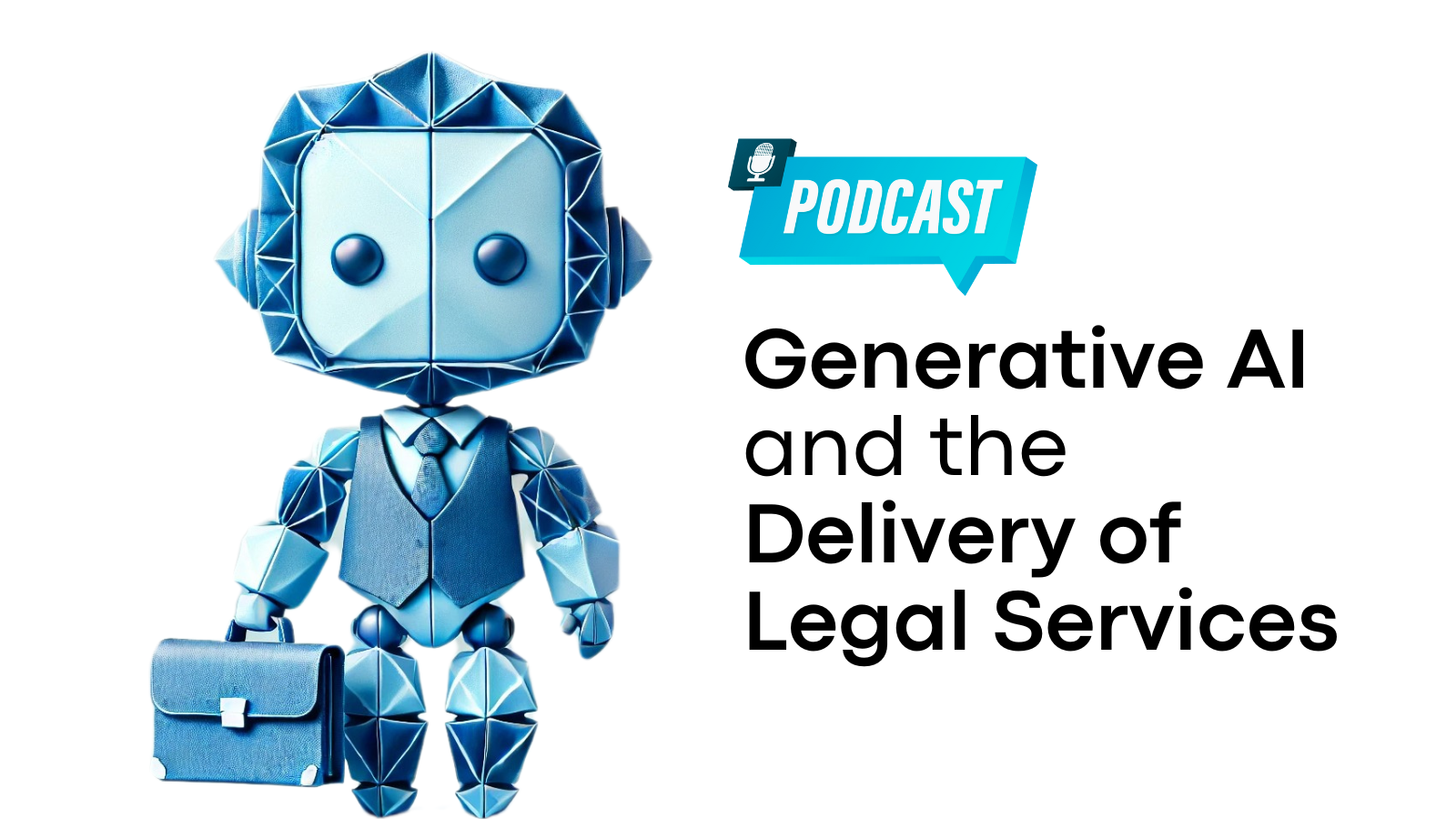
## Chapter 1: The Context of Generative AI
## Chapter 2: How Does Generative AI Work?
## Chapter 3: Generative AI Models and Tools
## Chapter 4: Legal AI Tools and Use Cases
## Chapter 5: Bringing It All Together – A Review of Chapters 1-4
[TBD]
## Chapter 6: Prompt Engineering and RAG
## Chapter 7: Impact of AI on the Business and Practice of Law
## Chapter 8: Ethical and Regulatory Implications of AI in Law
## Chapter 9: Rethinking Access to Justice and Pro Bono
## Chapter 10: Seeing the Big Picture – A Review of Chapters 6–9
## Chapter 11: Cultivating a Culture of Innovation and Continuous Learning
## Chapter 12: Transformative Change and the Future of AI in Law Practice
# Chatbot Tutor